Original article: Petro llama a unir esfuerzos entre países amazónicos para enfrentar el crimen organizado: «Tenemos que coordinar la inteligencia y los ejércitos»
“We must coordinate intelligence, military forces, air power, civil aviation, etc., in a common Amazonian effort,” declared Petro during the launch of a 3D radar in the border municipality of Leticia.
The President of Colombia, Gustavo Petro, urged coordinated action among the countries in the Amazon basin to combat illegal economies and transnational organized crime.
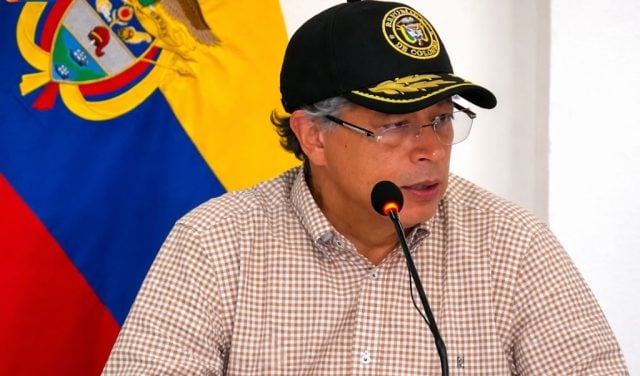
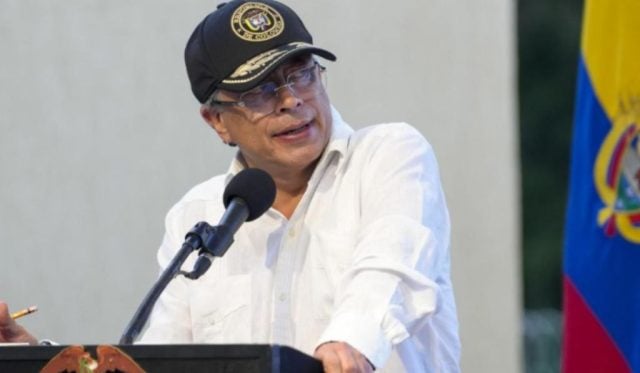
This statement was made on Thursday during the operational launch of a modern 3D radar that will enhance aerial surveillance in the strategically important triple border area between Colombia, Brazil, and Peru.
Speaking from deep within the Amazon, the Colombian leader outlined a security vision that transcends traditional drug war parameters, focusing instead on protecting life, territory, and democracy.
A New Security Metric: Life, Not Death
Petro began his address by questioning conventional security indicators. “Human security is not measured by deaths,” he asserted, explaining that, in his view, an increase in fatalities reflects rising insecurity—an idea contrasting with the prevailing perspective that he described as having deepened the war without resolving structural causes.
Instead, he proposed measuring security by “how much more life can be sustained in a society, beyond just human beings,” a concept that invites the inclusion of environmental protection and overall well-being.
The Changing Territory: Climate Change as a Security Factor
The Colombian head of state introduced an unconventional variable in the security analysis, based on the dynamics of the Amazonian territory.
He stated that the Amazon compels a reconceptualization of security considering another variable: the territory is shifting. He noted that climate change is altering river paths, creating new islands, and that this instigates territorial conflicts along a border drawn on water.
“Authorities must deeply examine how to ensure security and life in changing times,” he remarked, suggesting that “the scenario could be that Leticia no longer has a river in its territory.”
Nevertheless, he referenced the need to prepare the city’s infrastructure to accommodate a potential tourist influx that could reach “up to a million visitors a year” and to welcome larger tourist vessels, as already occurs in neighboring countries.
The 3D Radar and the Struggle for Airspace Control
The central event was the commissioning of the 3D radar, a tool that, according to Petro, will enable “airspace control and enhance security by tracking aircraft involved in illegal economies.”
The president emphasized that territorial control cannot be left in the hands of illegal armed structures and issued a warning: “There is a danger here: that the illegal takes over the state apparatus and the citizenry is left utterly defenseless, divided, and terrorized, which signifies the end of democracy […] and a society without democracy is a dead society.”
He announced that seven modern radars have been contracted with the capability to render clandestine air activities in the country impossible.
However, he acknowledged that this system is “insufficient” and pointed out two critical areas requiring immediate coverage: the border with Ecuador (Ipiales or Pasto) and Arauca.
“It’s undeniable that the cocaine arriving in Apure is being shipped out on paved runways to the north, coming from Colombia,” he noted, while mentioning the necessity of a radar at Alto de las Papas in Nariño to curb drug trafficking toward Ecuador, although he clarified that the main route to that country is maritime.
Ecuador Border: A Binational Problem and a Call to Coordination
Specifically addressing the southern neighbor, Petro tackled the tension surrounding drug trafficking. He stated that narcotics are moved from Colombia to Ecuador, and “we get blamed as the government.”
He indicated that if two armies exist along the border and yet drug trafficking still occurs, the problem is shared. “If one doesn’t think, they blame the other and fail to recognize the reality on the ground,” he expressed.
He interpreted the drug trafficking pressure on Ecuador as a sign of Colombian efficacy: “Because if the drug traffickers are going there, it’s because they don’t want to be here […] the demonstration of our effectiveness is that drug traffickers are fleeing to other countries.”
Amazonian Intelligence Center
In this context, the Colombian president launched his proposal for operational integration among Amazonian nations. “We need to coordinate intelligence, military forces, air power, civil aviation, etc., in a common Amazonian effort,” he stated.
“We inaugurated the first center in Manaus; in Leticia, we have the plot,” he added, affirming that this space should become a hub for police intelligence coordination, as reported by Radio Nacional de Colombia.
According to this progressive leader, this will facilitate information flow among countries to anticipate and jointly combat organized crime activities operating in the triple border region.
Maximum Alert: Fentanyl and Ports
Extending his focus beyond cocaine, Petro raised an alarm about a growing threat: fentanyl, and warned that, in addition to cocaine trafficking in the Pacific, precursors for this synthetic opioid could be entering through South American ports, hidden in commercial shipping containers.
In light of this risk, he instructed authorities to prevent the entry of these substances. “Colombia must be entirely free from any entry of fentanyl precursors through all its cardinal points,” he asserted.
Relacionados
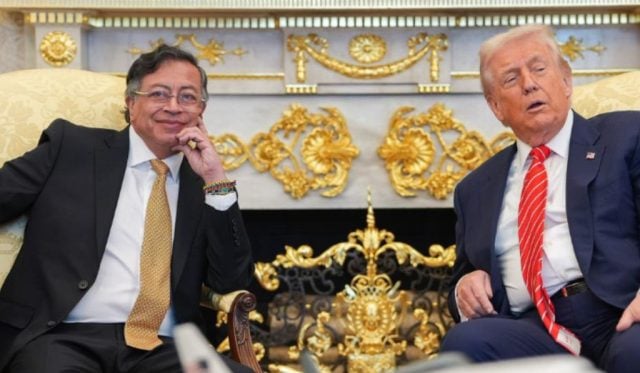
Petro to Trump: The Drug Trafficking Elite Is Not in Colombia, Calls for International Cooperation
Hace 1 mes
Venezuela's Delcy Rodríguez Announces Upcoming Binational Meeting with Colombian President Gustavo Petro
Hace 3 semanas
President Petro Announces Military Leadership Changes for 2026 and Highlights Record Cocaine Seizures
Hace 2 meses