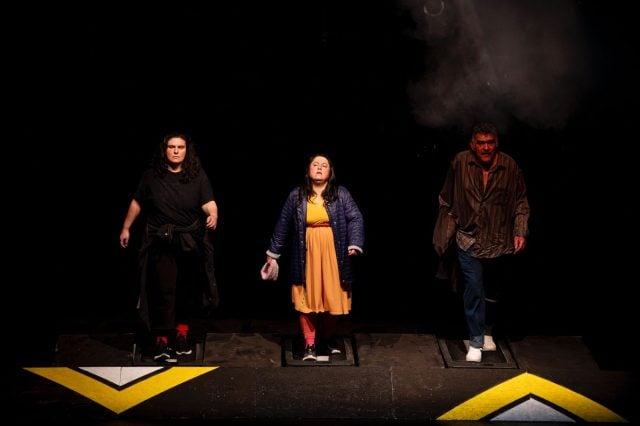
Original article: Porno, no es
By Valentina Serrati, UC Academic, Media Artist, and Performer
Emerging in the late 20th century, post-pornography serves as a critical response to hegemonic pornography, particularly targeting the industrial audiovisual apparatus that organizes desire around consumption, normative heterosexuality, and the objectification of the body.
In this context, Excéntrico, a Showcase of Film and Critical Pleasures, plays a crucial role in developing erotic culture in Chile and Latin America.
Post-pornography transcends being merely a “genre”; it encompasses a field of aesthetic, political, and performative practices that shift the focus from standardized arousal to the production of meaning, bodily agency, and the reappropriation of desire, alongside the emancipation of identities and bodily practices.
Within academic and curatorial realms, post-pornography fits into the expanded history of performance and body art, engaging with sex-positive feminisms and transfeminisms, queer studies, biopolitics, institutional critique, and new materialisms.
From this viewpoint, the body is neither a support nor an object; it is a site of embodied knowledge. Post-pornography acts as a critical performance of sex, where the sexual act—whether real or represented—functions as a language rather than a spectacle. The scene transforms into a laboratory of relationships, consent, affections, and non-normative narratives.
As highlighted by Chilean artist, writer, and researcher Lucía Egaña Rojas, “post-pornography will thus be a new way of understanding bodies in direct critique of the representations we consider to be pornography without a post.”
The author astutely points out that post-pornography does not eliminate pornography but rather calls for a critical reassessment of its tenets and mechanics, and potentially, a reworking of its outputs.
In this sense, the author invites us to embrace new nuances, recognizing this history as a changing phenomenon not only at a stylistic level but (more importantly) at the ideological content level. This is particularly intriguing as it questions the ideology behind the initiative and the state funding that supports it.
Notably, it suffices to observe throughout art history how trends proposing new reconfigurations consistently generate tensions with those who uphold a conservative establishment characterized by false morality and limited access to artistic education and cultural openness.
Thus, let us establish that the root issue is a lack of access to education across all forms of artistic expression; we in Chile tend to define “artistic” within a limited scope of conventional practices, also failing to adequately recognize the new as such.
This is not pornography; it is post-porn. A key distinction from commercial pornography is the suspension of the extractive logic regarding the body. Post-porn does not aim to maximize visibility, performance, or arousal but instead seeks to reconfigure the regime of the gaze. The camera transitions from a tool for capture to a device for negotiation, care, or even opacity.
This shift allows for a direct critique of the objectification of the body—not through concealment, but through active reappropriation: the body self-represents, narrates, fragments itself, or refuses to be legible under dominant codes. In this way, it is highly critical of pornography, dismantling the equivalence between eroticism and merchandise.
Within the history of performance, this imagery does not propose a closed model but rather reconstructs a just and responsible erotic imaginary. As an artistic practice, post-porn contributes to bodily justice—what bodies appear and how they appear matters—along with pleasure, viewed as a right and a means of knowledge.
Post-pornography solidifies not as excess but as a critical tool for envisioning other forms of intimacy, desire, and coexistence. When viewed through the lens of body studies and performance, it does not amplify sexual consumption; it disarms it, advocating for artistic practices that perceive eroticism as a space for emancipation, knowledge production, and cultural transformation.
For further reading on this topic, check out this article published on lafuga.cl: Pornography as a Technology of Gender.
By Valentina Serrati.-
Relacionados

U.S. Prosecutor on Epstein Files: "They Contained Images of Sexual Abuse, Child Pornography, Death, Injuries and Physical Abuse"
Hace 2 semanas

Spain Takes Firm Action: Criminal Penalties for Digital Platform CEOs and Ban on Social Media for Under-16s
Hace 2 semanas
"The Island of the Elders" Arrives at CA660: A Critical Exploration of Aging Through Real-Life Narratives
Hace 3 meses
Hotel O’Clock: A Disturbing Exploration of Reality and the Virtual World Opens at Teatro Mori
Hace 3 meses