Original article: Caso Quilleco: La huelga de hambre de 5 presos políticos mapuche bajo la lupa internacional
By Axier Lopez, Basque Journalist
An international delegation of observers has arrived in Temuco (Araucanía Region, Chile) amid growing scrutiny of the Chilean state’s actions regarding the so-called «Quilleco Case,» which reignites the historical tensions with the Mapuche people.
The delegation—sponsored by Fundalatin—includes lawyer Gabriela Conder, Isabel Vileya, a representative of the organization, and Eduardo Soares, representing the Argentine Lawyers’ Association.
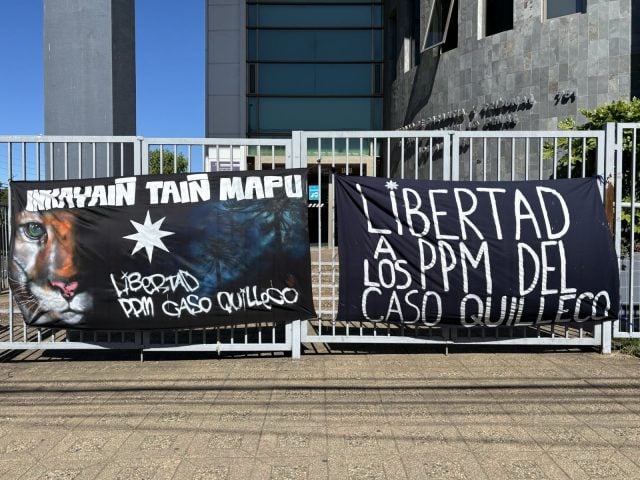
The Quilleco Case stems from two arson attacks on forestry machinery in the commune of the same name in the Biobío region, leading to the sentencing of seven Mapuche community members to prison terms of up to 17 years.
However, defenders and support organizations claim that the trial was based on insufficient evidence, protected witnesses, and questionable procedures, prompting the filing of partial nullity appeals to the Supreme Court.
International Observation and Allegations
The international mission focuses on alleged judicial irregularities, the use of protected witnesses, the imposition of severe sentences that exceed the legal standards in Chile, and the impact of the ongoing hunger strike, which has deteriorated the physical condition of incarcerated community members Óscar Cañupan, Bastián Llaitul, José Lienqueo, Roberto Garling, and Axel Campos.
This hunger strike has surpassed one month and was initiated as a means of protest to demand partial annulment of the trial and humane prison conditions. As of now, reports from organizations and visits by international lawyers indicate significant loss of body mass and a «complex» health state, raising concerns about potential violations of fundamental rights.
In this context, we spoke with Isabel Vileya, coordinator of Fundalatin Chile, and Maruxa Silva, a member of the same organization, who discuss the international ramifications of these allegations, the role of the observers, and the political and legal implications of a case that could escalate beyond Chile’s borders.
In the context of the Quilleco case, what is the main goal of your visit as an international delegation?
R: The main objective is to verify the prison conditions and exchange information about the judicial situation, keeping in mind the opaqueness and repression faced by the Mapuche community, especially those imprisoned.
In your preliminary assessment, are there indications of irregularities or violations of due process in the Quilleco case?
R: Absolutely, a verdict based on the testimony of protected witnesses, while dismissing expert evidence conducted by the Chilean Police that leads to the exculpation of the accused, is clearly a manipulated case aimed at incriminating and convicting Mapuche political activists.
What is the current status of the hunger strike being maintained by the political prisoners?
R: In its current phase, after a month of protest, it has entered a secondary phase characterized by muscle loss and organ impairment. Regardless of the concerning medical situation, the prisoners maintain an enviable state of mind.
What are the main demands raised by the hunger strikers?
R: The primary demand is the partial annulment of the case, which would lead to reduced sentences. Additionally, they request transfers closer to family and, lastly, humane prison conditions that respect the physical and spiritual integrity of the prisoners.
How do you assess the state’s response to this hunger strike?
R: The State of Chile completely ignores the demands of the Mapuche Nation, dismisses dialogue, and undermines the right to self-determination. Just as the Chilean state neglects these demands, it conceals and silences all actions arising from the aforementioned situation.
Are there adequate medical guarantees for those on hunger strike?
R: Absolutely not. In the Temuco Penitentiary Center, there is no medical or health assistance. The WHO recommendations for the incarcerated population state that they should receive the same care protocols as the general population. In Chile, there is a ratio of 1.3 doctors per thousand patients, which is clearly insufficient for the imprisoned population. There are 45 doctors for a national prison population of 50,000 people.
This places prisoners in critical situations where their lives are constantly exposed to the harsh realities of their conditions. It is important to remember that incarceration, according to international treaties, does not limit, or should not limit, civil rights.
In this specific case, what role have human rights organizations played?
R: Without the involvement of the Fundalatin Foundation, which has consultative status with the United Nations, and the technical support of the Maruxa Silva civil defense association, we understand that the willingness of authorities to cooperate would have been different.
Based on your observations, what preliminary recommendations does the delegation propose?
R: The urgent matter is undoubtedly to raise awareness of the case, its internationalization, and broad dissemination as part of a strategy to open up the Mapuche issue and seek intervention from international organizations, especially networks of popular international support.
What urgent measures do you consider necessary to address the current situation?
R: The urgent need is to recognize that this case reflects the necessity of decolonizing the world. This stems from five centuries of land distribution marginalizing its inhabitants, prioritizing profit over the rights of indigenous peoples, which will not be resolved in the Supreme Court of Chile, nor is it confined to the Quilleco Case.
However, this case illustrates that a political conflict underlies these issues and that such cases are clear evidence that the lives of oppressed peoples— in this instance, the Mapuche—are subject to the interests of those who do not hesitate to condemn them to misery, imprisonment, and suffering in the pursuit of capital accumulation.
Finally, what message do you wish to convey to the international community regarding what is happening in this case?
R: The key is to make the demands of the Mapuche Nation known, their right to resist, and their steadfastness and willingness to fight. The prisoners in the Quilleco Case, like many others imprisoned, are dignified representatives of their people, embodying their tradition of struggle and resistance. They should never be labeled under any other term than «weichafe» (warrior).
Interview by Axier Lopez
Artículos Relacionados
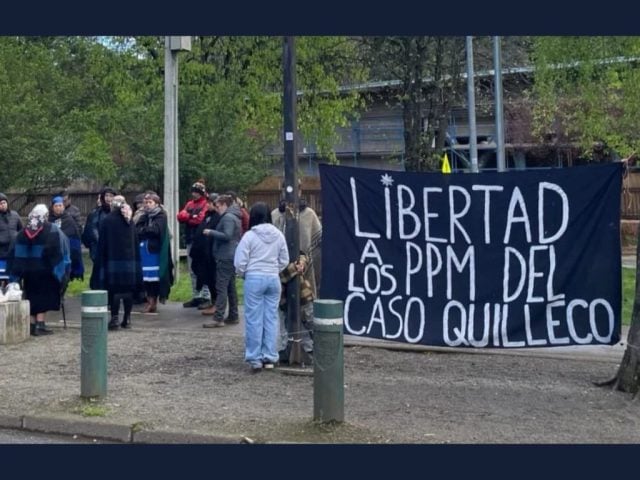

Quilleco Case: Trial Postponed Again Due to Lack of Judges, Raising Concerns Over Legal Irregularities
Hace 4 meses
International Gathering in Pallaco, Lake Lleu Lleu: "Building Paths to Reconstruct Our Worlds"
Hace 1 mes
Chilean Solidarity Delegation Arrives in Cuba, Bringing Nearly One Ton of Aid for Hospitals
Hace 4 días
India and Chile Conclude Fourth Round of Negotiations for Comprehensive Economic Partnership Agreement
Hace 3 meses