Original article: Recoleta, trinchera del Sur Global: La ofensiva mediática y la defensa de la soberanía en la Fiesta de los Abrazos 2026
By Jean Flores Quintana
The Fiesta de los Abrazos first emerged in 1988, during a time when dictatorship still loomed over Chile, as a necessity to overcome fear and reconnect. Since then, it has served as a gathering place for the Chilean and Latin American left. However, January 2026 marks a significant shift: the event will be held in the heart of Recoleta.
Moving away from its traditional location is not merely a logistical detail; it conveys a strong political message. Setting up in a municipality constantly besieged by powerful forces represents an act of defense for popular sovereignty.
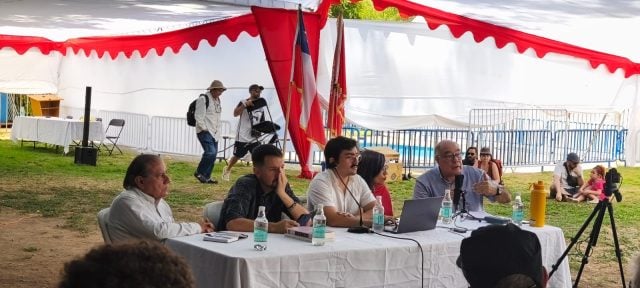
In this context, the forum on communication and sovereignty set the tone. With a panel featuring Juan Andrés Lagos, head of communications for the Communist Party of Chile; Pablo Iglesias, Director of Canal Red and former Vice President of Spain; Alejandra Valle, host of La Voz de los que Sobran; Javier Pineda, Director of El Ciudadano; and Hugo Guzmán, Director of El Siglo, the debate was unflinching: how to confront the media blockade and the reactionary offensive targeting transformative projects.
Juan Andrés Lagos, a strategic communications expert for the communists, opened with a powerful connection between internal persecution and external military threats. He framed Chile within the context of hybrid warfare: «Celebrating this festival in Recoleta asserts our commitment to fight against a continental intelligence design,» Lagos declared.
He further elaborated, «The operation against Daniel Jadue and this municipality replicates manuals used throughout the region to criminalize popular governance. But we must look beyond: the threat is territorial. While we discuss the current situation, NATO establishes a base in Ushuaia, and Peruvian troops train under American guidance. The media blockade aims to distract us from this reality: they are after our natural resources and Antarctic sovereignty. Defending Recoleta is defending the homeland against foreign tutelage,» the PC leader asserted.
Pablo Iglesias, Director of Canal Red, raised awareness about global narrative control, presenting concrete evidence of ‘Mediafare.’ He referenced a recently leaked internal memo from the BBC.
«The war begins with the imposition of language,» the founder of Podemos stated. «The BBC forbade its journalists from using the term ‘kidnapping’ for U.S. operations, forcing them to use the euphemism ‘extraction.’ Whoever controls the vocabulary wins the war.»
Iglesias was incisive in explaining why the left needs its own media: «We live in a cruel paradox: the left-wing candidate must moderate and soften their message to survive interviews; only the media owner has the freedom to speak the truth. We need to own the antenna to stop apologizing for our ideas.»
Journalist Alejandra Valle embodied the necessary self-critique and resistance from the front lines. Her intervention made a sharp distinction between the current government’s management and the actual needs for democratic communication: «We must differentiate between a progressive government and one that is truly transformative,» Valle asserted, earning applause from the audience.
«The current administration chose to keep the duopolistic media ecosystem intact, abandoning the promise of democratizing public discourse. At La Voz de los que Sobran, we have taken on the task that the State neglected: to contend for common sense. Practicing independent journalism in Chile requires daily heroism against a system designed to silence us, but we persist because the truth is a contested right,» Valle stated.
Javier Pineda, Director of El Ciudadano, delved into the symbiosis between the judiciary and corporate press, tracing the path of political criminalization: «We are witnessing an operational alliance between prosecution offices and newsrooms,» he denounced.
«The hegemonic press dictates the guilty sentence to enable political proscription. The headline criminalizes social leaders well before any trial, annihilating the presumption of innocence. At El Ciudadano, we constantly denounce this machinery. Defending popular leadership in Chile means confronting this collusion that seeks to eliminate political adversaries by administrative means,» Pineda pointed out.
Lastly, Hugo Guzmán, Director of El Siglo, revealed the planned economic strangulation of counter-hegemonic press, exposing the insidious roles of intermediaries: «The issue transcends ownership; it lies in financing and active boycott.»
«The State allocates resources, but private advertising agencies withhold or ‘bicycle’ payments meant for media like ours, financially choking us. There is a political decision in the market to break us. Thus, subscribing and providing militant support to El Siglo and allied media constitutes an act of self-defense. Communication sovereignty demands economic independence,» Guzmán explained.
The forum concluded with a resonant certainty. The convergence of Lagos’ geopolitical alertness, Iglesias’ global evidence, and the structural denunciations from Valle, Pineda, and Guzmán transformed the Fiesta de los Abrazos into a summit of internationalist resistance.
The cultural battle demands a total offensive. «Truth prevails only when organized peoples build their own media tools and defend their territory,» was the synthesis that echoed as the evening fell. In this 2026, from a resisting Recoleta, the Chilean left tells the world and imperialism that history is written by those who dare to contest both words and power.
Jean Flores Quintana.-
