Original article: Salarios e inflación: la evidencia que contradice un mito económico en Chile
The debate over whether raising salaries leads to inflation has resurfaced vigorously, despite historical evidence from Chile suggesting otherwise. Data indicates that even during periods of significant nominal wage increases, real wages—the ones that determine how far income stretches—grew at a much slower pace, without causing significant inflationary pressures.
In an interview with El Ciudadano, Andrea Sato, a researcher at Fundación Sol, explained that the debate about whether salary increases generate inflation has existed since the 19th century, and there is no consensus on the matter. Sato pointed out that traditional economic perspectives often claim that higher wages put upward pressure on prices, but she cautioned that this view is “unidimensional,” as it ignores key factors such as wealth concentration, inequality, and the undervaluation of labor.
“In this regard, it is crucial to incorporate into the discussion on inflation and wages the low value of earnings, which translates into meager incomes for the working class, in contrast to the concentration of wealth in very few hands within the country,” the researcher noted.
Sato emphasized that salaries in Chile remain low, both on average and at the median. According to the Supplementary Income Survey, 50% of workers earn less than 612,000 Chilean pesos net, and only 25% exceed one million pesos. When comparing these figures to the Family Budget Survey—which calculated an average per capita expenditure of 565,000 pesos in 2022—this gap becomes evident.
In this context, she warned that labor incomes fall far below families’ actual expenses and are completely misaligned with wealth concentration in the country. This, she argues, indicates that the issue is not that wages are “growing too much,” but that they continue to be insufficient compared to the cost of living and structural inequality.
Sato stated that given the rise in wealth concentration and the deepening inequalities, there is no reason to believe that increasing wages from a redistributive perspective would generate inflation, as workers would merely be reclaiming part of the wealth they produce.
“In that sense, it is crucial to establish that there may be evidence on both sides, but from Fundación Sol, we consider it key to think about the poor redistribution of wealth generated by workers, the high levels of concentration and accumulation, and, ultimately, the misalignment between the monthly income workers earn and the expenses faced in households,” Sato declared.
Sato added that this gap drives families into perpetual indebtedness. Nearly four million people are struggling with unpaid debts they cannot manage. “This also impacts the macroeconomy in a context where salaries do not suffice to sustain daily life,” she asserted.
Historical Evidence: High Wages Did Not Generate Inflation
Sato explained that looking at a limited period like the last five years, the salary landscape is “discouraging” and reflects structural problems that Chile has been grappling with for decades. Between 2019 and 2024, the average real net income increased by only 6.6%, which translates to just over 55,000 pesos in five years. In the same period, real GDP grew by 10%, meaning it outpaced salaries by 53%.
She warned that this gap is key to understanding the relationship between wages, inflation, and purchasing power. Salaries should systematically grow above inflation to avoid a loss of purchasing capacity, but this has not happened. Although the economy has shown “good health”—as reflected in GDP and Imacec—this growth has not translated into better incomes, leaving workers facing goods and services whose costs rise faster than their wages, exacerbating a process of structural impoverishment.
Indeed, between 2000 and 2008, nominal wages in Chile expanded significantly, but these gains were eroded by inflation. While the nominal index rose from 78.6 to 119.0, real wages—the measure of purchasing power—only advanced from 90.8 to 103.1. This means wages “increased” numerically during the Concertación governments, but the money did not stretch much further.
During the last Concertación government, the trend persisted. Between December 2009 and December 2010, nominal wages rose from 101.67 to 106.44, yet real wages barely increased from 111.96 to 113.56. This confirms that nominal increases did not result in significant improvements in purchasing power.
Despite some sectors attributing inflation to wage increases, the data shows the contrary: real wages have seen minimal growth. Between 2009 and 2010, for example, they went up only from 111.96 to 113.56. Economists argue that inflation is more a result of large companies’ pricing power, their profit margins, and external shocks, rather than the evolution of labor income.
Understanding Inflation Beyond the Wage Myth
For Sato, it is crucial to recognize that we remain in a post-pandemic scenario, where neither Chile nor the region has achieved full recovery. The closing of markets and disruptions in import and export chains continue to leave visible effects, and productive structures are still being reconfigured.
Sato posited that the Chilean economy relies on a highly concentrated and low-value-added production matrix, based on natural resources that are already showing limitations. This makes the economic model that has guided the country for much of the 20th century reach a point of exhaustion, as its own foundations no longer allow for growth as before.
“From Fundación Sol, it is fundamental to highlight that one of the causes of price increases relates to the structure of a highly oligopolistic, highly concentrated market, where ultimately this illusion of free competition imposed by neoliberalism does not exist in Chile. Instead, we have small business enclaves that control entire productive branches, manage services and goods almost entirely, and face little counterbalance or oversight from the state. Clearly, this operates in a context where unions are quite weak, demanding a real redistribution of wealth,” Sato elaborated.
The researcher added: “The oligopolistic model present in Chile gives us significant insights regarding how certain business sectors manage and control not only pricing but also how these wealth concentrations are established and remain unre-distributed.”
In that vein, Sato warned that the regressive model of the fiscal structure in Chile is particularly concerning in a scenario where prices continue to rise, especially for essential services used by low-income workers.
“We cannot think that the rise in inflation is one-dimensional, such as due to wage increases. We also need to examine what factors drive inflation, especially in an oligopolistic structure with weak unions, significant anti-union policies, and the knowledge that mechanisms to address inequality and promote better wealth redistribution have traditionally relied more on robust unionism, better collective negotiation, and the protection of the right to strike,” Sato stated.
Furthermore, she added: “In this same context, Fundación Sol argues that it is crucial to assess the productive matrix, the tax model that does not tax large capital, and clearly the alarming concentration of wealth that significantly contributes to high levels of inequality in the country.”
The Myth Sustaining Wage Inequality in Chile
For Fundación Sol, we are facing a myth that has lasted for over 200 years and has been used as an excuse to keep wages quite low, arguing that it is necessary for macroeconomics, sustainability, and market equilibrium. In the end, for Sato, this increases the level of exploitation of workers while maintaining protected profit margins.
“It is important to observe these real phenomena—the reality of inflation and the reality of low wages—but it is equally important to examine them in context and from an intellectual and scientific openness, where we consider that the fundamental aspect is democratic, open debate, allowing us to see the various facets of inflation and the critical issue of low wages. In this sense, it is essential to consider, to also challenge these established truths, the new structures we should aim for as a country in terms of a model with higher levels of redistribution,” Sato noted.
In conclusion, Sato affirmed that an honest and well-informed debate centered on workers’ living conditions is necessary. Discussing “macroeconomic balances” while families struggle to make ends meet is concerning; many fall into debt and remain unable to pay for years because their incomes only suffice for survival. Therefore, she insists, robust public policy is needed to improve employment and transform the productive matrix. A model based solely on extracting raw materials without added value will not generate better jobs or better wages.
The evidence on salaries, low purchasing power, and economic concentration shows that the main issue lies not in workers’ incomes but in a productive and tax model that poorly distributes wealth. In a situation where half the country earns less than what it costs to live, Fundación Sol underscores that increasing wages is a measure of economic justice, not an inflationary risk.
Relacionados
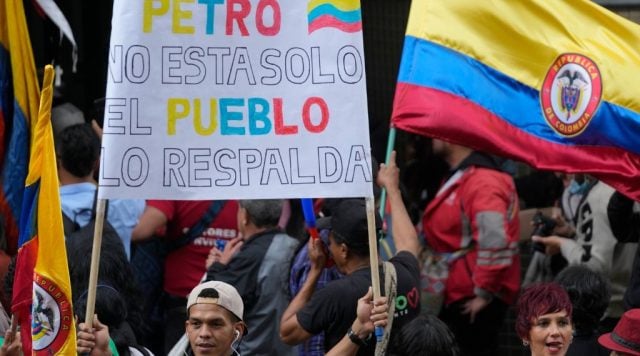
Labor Unions and Pension Federations Call for Protests to Defend Minimum Vital Salary Established by President Petro
Hace 2 meses
Milei's Economic Recipe Falters: Inflation Hits 2.5% in November, Food Prices Surge, No Relief in Sight for 2026
Hace 3 meses
Colombian President Petro Declares Minimum Wage Increase: 22.7% Hike Announced for 2026
Hace 2 meses
Chile's Government Highlights Historic Minimum Wage Increase and Economic Growth Potential
Hace 2 meses