Original article: ¿Trabajadores salmoneros reemplazados por máquinas? El debate silenciado sobre el empleo y automatización de la industria acuícola
The Salmon Paradox: Investing Millions in Robots That Replace Workers While Blaming Environmental and Indigenous Laws for Job Loss
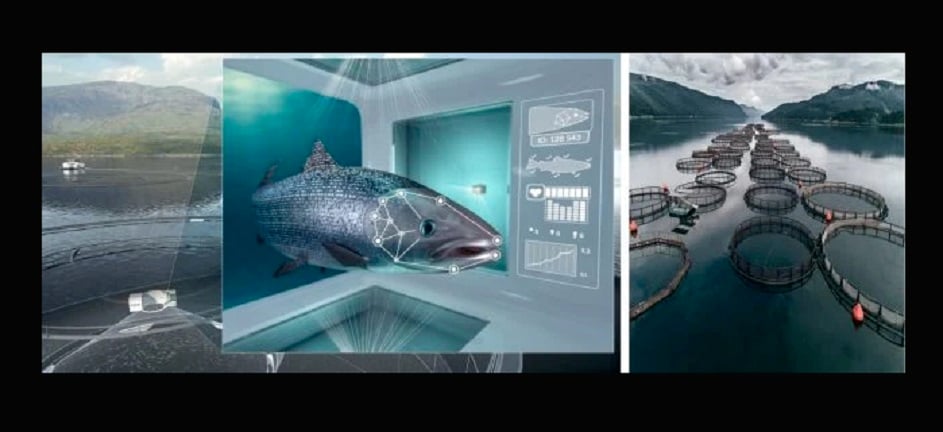
As the Chilean salmon industry actively promotes its so-called «technological revolution,» portraying an image of sustainability and progress, an analysis grounded in official data, key stakeholder statements, and specialized reports reveals a central contradiction: the deployment of Artificial Intelligence (AI) and automation continues to threaten the labor base of the sector. This contradicts the industry’s repeated claims and its campaigns against environmental laws like the SBAP or the Lafkenche Law, which they often label as primary threats to employment, even mobilizing workers under a polarizing narrative.
On December 5, 2024, Mowi Chile inaugurated its «remote feeding and monitoring operations room» in Chonchi, a key part of its global strategy called «Mowi 4.0 Smart Farming.» According to their statement, this 160 m² facility will manage «around 30 farming centers» using «cleaning robots,» «multipurpose cameras,» and «image processors with artificial intelligence,» as highlighted by Diario Chiloé.
In April 2025, a report by SalmonExpert detailed how the top five companies in the sector – AquaChile, Australis, Cermaq, Mowi, and Salmones Aysén – are implementing AI to «optimize processes,» «reduce costs,» and achieve a «lower environmental impact,» digitalizing everything from feeding to filleting.
However, this technological advancement occurs alongside a historic stagnation in job generation. A 2023 study by Fundación Terram, based on data from the Internal Revenue Service (SII), concluded that the industry generated, on average, only 16,999 direct jobs annually between 2005 and 2021, far fewer than the nearly 28,000 positions typically reported.
See also / Low Employability and Absence of Royalty: The Intense Political Debate on the Salmon Industry in Patagonia
Another study, cited by Radio JGM in December 2024, is striking: «the informed employed workers in the industry reach 27,958 jobs annually, yet the weighted workers based on months worked represent, on average, only 61% of this total.»
More revealing still: between 2010 and 2020, the harvest of salmon grew by 131%, while the weighted employment only increased by 62%. «In proportional terms, greater salmon production has not translated into a greater number of jobs,» emphasizes a publication from Interferencia.
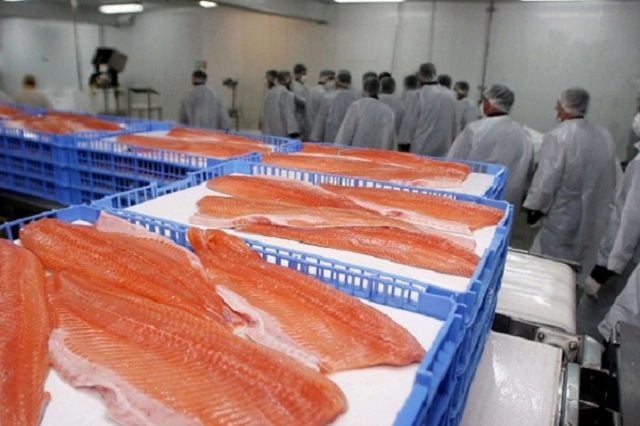
This trend of disconnect between production and employment is exacerbated by new technologies. An example is the filleting machine MS 2750 from Marel, showcased at Aquasur 2024 and reported by El Divisadero, which processes 25 fish per minute “without operator intervention”. The goal, according to the Norwegian Sotra Fiskeindustri adopting it, is clearly to «reduce reliance on labor.» This case is not uncommon in Chile: the modernization project at Mowi’s plant in Bahía Chacabuco (Aysén), approved in 2022 and cited by Radio JGM, tripled its processing capacity (from 8 to 27 tons/hour) through automation, without a proportional increase in jobs.
The industry narrative, which positions itself as a labor pillar of the south, is even questioned by authorities. In December 2024, Aysén governor Marcelo Santana stated to El Divisadero: «It is not a sector that impacts employment significantly.
Reviewing data from the INE, aquaculture is the fifth or sixth productive sector in terms of labor impact in the region.» This statement clashes directly with the industry’s claim that environmental laws, like SBAP regulating protected areas, or the Lafkenche Law, are the main threats to jobs, often featured in the discourse of salmon farming companies.
The paradox deepens when it is observed that the industry is expanding production precisely in these fragile ecosystems. A November 21, 2024 investigation by Interferencia, revealed that there are 409 salmon farming concessions granted within protected areas, with 309 active that produced 3.2 million tons between 2001-2023. Economist Cristopher Toledo from Terram, author of the study, explained to the outlet that while the industry grew at a national rate of 4% per year, inside parks and reserves, it grew at nearly 30% annually. «The ecosystem characteristics that justified the protection – its clean waters, lower intervention – are enhancing the industry’s profitability,» noted Toledo.
In light of this evidence, environmental and social organizations argue that the real threat to employment lies not in protective regulations but in the extractive and highly technical logic of the model. Looking ahead, it is worthwhile to ask what changes new technologies will bring for the future of employment. Thus, the debate is no longer just environmental but about what kind of development – and for whom – the digital transformation of an industry marked as key for southern Chile promotes, amid a broad record of social and environmental impacts in Patagonia.
Relacionados
Salmon Industry Celebrates 'Salmon Worker Day' Amid Mass Layoffs and 90 Workplace Deaths in Chiloé
Hace 1 semana
Festejo patronal: Salmoneras celebraron el 'Día del Trabajador' en Chiloé en medio de despidos masivos y 90 muertes laborales
Hace 1 semana