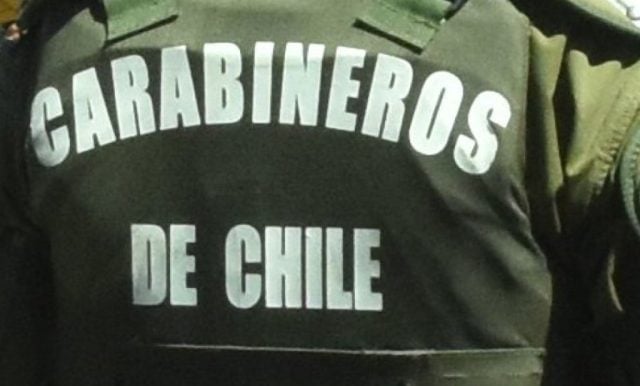
Original article: Cárcel para mayor de Carabineros: Corte confirma condena por disparo brutal contra estudiante de la Usach
In a ruling that affirms the criminal responsibility of an active-duty officer for acts of violence during a social protest, the Santiago Court of Appeals has confirmed the effective prison sentence for Carabineros Major Rodrigo Sanzana Olhaberry.
The appellate court supported the sentence issued in 2024 by the Fourth Oral Criminal Court of Santiago, which sentenced the officer to over three years in prison for the crimes of unnecessary violence causing serious injuries and denial of aid against the then-student of the University of Santiago (Usach), L.D.
The incidents that led to this judicial action date back to May 14, 2015, a day marked by a protest from the Teachers’ College in downtown Santiago. During incidents on Alameda Avenue, a tactical vehicle from Carabineros entered the campus of the University of Santiago. From the vehicle descended then-Captain Rodrigo Sanzana, who led the Special Forces unit, and without any imminent risk situation, shot a high-powered cartridge from a tear gas launcher directly at the then 19-year-old student who had just finished lunch with peers and was standing about fifteen meters away.
Lifelong Consequences
The impact of the projectile caused extreme damage to the victim, who suffered severe eye trauma with exposed fractures of the right orbital roof, muscle compromise, and bone displacement.
The Medical Legal Service confirmed the severity of the injuries, categorizing them as serious. Despite undergoing four surgeries, the student has suffered irreversible vision loss.
Despite the brutality of the act and the investigation establishing that the officer had the means to assist, Sanzana left the scene, exacerbating the victim’s suffering.
The situation became critical when the Carabineros vehicle obstructed the ambulance access to the university, causing the student to wait an additional 15 to 30 minutes for urgent medical attention.
Trial Against the Carabinero
The judicial process to establish these responsibilities was not swift, extending nearly nine years. Despite overwhelming evidence against Sanzana, Prosecutor Jaime Retamal chose not to file charges in the case. This led the National Institute of Human Rights (INDH) and the complainants, representing the victim and the University of Santiago, to request the court to deduct particular charges, a motion approved by the Sixth Guarantee Court of Santiago in November 2021. Following a trial preparation hearing in 2022, the oral trial finally took place in February 2024.
During the eight-day trial, the Fourth Oral Criminal Court of Santiago received a wealth of evidence, including graphic and audiovisual materials. Testimonies were heard from the victim, family members, eyewitnesses, and experts.
The guilty verdict established that Sanzana’s actions contravened existing protocols regarding the use of force and deterrent elements. It was determined that the uniformed officer shot directly at the victim from a distance of fifteen meters without any public disorder justifying the use of lethal force.
The court verified all elements of the criminal type for unnecessary violence resulting in serious injury and convicted the defendant for the crime of denial of aid to the victim.
The first-instance sentence concluded with a conviction of three years and one day for unnecessary violence causing serious injuries, plus 61 days for denial of aid.
Following this ruling, Major Sanzana’s defense filed an appeal with the Santiago Court, seeking a alternative sentence to the effective prison term.
The legal strategy focused on a technical argument related to the nature of the weapon used. Given that the law regulating alternative sentences specifies that those convicted of crimes committed with firearms cannot benefit, the defense argued that the tear gas launcher was not classified as a firearm per the Arms Law definition. They further claimed that the crimes were not sanctioned under that legislation and that Sanzana had acted within his official duties.
However, the Second Chamber of the Santiago Court of Appeals agreed with the first-instance court, dismissing the defense’s arguments.
The appellate court considered that under the parameters of the Arms Law, the launcher qualifies as a firearm.
By majority vote, the Second Chamber ruled that the «regulation does not require the crime motivating the sentence to be one enumerated in the Arms Law, but only pertains to the crime being committed with a firearm.» This reasoning was key in confirming Sanzana’s obligation to serve time in a closed regime.
The ruling was not unanimous, as Judge Juan Cristóbal Mera noted that it was a «less lethal» weapon and argued that restrictions on benefits should only apply to individuals committing crimes with weapons that were illicitly possessed.
Complainant Appreciates Court Ruling
Complainant attorney Cristián Cruz positively assessed the Appeals Court decision, highlighting its significance in the current context.
In his view, the ruling affirms «an obvious but necessary fact in today’s times» and argued that «just because someone holds a certain profession, wears a particular uniform, or has a specific standing, they should not benefit from a lesser penalty when committing a crime using a firearm.»
According to the cited media outlet, Major Rodrigo Sanzana Olhaberry remains free while awaiting the sentence to be finalized.
Relacionados


Court Upholds 77-Year Prison Sentence for Colombian Crime Leader Operating in Antofagasta
Hace 2 semanas
Supreme Court Convicts Former Joint Command Agents for the Disappearance of Communist Leader in 1976
Hace 2 meses
Court Upholds 11-Year Sentence for Police Officer Who Struck 14-Year-Old Girl with Bat in 2019 Incident
Hace 2 semanas
UAcademia Criticizes Claudio Crespo Acquittal as a "Deep Institutional Failure" and a "Signal of Impunity"
Hace 2 meses