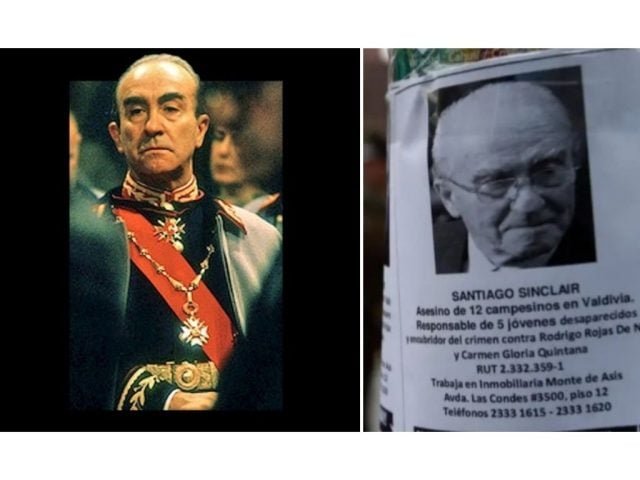
Original article: Muere Santiago Sinclair, pieza clave de la cúpula pinochetista: condenado por la Caravana de la Muerte
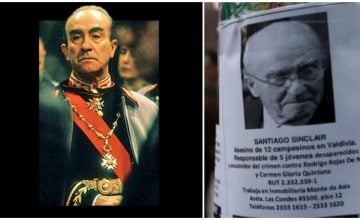
Santiago Sinclair Oyaneder passed away at the age of 97 on Sunday, December 28, marking the end of the life of a prominent figure in Pinochet’s regime who held high military and political positions despite his involvement in serious human rights violations. His career is closely tied to the repression that followed the September 11, 1973 coup, characterized by a series of promotions facilitated by Augusto Pinochet, elevating him from regional command roles to Vice Commander of the Army, a member of the Military Junta, and a designated senator.
Sinclair’s judicial history includes, among other incidents, his conviction in the Caravan of Death (Valdivia Episode), a landmark trial for homicides committed during the repressive operations following the coup. His death comes against a backdrop of tension for victims and organizations because, in 2023, due to his advanced age, the justice system ruled that his “mental incapacity” exempted him from serving time in prison.
Conviction in the Caravan of Death (Valdivia)
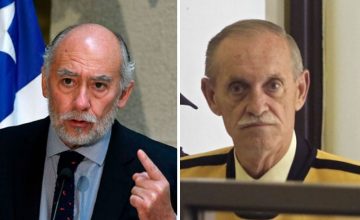
In a ruling that set a precedent for crimes against humanity, the Second Chamber of the Supreme Court sentenced four defendants to effective prison time for the murders of 12 individuals connected with the Caravan of Death, Valdivia Episode. The Supreme Court dismissed the statute of limitations due to the nature of the crimes against humanity, sentencing Santiago Sinclair to 18 years in prison; Colonel (r) Juan Chiminelli Fullerton to 18 years; Brigadier (r) Pedro Espinoza to 10 years; and, as an accomplice, Brigadier (r) Emilio de la Mahotiere González to 5 years and 1 day.
The Supreme ruling overturned a decision made in 2020 when the Santiago Court of Appeals applied a partial statute of limitations in reviewing an initial sentence for the four convicted. This debate also considered inputs from the National Institute of Human Rights in its 2022 Annual Report, which urged the Judiciary to refrain from applying the statute of limitations due to its violation of principles of proportionality and imprescriptibility.
Rise Protected by the Dictatorship
Sinclair was born in Santiago, entered the Military School, and graduated as an officer in 1948. By the late 1960s, he served as a military observer in the Suez Canal, and in 1973, he was appointed commander of the 2nd Armored Cavalry Regiment of Cazadores in Valdivia.
Subsequent positions brought him directly into the inner circle of dictatorial power: in 1975 he was a military attaché in Korea; in 1979 he became Minister Chief of the Presidential General Staff; in 1983, he held the position of State Minister as Secretary General of the Presidency; and by 1988, he was a full member of the Military Junta representing Pinochet. By that time, he had already assumed the role of Vice Commander of the Army.
Chihuío and Liquiñe: Executed and Missing Farmers
The name of Sinclair is also associated with repressive events in the south. In Chihuío, on October 9, 1973, 17 farmers were murdered by personnel from the Cazadores and Maturana regiments in Valdivia, commanded by Colonels Santiago Sinclair and Jerónimo Pantoja Hernández. The bodies were unearthed by Army personnel in late 1978 and remain missing; in 1990, graves were found, but only small bone fragments were discovered.
One day later, on October 10, 1973, an Army and Carabineros operation kidnapped and killed 15 farmers in Liquiñe. Eyewitnesses reported that the workers were executed at the Toltén River bridge and their bodies thrown into the river.
Other Cases: Helicopters, Repression, and the Setup of Plan Z
In 2008, Judge Mario Carroza processed officers for the kidnapping and disappearance of five militants from the FPMR, events that occurred in 1987 by agents of the CNI in collaboration with the Army. In that case, Sinclair was processed as a co-author for the homicide of Manuel Sepúlveda Sánchez, Gonzalo Fuenzalida Navarrete, Julio Muñoz Otárola, Julián Peña Maltés, and Alejandro Pinochet Arenas, who were thrown from an institutional helicopter into the sea, after a coordination meeting attended by the then Vice Commander of the Army.
In 2020, Judge Álvaro Mesa processed Sinclair for his responsibility in the illegal coercion of nine political prisoners, a case where victims were accused in a setup described as “Plan Z”. The investigation detailed transfers from the Valdivia Public Jail to the Cazadores regiment, interrogations, and the existence of a room where torture was administered, including electricity and beatings.
Impunity and Outstanding Debts
The judicial and political history of Santiago Sinclair reveals a constant: the lengthy processes of justice, defenses, and obstacles that often accompany cases of human rights violations. The fact that in 2023 his “mental incapacity” exempted him from serving time in a prison facility raises an uncomfortable question for victims and the nation: how much of the harm remains without effective reparation, and how much of the regime’s leadership’s responsibility faded into impunity.