Original article: El detalle de las acusaciones de Estados Unidos contra Nicolás Maduro (Documento completo en inglés)
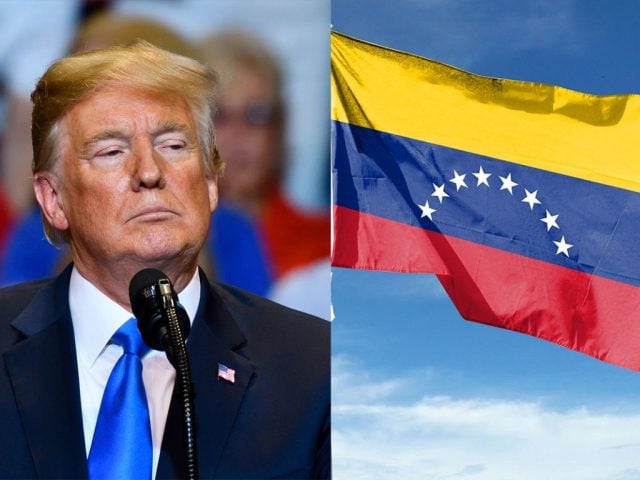
The historical legal proceedings initiated in New York against Venezuelan President Nicolás Maduro unfold in the shadow of a warning issued years ago by his predecessor, Hugo Chávez. On multiple occasions, Chávez cautioned that the United States might leverage drug trafficking allegations against Venezuelan officials as part of a broader strategy to justify military intervention or destabilize his government.
The Citizen
Chávez’s claims were grounded in his analysis of U.S. foreign policy, referencing the 1989 invasion of Panama, which Washington justified partly by citing the need to capture General Manuel Noriega for drug trafficking charges.
This historical warning provides a geopolitical context in which many analysts and the Venezuelan government frame the current accusations, viewing them as a tool of «lawfare» or legal warfare aimed at achieving political and strategic objectives, with some pointing to an interest in Venezuela’s vast natural resources.
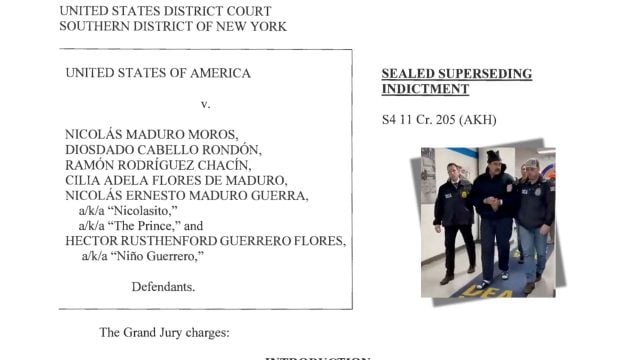
Now, following the military abduction of President Nicolás Maduro by the United States on January 3, 2026, in the heart of Manhattan’s financial district, a federal court becomes the stage for one of the U.S. justice system’s most globally captivating cases, which is likely to attract widespread attention for weeks, if not months. The formal charges against Maduro and six high-ranking members of his inner circle are detailed in this case.
The document, referenced as S4 11 Cr. 205 (AKH), outlines a series of charges that, regardless of the political framework, paint a legal portrait of state corruption and criminal alliances on a scale rarely seen outside of cinema.
Legal Context of the Extraterritorial Accusation
The Justice Department’s strategy is rooted in laws that allow the prosecution of crimes committed abroad when they directly impact the United States. By filing the case in the Southern District of New York, the prosecution taps into a jurisdiction with extensive experience in transnational organized crime. The charges are based on the premise that illegal actions aimed at smuggling tons of cocaine into U.S. territory make the defendants prosecutable under federal laws, regardless of their official title or geographical location.
This rationale underpins the military operation in Venezuela, which is currently condemned internationally, particularly by Latin American countries upholding democracy and having a historical memory of U.S. actions in the region.
Four Pillars of the Accusation
The prosecution has structured its case around four main charges. The first and most serious is the Conspiracy for Narcoterrorism. This charge, directed specifically at Maduro, Diosdado Cabello, and Ramón Rodríguez Chacín, alleges that they not only participated in drug trafficking but also conspired to enrich and provide material support to organizations officially designated as terrorist groups by the U.S., such as the FARC and ELN, using profits from drug trafficking.
The second pillar is the Conspiracy to Import Cocaine into the United States, which involves all seven defendants. Here, the prosecution details a decades-long criminal enterprise, alleging a conspiracy to manufacture, distribute, and ultimately introduce vast quantities of cocaine into the U.S. market, with a minimum of five kilograms per shipment, though references within the document suggest thousands of metric tons in total.
The third and fourth charges involve possession and conspiracy to possess firearms in furtherance of drug trafficking. It is alleged that the defendants used and possessed automatic weapons and destructive devices—tools of war—to safeguard their illicit operations, directly linking drug trafficking to paramilitary violence.
Additional Details from the Document
Beyond the formal charges, the document presents a series of specific incidents that the prosecution claims serve as evidence of the conspiracy. For instance, it describes how Nicolás Maduro, during his tenure as Foreign Minister, allegedly sold Venezuelan diplomatic passports to drug traffickers and coordinated secret flights under diplomatic immunity to repatriate illicit money from Mexico.
One of the more detailed narratives recounts the failed shipment in 2006 of over 5.5 tons of cocaine aboard a DC-9 jet, which allegedly departed from the presidential hangar at Venezuela’s main airport. The indictment names Diosdado Cabello and high-ranking military officers as coordinators, and details subsequent bribery payments amounting to millions of dollars to cover up the event.
The narrative also places Maduro’s immediate family at the center of the operations. It is alleged that his wife, Cilia Flores, acted as a bribery intermediary; that his son, Nicolás Maduro Guerra, used aircraft from the state oil company PDVSA to transport suspicious shipments; and that close relatives conspired from the so-called «presidential hangar» to move cocaine, even declaring themselves «at war with the United States.»
While the document does not present concrete evidence, these will have to be submitted and analyzed during the trial.
Accusation of Strategic Alliances with Terrorism
One aspect of the accusation is the description of a strategic and operational alliance with Colombian guerrilla groups. It recounts meetings between Ramón Rodríguez Chacín and leaders of the FARC and ELN, both in jungle camps and at the Venezuelan presidential palace, Miraflores. The prosecution goes further, asserting that the Venezuelan government, by order of its highest officials, supplied military-grade weaponry, including grenades and rocket launchers, to the FARC, a group at that time listed as a terrorist organization.
The Venezuelan defense has denounced the case as «lawfare,» a political persecution with geopolitical motivations that conceals an interest in the country’s natural resources. However, the fact that the accusation links to co-conspirators who have already pled guilty in the same court, such as former intelligence chief Hugo Carvajal, grants a tangible and complex procedural dimension that cannot be overlooked.
More than just a rhetorical showdown, the case in New York represents a long-term legal battle unfolding on two simultaneous fronts: the federal court, with its charges and evidence, and the global geopolitical stage, laden with history, distrust, and fulfilled warnings.
Relacionados
U.S. Department of Justice Drops 'Cartel of the Suns' Accusation Against Maduro, Reports NYT
Hace 1 mes
Trump Declares "Total Access" to Venezuelan Oil as Milei Refutes Claims of U.S. Oil Seizure
Hace 1 mes
Colombian President Petro Criticizes Trump, Defends Anti-Drug Achievements Amid Cocaine Seizures
Hace 2 meses