Original article: Breve historia de la rapiña de EEUU sobre Venezuela y sus recursos naturales: Asfalto, petróleo y golpes de Estado
The streets of Washington and New York were completely paved with Venezuelan asphalt, extracted by eager American companies that enjoyed advantageous conditions for resource extraction during the late 19th and throughout the 20th century.
One chapter of the story of resource exploitation began in 1883, when the government of Antonio Guzmán Blanco granted the American company New York & Bermúdez Company an «exclusive concession» to exploit asphalt for 25 years in the former state of Bermúdez (now Sucre state), as recorded by Fundación Polar.
The American firm established its operations near Lake Guanoco, recognized as the world’s largest asphalt lake, spanning 4km². There, it began constructing facilities in 1886, and two years later, its concession was extended for an additional 99 years. By 1891, exports to the U.S. commenced.
Political Interference and Oil
New York & Bermúdez failed to honor its agreement with the government, leading to a prolonged legal dispute over concessions with other contractors who sought support from both the U.S. and Venezuela, employing all available means, from legal recourse to bribery, reported Fundación Polar.
As courts ruled in favor of the American Warner-Quinlan and local Venezuelan Mine, New York & Bermúdez accused then-President Cipriano Castro of orchestrating the decision, subsequently funding his overthrow. This kind of interference remains a tactic corporations use to «defend» their interests.
After the legal battle, Washington’s backing of New York & Bermúdez became evident. This scandal did not prevent the company, which was acquired by General Asphalt Company, from operating in Venezuela until 1935.
Gifted Concessions
When concessions were awarded to Venezuelans, they often transferred them to foreign companies that exploited legal loopholes to obtain increasingly more operating licenses in the country. Although the so-called «black gold» had not yet gained the economic significance of asphalt in the 19th century, that would change in the following century.
The first national mining code was established on March 15, 1854, which assumed the nation retained ownership of subsoil deposits; however, this was not explicitly stated and was later corrected in 1855.
Until 1904, oil concessions were granted under these principles. That year, under Castro’s administration, a mining law was created stipulating that companies would pay taxes of 2 bolívares per hectare of selected surface area (with 1 bolívar equivalent to at least 3 dollars) for exploitation, plus a fee of 4 bolívares per ton.
At that time, the low rates, the «generosity» of contracts, the absence of compensation for exploration rights, and the extensive nature of the concessions were already criticized. Moreover, a critical omission remained: there was no provision reserving land for the nation as a safeguard for the future.
Consequently, these liberal policies aimed at generating revenue attracted greedy foreign investors who paved their way through legal opacity, blackmail, influence peddling, and pressure on successive governments.
Staggering Figures
In his seminal work «Hundiéndonos en el excremento del Diablo,» Venezuelan lawyer and former minister Juan Pablo Pérez Alfonso provides a shocking statistic: between 1917—when significant exports began from well Zumaque I (Zulia)—and 1928, «the accumulated production of 240 million barrels of oil and 26 million more in thermal equivalence from gas extracted with that oil» yielded only a fiscal share of 8 million dollars.
Therefore, in almost 20 years of hydrocarbon exploitation (1917-1936), the country received only 90 million dollars, which represented just 8% of a production totaling 1.148 billion barrels of oil and 153 million barrels of gas.
With the rise of dictator Marcos Pérez Jiménez, a staunch ally of U.S. interests, the stage was set for rampant exploitation, according to Pérez Alfonso, facilitated through the unregulated issuance of foreign licenses and the reversal of concession policies, including the so-called 50/50, advocated by deposed President Isaías Medina Angarita.
From 1917 until the nationalization of oil in 1975, a total of 38.664 billion barrels were produced, generating 104.167 billion dollars. The state received 43.900 billion, amounting to 42% of that total, the majority of which was contributed between the mid-1960s and early 1970s.
Grasping Control Over Oil Wealth
Pérez Alfonso, the founding member of the Organization of the Petroleum Exporting Countries (OPEC), discusses in his book the «pressure from privileged interests, accomplices of multinationals,» which «prevailed over governments ill-equipped» to manage the immense wealth generated by hydrocarbons.
Moreover, writer Orlando Araujo in «Venezuela violenta» highlights the subordination of the national economy to the decisions of «foreign capital, primarily from the United States.» For him, the country’s «destiny» became «a peripheral extension of a more powerful economy,» often pressuring local oligarchies to coerce governments.
Black Gold in Few Hands
By 1920, the U.S. had become «the primary commercial partner and foreign investor in Venezuela,» and with World War II, the South American country turned into a «secure and reliable supplier,» as noted by Petroleum.
American companies such as Standard Oil (now ExxonMobil), whose subsidiary was Creole Petroleum Corporation, and Gulf Oil Corp (now Chevron), alongside British-Dutch Royal Dutch Shell, monopolized oil production and developed the country’s infrastructure for extraction in the Orinoco Oil Belt, in Mene Grande (Zulia), Anaco (Anzoátegui), and Jusepín, as well as refining in Cardón, Amuay (Falcón), and El Palito (Carabobo).
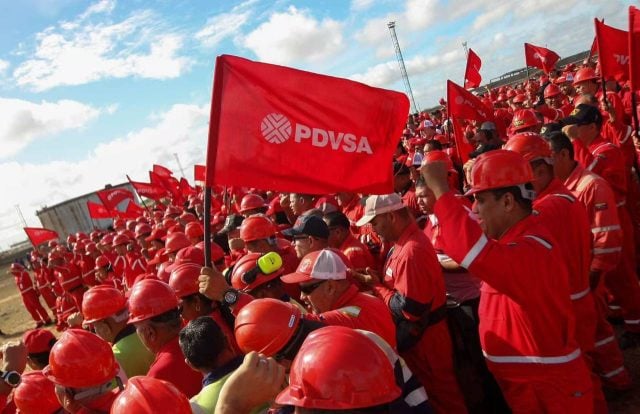
These multinationals, according to Carlos E. Lippo, operated «under different legislations, crafted by themselves or widely agreed upon with them, until the enactment of the Hydrocarbons Law of 2001» during Hugo Chávez’s administration, based on the Constitution, which states: «For reasons of economic, political, and national strategic sovereignty, the state will retain 100% ownership of Petróleos de Venezuela, PDVSA, or the entity created to manage the oil industry.»
Just over four months after the law’s enactment, Venezuelan right-wing factions, supported by the U.S., staged a coup against Chávez, which was swiftly overturned by a popular uprising.
According to Lippo, foreign monopolies negotiated the nationalization of oil in 1975 with Carlos Andrés Pérez’s government and «promoted coups and state crimes whenever succeeding governments proposed any legal reforms aimed at increasing the state’s fiscal share in oil exploitation.»
Source: RT
Relacionados

Academics and Activists Urge Chile's Contraloría to Reject Codelco-SQM Lithium Deal for National Interest
Hace 2 meses

Chilean Audit Office Delays Codelco-SQM Lithium Contracts, Leaving Control Up to 2060 Uncertain
Hace 2 meses
"They Deceived Congress Outrageously": US Dissent Against Trump Accuses Him of Illegal Attack on Venezuela
Hace 4 semanas