Original article: El enemigo principal está en casa: Recordando a Rosa Luxemburgo ante la guerra económica contra Venezuela
By Daniel Jadue
One key lesson I learned from reading Rosa Luxemburg’s Junius pamphlet during the experience of World War I in 1914 is that decisive moments are not signaled by the sound of cannons, but rather by the complicit silence of those who claim to speak for the people.
Today, as the United States continues its imperial narrative, repeatedly labeling Venezuela as an «unusual and extraordinary threat» to its security, and unleashing a mix of sanctions, financial blockades, covert operations, attempted coups, and open military threats, all aimed at seizing the wealth of the Venezuelan people, we find ourselves in a situation reminiscent of August 1914: a historic test. Where do the so-called democratic, progressive, and responsible parties align? With the people, or with capital and empire?
In 1914, the majority of the German Social Democratic Party voted in favor of war credits. Instead of saying «no» to imperialist slaughter, they rallied under the false slogan of «defending the homeland.» Lawmakers who had sworn to represent the working class approved funds that would send that same class to kill and die for interests that were not their own. With that vote, the moral bankruptcy of the Second International was sealed, opening the door to barbarism.
Today, as we observe governments, parliaments, parties, and media aligning with Washington’s narrative against Venezuela, repeating uncritically terms such as «dictatorship,» «illegitimate regime,» and «regional threat,» we witness a similar gesture. They may not wear uniforms or raise their hands in a Reichstag, but they do the same: they lend their political support, their complicit silence, or their hypocritical neutrality to a war policy that is now presented under the «civilized» guise of sanctions, blockades, and «diplomatic pressure.»
Let us call things by their true name. The sanctions that the United States and its allies impose on Venezuela, Cuba, and Iran, while simultaneously financing genocide in Gaza under the false banner of the right to defense, are a form of economic warfare aimed at breaking the resistance and the right to self-determination of people unwilling to kneel before the empire. They seek to destroy their productive fabric, create scarcity, suffering, and anger, all to force a political change favorable to the interests of transnational capital. They are the equivalent of the war credits of 1914: funding an imperial offensive fought not with bayonets, but with banks, embargoes, and «blacklists.»
So, who is the real enemy of every people? In 1915, Rosa Luxemburg and Karl Liebknecht taught us that «the main enemy is in our own country,» referring not to the French peasants or the English or Russian workers, but to the German bourgeoisie and its state, which were urging the working class to war to reorder the distribution of the world.
Today, the main enemy of the peoples of the United States and Venezuela, of Europe and Latin America, is not a distant country or a government that refuses to obey the White House. The real enemy sits in the boards of large companies, in the offices of banks, in the military high commands that capitalizes on war, in the media apparatus that manufactures consent for aggression, and in all those who prefer to finance wars rather than support their peoples crying out for food, housing shortages, and lack of health and education.
This enemy speaks the language of «democracy» and «human rights» while suffocating entire populations under sanctions that deny food, medicine, spare parts, technology, and sabotages any attempts at economic sovereignty.
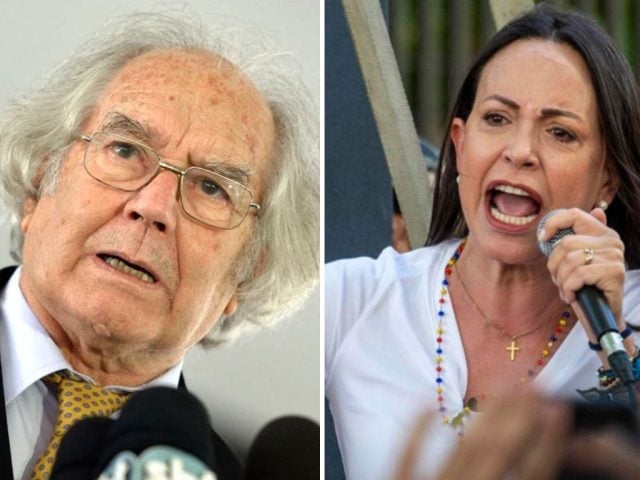
The enemies of the Venezuelan people are the few Venezuelans like María Corina Machado, who prefer to call for war against their own country, so that those who believe they own the world can enjoy the oil rents and all the common goods and riches of the Bolivarian Republic of Venezuela, in exchange for a slice for themselves.
The enemies of the people of the United States are Trump and his associates, who prefer to invest hundreds of billions of dollars in financing the war in Ukraine, genocide in Gaza, and the occupation in the Sahara, instead of improving the lives of millions of the poor, sick, and addicted that exist today in the U.S., and who could resolve most of their problems with even a fraction of those resources.
The working class must never forget that in these adventures, only dignified representatives of the working class die, because the relatives of Machado and Trump will not go to war, nor will the generals who will monitor from their offices as the poor, who are the cannon fodder for Great Capital, sacrifice their lives for the petty interests of those who send them to war, who will profit twice from it: first from the business of war, and second from the spoils they will possess if they win, holding onto everything—oil, gas, coastlines, gold, and everything that truly drives them.
Those who endorse these sanctions, justify the blockade, and remain silent in the face of this aggression that has been extending for decades behave like those social democrats who in 1914 raised their hands to vote for the war credits. They may wrap themselves in the banner of human rights and speak of «concern for democracy,» but the real content of their actions is the same: siding with imperialism against a people and their decisions.
From a Marxist perspective, the issue is crystal clear. The working class of the United States and that of Venezuela, of Europe and Latin America, has nothing to gain from this economic war. The destruction of the Venezuelan economy does not improve the lives of a North American worker; it merely reinforces the power of oil companies, investment funds, and the military-industrial complex. Similarly, the Venezuelan people suffer not only from their own process’s errors or limitations but also from an external aggression aimed at disciplining any nation that strays from the neoliberal script.
Thus, for a truly leftist political stance, there are two principles that leave no room for ambiguity. The first is that the working class must always stand against war between states and for peace among peoples. This is not abstract pacifism; it is about understanding that in every imperialist war, the dead are always the same: the poor, the workers, women, and children on both sides.
In this case, the “war” that has yet to erupt takes the form of sanctions, financial sieges, media campaigns, and military threats; yet the logic remains identical: breaking the will of a people to impose the interests of another state. The task for workers in the U.S., Europe, and Latin America is not to applaud the escalation, but to denounce it, organize against it, demand the end of sanctions, and defend Venezuela’s right to decide its own fate.
The second is that defending sovereignty and non-intervention is to support the right of peoples to err and correct themselves without foreign bayonets. When we say «no to intervention,» we do not mean that in Venezuela, or in any country, everything is fine, or that there are no critiques to be made towards their leaders, policies, or mistakes. We are stating something simpler yet deeper: these debates belong to the Venezuelan people, not to Pentagon strategists or the murderous bureaucrats of Washington or Brussels. The working classes of other countries do not have the right or the duty to «correct» any people by force, but rather to respect their self-determination and strive for their own states to stop acting as gendarmes of capital.
The responsibility of the left in facing this crisis is immense. In 1914, social democracy bowed before nationalism and sacrificed its internationalism on the altar of «national unity.» Today, part of the forces that call themselves progressive make a similar mistake: they accept uncritically the imperialist narrative that installed dictatorships in Latin America and validates the genocide in Gaza, concerning Venezuela; they repeat its accusations, declare themselves «equidistant» between the aggressor and the aggrieved, or hide in cowardly silence. In all those cases, they renounce their historical role as tribunes of the people and become notaries of the global order.
From a leftist perspective, worthy of a legacy from Rosa Luxemburg, Lenin, Fidel, Mariátegui, and Simón Bolívar, among many others, there is no room for such imbalances. Neutrality in the face of imperial aggression is complicity.
The task for those who claim to be socialists is to clearly denounce the policies of the United States and its allies, patiently explain that sanctions are a form of war, and build concrete solidarity with the Venezuelan people, with the Cuban, Palestinian, Sudanese, and all the peoples of the world currently suffering the onslaught of imperial neocolonialism: to break the media blockade, promote support campaigns, boycott initiatives deepening the stranglehold, and above all, work within each country to ensure that their own governments cease being instruments of this aggression.
At the same time, true internationalism requires speaking clearly to all working classes. To those in the North, to say their enemy is not the Venezuelan worker or the migrant fleeing the crisis generated by their own government, but the capitalists of their own country who use war and blockade to maintain their dominance. And to those in the South, to remind them that no foreign power will come to liberate them and that only their own organization, their capacity to build real democracy and social justice, can open a different horizon.
Peace among peoples is not the balance of powers; it is the active solidarity of the subaltern classes beyond borders. Thus, in the face of the crisis between the United States and Venezuela, the socialist task is not to choose which national flag flies highest, but to raise another banner: the banner of peace without annexations or sanctions, the respect for sovereignty, the right of each people to decide its path without oversight or punishment.
In 1916, Rosa Luxemburg wrote from prison that humanity was at a crossroads: either the triumph of imperialism and the ruin of all culture, or the triumph of socialism. Today, from my confinement, I assert that this dilemma is repeated in other terms. If we accept that sanctions, blockades, and interventions are “normal” mechanisms of international politics; if we allow great powers to destroy entire countries in the name of democracy while trampling on their own; if we permit the left to become impotent commentators on geopolitics, then we will have chosen, once more, barbarism.
But if the working class of the United States refuses to be cannon fodder for this policy, if the European working class rejects following their governments into imperial adventures, if the Latin American working class unequivocally defends the sovereignty of Venezuela and all threatened peoples, then, even in darkness, a different path will begin to open.
This path continues to have a simple yet terrible name: socialism. Socialism as the real democracy of the people, as the end of imperial war, as a conscious organization of the economy in service of life and not profit. Socialism as an alliance among the downtrodden across all nations.
Meanwhile, in the face of each new sanction, each threat, and each destabilization maneuver, the Luxemburgian commandment retains all its relevance: not a man, nor a woman, nor a cent for the imperial war against the peoples; everything for the struggle for peace, sovereignty, and international brotherhood among the working class.
By Daniel Jadue
Relacionados
Nobel Peace Laureate Pérez Esquivel to Machado: Why Did You Urge the U.S. to Invade Venezuela?
Hace 4 meses
Debunking the Imperial Illusion: A Response to Elliott Abrams' Justification for Regime Change in Venezuela
Hace 2 meses
Chavismo Remains United: Jorge Rodríguez Reaffirmed as President of Venezuela's National Assembly
Hace 4 semanas
Venezuelan Human Rights Activist Critiques Nobel Peace Prize Award to Machado for Advocating Military Intervention
Hace 3 meses