Original article: A propósito de los SLEP: Una amenazante realidad educativa
By Leonardo Marcelo Guerrero Campos, Philosopher.
«We are what we repeatedly do. Excellence, then, is not an act, but a habit.»
Aristotle in «Nicomachean Ethics.»
Following the tenets of Aristotelian thought from the aforementioned quote, and interpreting its message from an educational perspective, we can understand that ethical virtues are habits formed through the repetition of virtuous acts guiding us toward excellence, not by mere theory or spontaneous events. True excellence is cultivated through our rigorous and daily efforts.
But why is it crucial to consider Aristotle’s principles in the 21st century, particularly in today’s Chile?
The answer becomes clear when we examine the negative repercussions stemming from the implementation of SLEPs (Local Public Education Services) within what is termed Chile’s «public education.»
Indeed, Law 21.040 established the «public education system,» leading to the creation of SLEPs in 2017, which have left much to be desired across various dimensions.
Throughout Chile, we have witnessed numerous adverse outcomes from their implementation. Initial issues arose during the transition from municipal education (which was forcefully imposed during the dictatorship and continues to be relevant due to the gradual rollout of SLEPs) to the so-called «new» public education.
As a result, many professionals, technicians, and administrative staff transitioned to the “new” system carrying unpaid pension debts from the previous municipal system (DAEM or Corporations), creating a new «historic debt» that no one seems to address, paradoxically within a government that prides itself on having settled its own «historic debt» at a distressingly unjust and ridiculous price.
The second major issue prevalent in the application of this «new» public education is embarrassing and reflects a significant neglect of duty from our democratic state.
Just a reminder: on April 2, 2025, a massive demonstration occurred in the city of Coquimbo, where educators and support staff protested against the «Puerto Cordillera Local Service,» citing ongoing administrative problems preventing many from receiving their salaries.
Furthermore, the infrastructural debt that these educational and public entities (SLEPs) owe to various educational communities is staggering, as many lack appropriate spaces for optimal «teaching-learning» processes. The situation is disgraceful: roofs that leak, broken windows, inadequate ventilation, and a lack of educational resources; schools that are literally falling apart. The manner in which local public education services are administered is overwhelmingly bleak and disheartening.
Yet, amid the turmoil, there exists one SLEP that appears to be the model to follow—undoubtedly the «monument of all SLEPs,» the «prodigal child of SLEPs.»
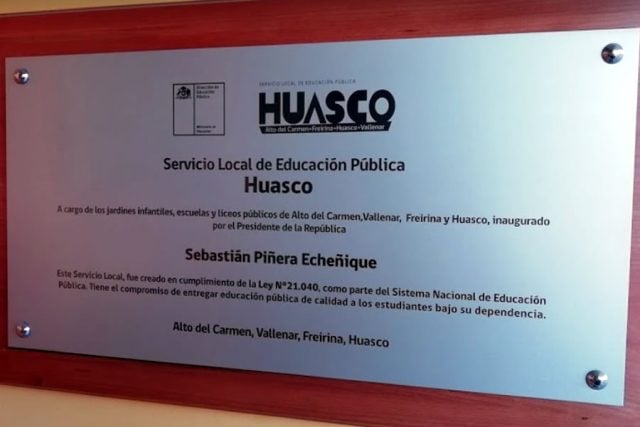
However, as the adage goes, not everything that glitters is gold; Immanuel Kant stated that we do not see the world as it is but as we are; what we experience is merely a projection of our personal perspective, not pure reality. The SLEP of Huasco, covering the communities of Alto del Carmen, Vallenar, Huasco, and Freirina in the third region, exemplifies this phenomenon, and I will explain why.
«The executive director» of the Huasco SLEP, Javier Obanos Sandoval (RN), belongs to the same political sector as the president who appointed him nearly a decade ago, who sadly passed away in an airplane accident. But what distinguishes this SLEP? Its merit lies in the fact that during the transition from municipal education to public education, all officials retained zero pension debt and consistently received their full monthly salaries.
Indeed, it stands out as one of the few (if not the only) that «luckily» meets the minimum legal obligations, as opposed to striving for the ethical maximum.
In other words, paying salaries (a legal obligation) and fulfilling pension payments (another legal obligation) has now become the solution. Does lowering the standards improve public education? Clearly not. Yet, it’s the standard to emulate, even for Education Minister Nicolás Cataldo (PC), who reappointed Javier Obanos Sandoval despite their personal ties.
Javier, the head of the best SLEP in all of Chile, does not operate alone; he has a highly capable Human Resources officer who should have retired years ago but continues to work diligently: none other than Lucía Mulet Martínez, sister of deputy Jaime Mulet Martínez. Everything seems fine at this point, but not all that glitters is gold.
This is my testimony:
From Santiago to Vallenar
I was hired to teach language classes at the Politécnico de Vallenar (ITSEP). I interviewed with the «adorable» and very sweet Lucía Mulet Martínez, who referred me to a second interview, this time with the school principal, Ana Carina Velásquez. She appeared very professional during the interview and thereafter, ultimately hiring me to teach language during the 2025 academic year.
However, on only the third day into my teaching role, I was publicly accused of something I never did and was unjustly and abruptly removed from my position without any guarantee of my fundamental rights as an employee or educator (such as the right to due process and to my honor), all handled by the principal, who treated me worse than a communist in Kast’s household.
I lodged complaints with every public entity I could and subsequently filed a lawsuit in April against those claiming to be «the best SLEP in Chile.»
On December 18, 2025, at the First Civil Court of Vallenar, Judge S. Mayra Monardes rendered a decision. I won my case against the Huasco SLEP, who were ordered to pay 10,519,584 pesos in indemnity under Article 489, along with 3,000,000 pesos for moral damages.
Additionally, they must issue a public letter on their website acknowledging the violation of my fundamental rights. They are also required to conduct training for their staff to ensure they learn to respect their employees’ labor rights.
Ten days before concluding the legal process, which to date remains unpaid, I pondered: how many of my colleagues have experienced something similar?
This led me to pursue a transparency request with the Huasco SLEP. The inquiry aimed to uncover: how much money had the Huasco SLEP lost in labor lawsuits?
The response revealed a harsh and grim educational reality — the Huasco SLEP, touted as the example of all SLEPs in Chile, has lost a staggering 117,244,494 pesos due to labor lawsuits. Money that comes from taxpayer funds.
Who bears the responsibility for such administrative and economic negligence? Shouldn’t the HR officer of this SLEP or, at the very least, its executive director resign? Why do they continue to work despite this considerable public economic waste?
How is it possible for Education Minister Nicolás Cataldo, a member of the PC, to endorse and promote the administration of those who do not respect the rights of their workers? Is it just me, or shouldn’t the Communist Party protect the interests of the oppressed rather than the oppressor? What about the political consequences for the current education minister, who is a history teacher?
Who will assume responsibility for these millions in losses in the educational domain for the State of Chile? Is Gabriel Boric aware of the severe educational decay we public education professionals, technicians, and administrators are experiencing under his administration?
These are questions that generate a cloud of doubts and lead us to conclude that the Huasco SLEP, in Aristotelian terms, does not achieve excellence, as its repeated practices are not genuinely ethical and rather border on illegality and inhumanity. This does not reflect an improvement in public education; instead, it degrades and diminishes its value.
Moreover, not only do they manage poorly, but they also make us lose millions by failing to comply with the law. Despite all the evidence presented, they cling to their exorbitant salaries and positions like ticks on a dog.
I wish to express my gratitude to those who supported me throughout this process: to my beloved partner Ignacia, my dear daughter Fernanda, my beloved parents Leonardo and Eugenia, and to my colleague Victoria Ceriche Araya.
Leonardo Marcelo Guerrero Campos.
Relacionados

Chilean Astronomer Teresa Paneque Awarded Prestigious 'Oscar' of Science Communication in Washington
Hace 3 meses