Original article: «Vamos a gobernar el país»: Preparando una ocupación ilegal en Venezuela
I listened to the press conference on January 3rd with a knot in my stomach. As a Venezuelan-American with family, memories, and a living connection to the country being discussed as if it were merely a possession, what I heard was very clear. And that clarity was chilling.
The president stated bluntly that the United States would «govern the country» until a transition deemed «safe» and «prudent» occurs.
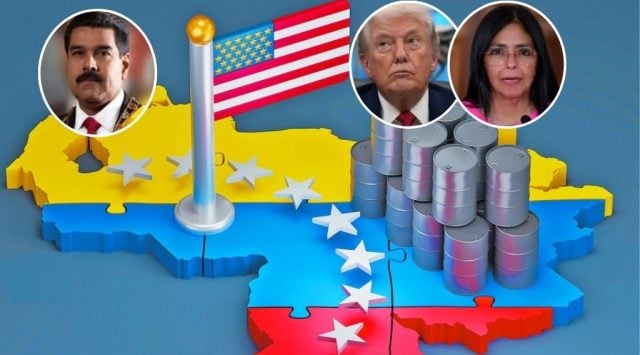
He talked about seizing the Venezuelan head of state, transporting him on a U.S. military vessel, temporarily administering Venezuela, and bringing in U.S. oil companies to rebuild the industry.
He dismissed concerns regarding international reactions with a phrase that should alarm everyone: «Understand that this is our hemisphere.» For Venezuelans, those words echo a long and painful history.
Let’s be clear about the claims. The president asserts that the United States can detain a sitting foreign president and spouse under U.S. criminal law. That the U.S. can administer another sovereign country without international mandate. That Venezuela’s political future can be decided from Washington. That control over oil and reconstruction is a legitimate consequence of intervention. And that all this can happen without congressional authorization or evidence of an imminent threat.
We have heard this language before. In Iraq, the U.S. promised limited intervention and temporary administration, only to impose years of occupation, take control of critical infrastructure, and leave behind devastation and instability. What was presented as administration became domination.
Now, Venezuela is being discussed in disturbingly similar terms. The «temporary administration» turned into a permanent disaster.
According to international law, nothing described in that press conference is legal. The United Nations Charter prohibits the threat or use of force against another state and forbids interference in a nation’s political independence. Sanctions designed to force political outcomes and inflict civilian suffering amount to collective punishment. Declaring the right to «govern» another country is the language of occupation, no matter how much the term is avoided.
U.S. law presents equally troubling assertions. War powers belong to Congress. There has been no authorization, declaration, or legal process enabling an executive to detain a foreign head of state or govern a country.
Calling this «law enforcement» does not make it so. Venezuela does not represent a threat to the United States. It has not attacked the U.S. nor issued any threats that would justify the use of force under U.S. or international law. There is no legal basis, national or international, for what is being asserted.
But beyond law and precedents is the most important reality: the cost of this aggression is borne by ordinary people in Venezuela. War, sanctions, and military escalation do not fall equally. They disproportionately affect women, children, the elderly, and the poor. They entail shortages of medicine and food, disrupted healthcare systems, rising maternal and infant mortality, and the daily stress of survival in a country forced to live under siege.
They also mean preventable deaths—people dying not from natural disasters or fate, but because access to healthcare, electricity, transport, or medication has been deliberately obstructed. Each escalation exacerbates existing harm and increases the likelihood of loss of life, civilian deaths that will be classified as collateral, even though they were foreseeable and avoidable.
What makes this even more dangerous is the underlying assumption: that Venezuelans will remain passive, submissive, and obedient to humiliation and force. That assumption is wrong. And when it collapses, as it inevitably will, the cost will be measured in unnecessary bloodshed. This is what gets erased when a country is discussed as a «transition» or an «administration problem.» Humans disappear. Lives are reduced to acceptable losses. And the ensuing violence is presented as regrettable rather than the predictable outcome of arrogance and coercion.
Hearing a U.S. president talk about a country as something to be managed, stabilized, and handed over once it behaves correctly, is painful. It humiliates. And infuriates.
And yes, Venezuela is not politically united. It isn’t. It never has been. There are deep divisions over government, the economy, leadership, and the future. There are those who identify as Chavistas, those who are fiercely anti-Chavista, those who are exhausted and disconnected, and yes, those who celebrate what they believe could finally bring change.
But political division does not invite invasion.
Latin America has witnessed this logic before. In Chile, internal political division was used to justify U.S. intervention, framed as a response to ungovernability, instability, and threats to regional order, which did not culminate in democracy but in dictatorship, repression, and decades of trauma.
In fact, many Venezuelans who oppose the government still firmly reject this moment. They understand that bombs, sanctions, and externally imposed «transitions» do not bring democracy but destroy the conditions that make it possible.
This moment calls for political maturity, not purity tests. You can oppose Maduro and still oppose U.S. aggression. You can desire change and still reject foreign control. You can be angry, desperate, or hopeful and still say no to being governed by another country.
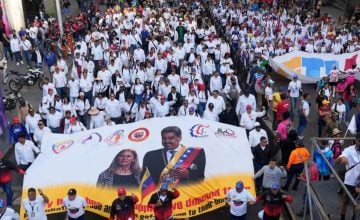
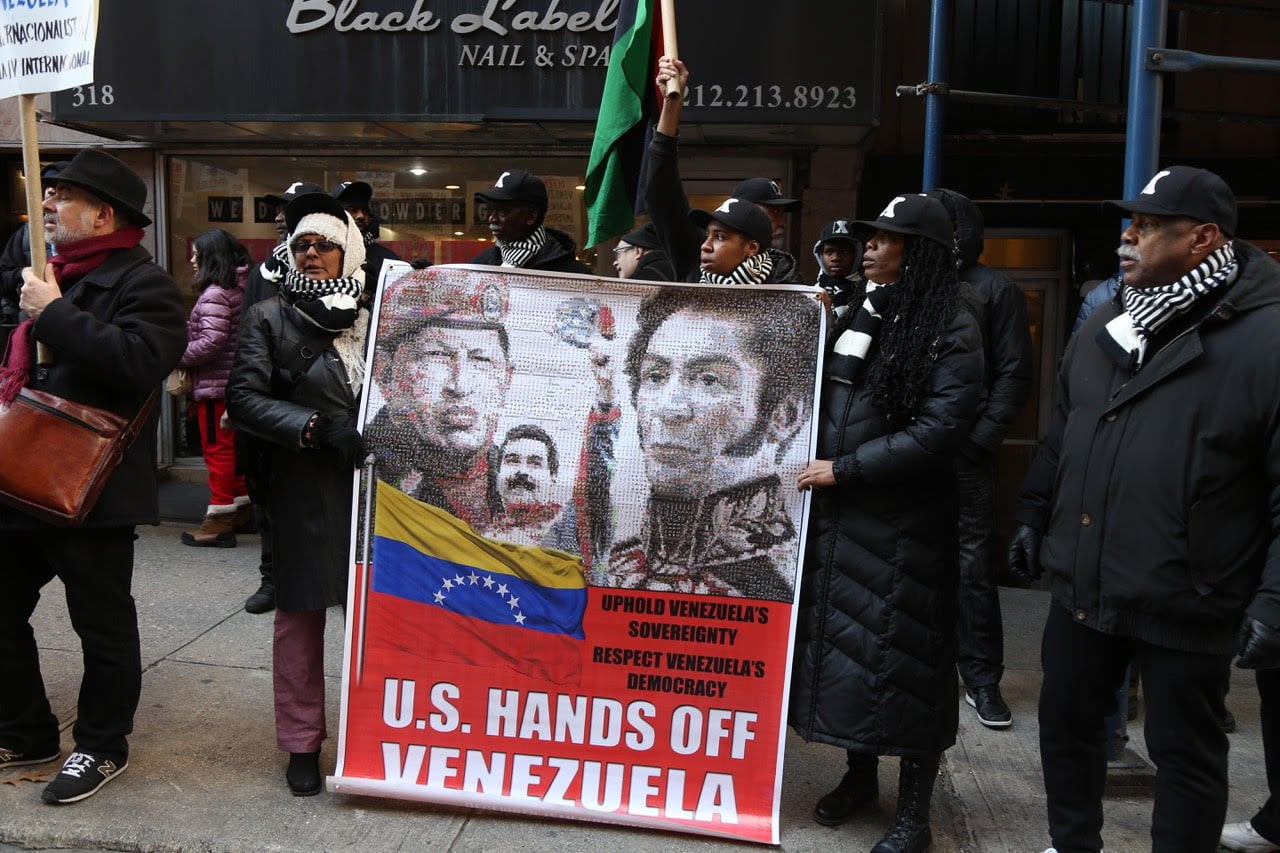
Venezuela is a country where communal councils, labor organizations, neighborhood collectives, and social movements have been forged under pressure. Political formation did not come from think tanks but from survival. At this moment, Venezuelans are not hiding. They are standing together because they recognize the pattern. They know what it means when foreign leaders start talking about «transitions» and «temporary control.» They know what often follows. And they are responding as they always have: turning fear into collective action.
This press conference was not just about Venezuela. It was about whether the empire can openly reclaim the right to govern other nations and expect the world to shrug. If this persists, the lesson is brutal and undeniable: sovereignty is conditional, resources are there for the U.S. to seize, and democracy only exists by imperial consent.
As a Venezuelan-American, I reject that lesson. I reject the idea that my taxes fund the humiliation of my homeland. I reject the lie that war and coercion are acts of «care» for the Venezuelan people. And I refuse to be silent while my beloved country is discussed as raw material for U.S. interests, not as a society of human beings deserving of respect.
The future of Venezuela is not in the hands of U.S. officials, corporate boards, or any president who believes the hemisphere is at their disposal. It belongs to the Venezuelans.
Michelle Ellner
The Citizen
Relacionados
Venezuela Accuses the U.S. of Turning the Country into a Testing Ground for "Unknown Weapons"
Hace 4 semanas