Original article: ¿Carey habría influido en decisión del tribunal de libre competencia chino?
The approval of the joint venture between SQM and Codelco, hailed by Beijing as a triumph of its regulatory framework, conceals a web of legal maneuvers, the sidelining of a Chinese giant (Tianqi), and potential risks for Chile’s industrial development, where the law firm Carey emerges as a pivotal thread.
The Citizen
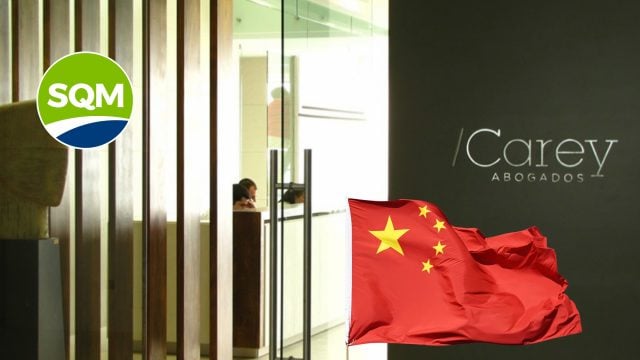
Following the State Administration for Market Regulation (SAMR) in China granting conditional approval for the merger between SQM and Codelco, an uncomfortable question arises among legal and mining circles: Did the Chilean law firm Carey play a decisive role in the regulator’s verdict, not only due to its advisory role to Codelco but also because of its deep understanding of the transaction that previously allowed the Chinese company Tianqi to enter SQM?
This question is relevant. Carey, one of the most powerful law firms in Chile, not only advised Codelco on the intricate mechanism to establish the joint venture with SQM but also played a crucial role in 2018 when one of its partners actively participated in the negotiation that allowed Tianqi Lithium to acquire 23.77% of SQM, a deal that at the time also required Chinese antitrust approval.
According to Carey, their firm «has extensive experience in advising Chinese companies on their investments in Chile and Latin America, as well as in managing, coordinating, and leading advice for clients looking to venture into the Chinese market.» Maintaining offices in the Asian country, they have conducted intense negotiations in recent months, as without the SAMR’s approval, no agreement would have been possible.
The Maneuver That Dilutes Tianqi and Avoids Its Vote
The method chosen by SQM’s management to partner with Codelco has been described by experts as a «master class» in legal engineering, but it carries severe economic repercussions for China. Instead of a traditional merger requiring shareholder approval—where Tianqi, the second-largest shareholder, could have voted against—it was structured through the absorption of Tarar SpA.
This maneuver allowed SQM to inject its lithium assets into the joint venture with Codelco without needing shareholder approval, strategically sidelining Tianqi. According to an analysis by researcher Lin Shuwen from the East China Institute of New Material Technology, this results in a catastrophic dilution for the Chinese giant.
«Under the new regulations, Tianqi Lithium’s capital will be significantly diluted,» pointed out Lin Shuwen. According to his estimates, «the agreement of different rights for the same shares actually dilutes Tianqi Lithium’s capital to 6.6%, and it will fall to 3.3% by 2031. As a result, the return on investment for Tianqi Lithium will be a long process.»
Carey: The Common Thread in Two Key Transactions
Carey’s dual involvement raises suspicions about its possible influence on the SAMR’s final decision. The firm not only has offices in Shanghai but one of its partners was a key member of the team that advised the sale of SQM’s stake to Tianqi in 2018. This provides them with insider knowledge of SQM’s ownership structure, Chinese interests, and, crucially, the processes and concerns of China’s antitrust regulators.
It’s worth noting that just as the law firm Claro & Cía advised SQM on its agreement with Codelco specifically regarding corporate and M&A matters, this same firm also advised Nutrien while Carey was advising Tianqi in the $4 billion transaction.
This insider knowledge would have been invaluable in crafting a strategy that, while technically compliant with Chilean law, results in an outcome that directly harms a flagship Chinese company abroad.
For Beijing, the conditional approval may have been the lesser evil, as it could not prevent Tianqi’s dilution; at least it secured—through strict conditions such as minimum volumes and price caps—the flow of precious lithium carbonate for its industry.
Will the tentacles of Ponce Lerou be capable of permeating the institutional framework of this Asian giant?
Chile: Benefited or Bound to Raw Materials?
The condition imposed by China, which essentially ties the sale of lithium carbonate from the joint venture to its market, presents a paradox for Chile. While the Asian country secures critical raw materials for its energy transition and battery production, Chile risks being left without the necessary input to develop its own value-added industry.
One of the central ideas of the National Lithium Strategy promoted by President Gabriel Boric’s government was to add value to lithium extracted within its borders.
However, following the condition laid out by China for approving the agreement, this may be thwarted. Is the deal still worthwhile for Chile? Who truly benefits?
The national strategy to promote a «National Lithium Policy» that fosters productive chain development and local manufacturing of cathodes or batteries could be undermined if production is contractually committed to a single destination.
Chile may once again be doomed to export raw materials without capturing additional value from the chain, while China consolidates its global industrial dominance.
A subject matter expert noted, «the real issue lies in whom China has placed their trust. They lack knowledge of who is who in Chile, and this has led them, for instance, to work with the Bofill brothers, one for Tianqi and the other with Ponce. They’ve been very naive; if the Chinese authorities truly had insight into all the records, and not just the ones provided by individuals who may be contaminated by Ponce’s networks, they would never have approved this agreement,» they told El Ciudadano.
In conclusion, China’s approval of the SQM-Codelco joint venture is far from a simple regulatory victory. It is the result of a sophisticated legal maneuver, possibly influenced by actors with deep knowledge of both sides of the negotiation, sacrificing the interests of a Chinese investor to secure vital supply for its industry.
The Citizen
Relacionados
Codelco and SQM Establish NovaAndino Lithium Partnership Through 2060 Amid Controversies
Hace 2 meses
Codelco-SQM Partnership Launches with Debt: Private Partner Issues $500M in Bonds for Implementation
Hace 2 meses

Chilean Audit Office Delays Codelco-SQM Lithium Contracts, Leaving Control Up to 2060 Uncertain
Hace 3 meses