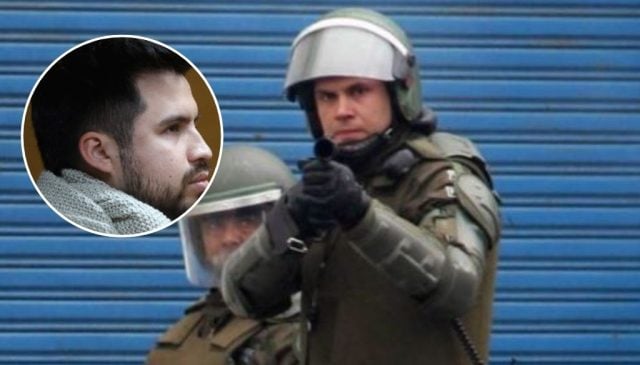
Original article: Gustavo Gatica: defensa de Crespo insiste en que no hay registros audiovisuales y fiscalía sostiene que el disparo “buscaba lesionar”
Gustavo Gatica: Crespo’s Defense Claims No Audio-Visual Evidence While Prosecution Argues Intent to Injure
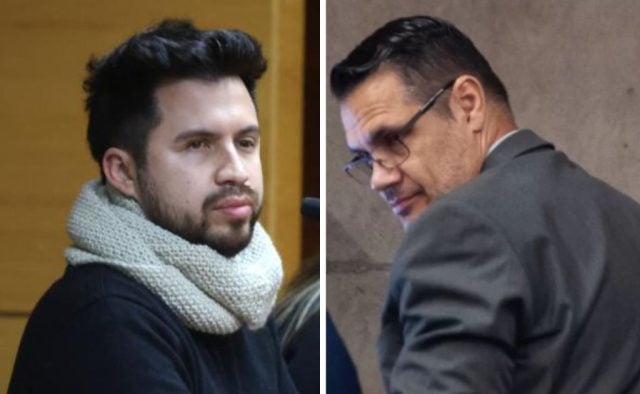
After six years of investigation and a trial examining one of the most significant cases of eye injuries during social unrest, the Fourth Oral Criminal Court of Santiago will announce its verdict on Tuesday, January 13, against former Carabineros lieutenant colonel Claudio Crespo. The ex-official is accused of firing anti-riot shotgun rounds that led to the double ocular mutilation of Gustavo Gatica, who was a Sociology student at the time of the incident on November 8, 2019.
During the closing arguments on Wednesday, January 7, both the defense and prosecution presented their cases. Crespo’s defense attorneys maintained that no direct audio-visual evidence links him to the shootings and asserted that his actions were in line with protocols for dealing with an “extremely violent” protest.
In contrast, the prosecution claimed that Crespo acted with punitive intent, openly disregarding Carabineros’ internal protocols, and that his shot was aimed to injure.
Defense: «No Records» and «The Shot was Justified»
The defense’s core argument challenges the direct evidence and methodology of the investigation. «My client should not have been formally charged or brought to trial; he should have been dismissed due to lack of involvement,» stated Pedro Orthusteguy, Crespo’s attorney.
The former prosecutor highlighted the absence of any credible witnesses or visual evidence confirming the authorship of the injuries inflicted on Gustavo Gatica, stating, «It was not possible to find a single witness who can confirm the responsibility for the injuries against Gustavo Gatica.»
Furthermore, he dismissed the sequence reconstructed by the prosecution from various recordings, labeling it as «an experimental method» which, in his view, fails to prove Crespo’s authorship.
Defense attorneys Mauricio Bascur and Nicolás Manríquez buttressed the argument. Bascur contended that given the violence from protesters—who attacked with Molotov cocktails and stones, barricading streets with metal barriers—Crespo’s actions were acts of legitimate and proportional defense. «We must conclude that the shot was justified, and that Carabineros personnel employed a differentiated and progressive use of force. How so? As established in Circular 1,832,» he asserted, as reported by CIPER.
Manríquez, for his part, criticized the prosecution’s expert assessments, arguing that the anti-riot shotgun is not a precision weapon.
«The officer does not have material dominion over the specific point of impact or the specific result of the shot, which excludes attributing conscious and directed control over the damage caused. If the weapon does not allow for precision or individual impact control, the subjective analysis cannot present itself as if it were a precision shot,» he argued.
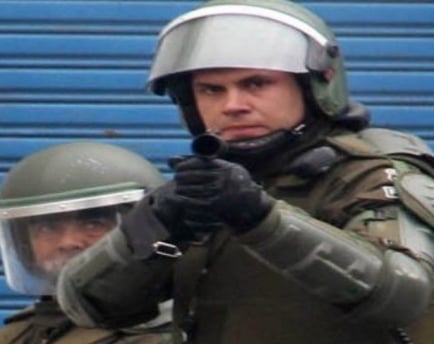
Prosecution: Crespo «Intended to Injure»
In response to these arguments, prosecutor Francisco Ledezma and plaintiff attorney Carlos Gajardo presented a contrasting narrative, based on the reconstruction of events from 6:07 PM to 6:10 PM on November 8, and the accused’s behavioral profile.
Prosecutor Ledezma asserted that Crespo did not fire with a deterrent intent, but rather punitive intent.
«Firing at the upper third of the protesters was not for deterrence, but aimed to injure. That indicates a punitive intention,» he claimed.
The prosecution contended that the ex-officer ignored the established protocols, known to Carabineros since at least 2012, which dictate shooting at the lower third of the body (between the knee and ankle) and from a distance greater than 30 meters to prevent lethal or ocular injuries.
During the trial, seven videos were presented—six recorded by Crespo’s own body camera—showing him assaulting and threatening already neutralized detainees, uttering phrases like «We’re going to take your eyes, you bastard.» These recordings, initially circulated by CIPER, were pivotal for the prosecution’s case.
«Unfortunately, there is a pattern with Mr. Claudio Crespo of non-compliance with regulations,» the former prosecutor stated in his arguments.
«During the trial, another series of videos showed his contempt for regulatory compliance. These are not isolated incidents; they have relevance because they demonstrate a constant disregard for the rules,» he added.
Gajardo also emphasized that Crespo, as a Special Forces officer, could not have been unaware of the potential harm of the weapon, particularly after weeks of social unrest where eye injuries were prevalent.
He even cited statements from other Carabineros confirming the training they received: «The instruction provided, the manner in which they were taught to fire these weapons, and the correct way to use the anti-riot shotgun was to shoot at the lower third, between the knee and ankle, and from more than 30 meters,» many stated.
The attorney reminded the court that by November 8, 2019, three weeks into the social unrest, it was common knowledge that shotgun pellets could cause severe ocular damage. «Ultimately, we’re talking about a Carabineros officer misusing the anti-riot shotgun in a manner that is not regulated, inappropriate, and expressly prohibited by internal regulations, leading to the injuries of the magnitude we’re discussing,» he stated.
Carabineros Protocols
The debate also focused on the interpretation of Carabineros’ internal protocols. The defense argued that Circular 1,832 and General Order 2,635 allow for discretion among officers on the ground. However, experts consulted by CIPER moderated this assertion.
Angélica Torres, a researcher at Diego Portales University, explained that «if an officer fires because Circular 1,832 allows him to shoot, that is not sufficient for the court to consider their conduct justified.»
«It’s not the same to shoot at the feet as it is to shoot at the eyes. So, while they may have authorization to use the anti-riot shotgun, that does not mean they’re going to point it at the eyes,» she stressed.
Meanwhile, Matías Insunza Tagle, an academic from the University of Chile, noted regarding the defense’s claim of lack of control over impact that «the prosecution pointed out, based on the principle of objectivity, that the weaponry used, its method of use, and the decisions made in this specific case clearly deviated from Carabineros’ established protocols. Therefore, the outcome was not merely coincidental but resulted from grievously non-compliant behavior.»
Conclusion of the Trial Against Crespo
Claudio Crespo, who was dismissed from Carabineros in 2020 following an internal investigation that revealed he improperly accessed his body camera footage, will have the opportunity for a final statement before the court this Monday, January 12 at 9:00 AM.
Twenty-four hours later, at 9:00 AM on Tuesday, January 13, judges Alejandra Pérez, Paulina Pino, and Francisco García-Huidobro will read the verdict concluding a judicial process that seeks to scrutinize not just a former official, but also police practices, the use of less-lethal weapons, and accountability during social protests.
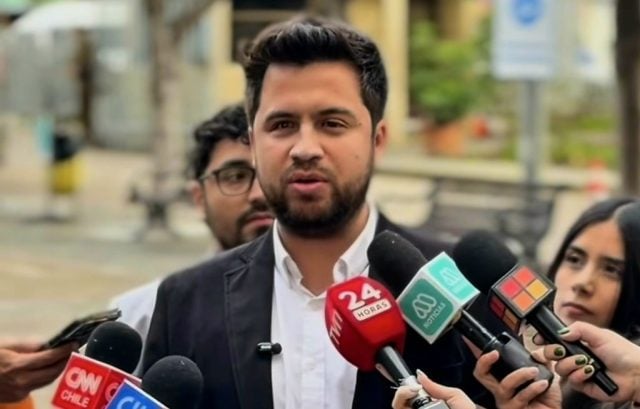
The ruling will determine whether the injuries that severely altered Gustavo Gatica’s life—who is now an elected congressman for District 8—resulted from legitimate actions carried out in the line of duty, or from an illegitimate and punishable act of violence.
Obtén tu Pasaporte y apoya a El Ciudadano
Elimina la publicidad, accede a contenido exclusivo y sé parte de la comunidad.
Cancela en cualquier momento · Sin permanencia