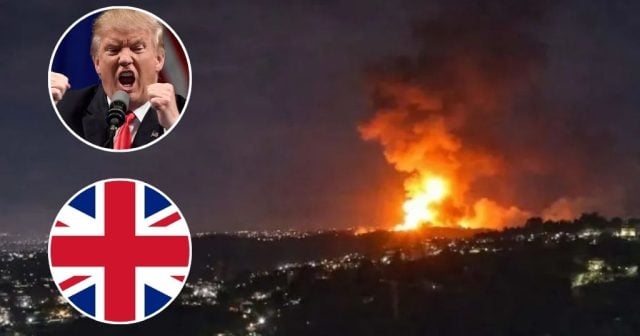
Original article: Cómo Gran Bretaña ayudó a Trump a desestabilizar a Venezuela
The UK government has systematically supported the United States in the overthrow of the Venezuelan government by recognizing a rival claimant, freezing state assets, and secretly planning for a post-Maduro economy.
By John McEvoy*
The integral role of the UK in backing the US-led campaign to oust Venezuelan President Nicolás Maduro extends beyond its recent failure to condemn military intervention. Investigations reveal a multi-faceted strategy spanning several years: a consistent British policy of regime change that prioritizes strategic alignment with the US and economic interests over principles of sovereignty and international law.
During the early hours of Saturday, US forces bombed Venezuela and took its president, Nicolás Maduro, hostage.
This was a clear violation of international law, breaching the terms of the UN Charter which prohibits interference and the use of force against sovereign states.
However, Keir Starmer, former human rights lawyer, has declined to condemn the attack or even acknowledge its blatant illegality.
«I want to gather all the material facts and we simply do not have the full picture at this moment,» the Prime Minister told the BBC on Saturday.
Starmer later stated on social media that the UK «viewed Maduro as an illegitimate president and we shed no tears over the end of his regime.»
In contrast, it took him less than 24 hours to label Vladimir Putin’s invasion of Ukraine as an «act of aggression.»
Former British ambassador Sir Richard Dalton told Declassified that the government has failed to oppose the «law of the jungle» with its «cynical» stance on Venezuela.
While refusing to condemn Trump’s actions, Starmer insisted that «there was no UK involvement in this operation.»
Nevertheless, personnel from the Royal Navy have been integrated into the US Navy surrounding Venezuela in recent weeks, and the Ministry of Defense has refrained from clarifying whether they were present during the attack.
Defense Secretary John Healey reportedly instructed them not to participate in the bombings of Venezuela, and it was reported that intelligence sharing between the US and UK was frozen in the Caribbean to avoid British complicity in violations of international law.
This sharply contrasts with the current position of the government that it cannot comment on the legality of Trump’s actions.
Even if British forces did not directly participate in the military operation, the UK government has been discreetly supporting Washington’s destabilization efforts in Venezuela for years.
Since 2019, the UK has frozen over $2 billion in Venezuelan gold at the Bank of England, sponsored anti-government initiatives, and even created a secret «Venezuela Reconstruction Unit» to plan the day after Maduro’s downfall.
Thus, Starmer does not speak in abstract terms when he says that «the UK has long supported a power transition in Venezuela.»
Recognition of Juan Guaidó
Seven years ago, the British government made the bold decision to recognize a politician named Juan Guaidó as the President of Venezuela.
Guaidó had never run for the presidency.
However, on January 23, 2019, he proclaimed himself «interim president» of Venezuela, using Article 233 of the Venezuelan Constitution to declare that Maduro had abandoned his post, thus creating an «absolute power vacuum.»
This vacuum, Guaidó claimed, was to be filled by the president of the National Assembly of Venezuela, a position he occupied.
Without the support of the US government, Guaidó’s legal maneuverings would likely have gone nowhere.
Nonetheless, the Trump administration swiftly moved to recognize Guaidó and began pressuring the so-called «international community» to follow suit.
On January 24, then Foreign Secretary Jeremy Hunt visited Washington to attend a «mid-morning meeting with [Secretary of State] Mike Pompeo and then Vice President Mike Pence.»
During this meeting, Hunt surprised everyone by «suddenly saying that we will consider recognizing Guaidó,» according to former minister Alan Duncan.
Duncan’s published diaries indicate that the following day, Hunt stated: «We need to use Venezuela as a topic where we can align ourselves as closely as possible with the US, because [Hunt] is out of line on several issues like Syria.»
Weeks earlier, Hunt had openly disagreed with Trump’s plans to withdraw US troops from Syria.
Duncan’s diary entry continued: «It’s one of those moments of exchange that we need if we want to skillfully handle the Trump administration.»
Apparently quoting Hunt, Duncan added: «Venezuela is in their backyard, and it may be the only foreign adventure they could pursue.»
Thus, Hunt appeared to see Guaidó’s recognition as a way to curry favor with Trump, but Britain also has historical interests in the region’s oil reserves.
«Reviving the oil industry [in Venezuela] will be essential to any recovery [economic], and I can imagine British firms like Shell and BP wanting to be part of it,» Duncan stated in 2018.
British businesses are also interested in neighboring Guyana, which has a territorial dispute with Venezuela over the rich oil region of Esequibo.
In January 2019, Guaidó’s representative in London, Vanessa Neumann, was recorded stating that «the number one issue identified by the Foreign Office is that they will not support us while we continue with the official line of wanting to reclaim Esequibo from Guyana.»
Neumann thus instructed her colleague to «leave the issue» of the Venezuelan claim over the region in exchange for British support for the coup.
Freezing Venezuelan Gold
The British recognition of Guaidó was a key requirement for the Bank of England’s decision to freeze Venezuelan gold in 2019, a significant British contribution to Washington’s coup efforts.
According to former US National Security advisor John Bolton, Hunt was «delighted» to assist with Washington’s destabilization campaign, «for example, by freezing Venezuelan gold deposits at the Bank of England.»
The bank’s directors were uneasy about the legal implications of freezing a foreign state’s assets, but the Foreign Office made an effort to reassure them.
On January 25, 2019, Duncan wrote in his diary that he held a call with Mark Carney, then governor of the Bank of England, regarding the Venezuelan gold:
«I tell Carney that I fully understand that while it’s a decision for the Bank, it needs some political cover from our side. I say that I will write the strongest letter I can to pass through the lawyers at the FCO, which will explain the growing doubts about Maduro’s legitimacy and that many countries no longer consider him president of the country.»
In other words, the Bank of England required solid legal justification to keep the Venezuelan gold frozen, and the Foreign Office was happy to provide it.
In May 2020, Maduro’s government sued the Bank of England for its refusal to release the gold.
When the matter reached the courts, the British government supported Guaidó by reaffirming its recognition, even spending £80,697 to promote his legal campaign.
This was despite repeated condemnations from the UN Special Rapporteur Alena Douhan about the negative impact of unilateral sanctions on Venezuela.
In 2021, for instance, Douhan noted the «repeated denials of banks in the… UK… to release Venezuelan assets even to purchase medicines, vaccines, and protective equipment» during the Covid-19 pandemic.
With each hearing, Guaidó and his representatives also incurred substantial costs, with published accounts suggesting that Guaidó’s team spent over $8.5 million on legal fees, approximately £7 million.
Remarkably, Guaidó’s legal fees in the UK were paid with money that was originally appropriated from the Venezuelan state in the US.
Venezuela Reconstruction Unit
After freezing Venezuelan gold, the British government established a secret «Venezuela Reconstruction Unit [VRU]» in the autumn of 2019.
The VRU was based in the Foreign Office and led by diplomat John Saville, with three other staff members, one of whom was an «external consultant.»
Seemingly tasked with planning for the aftermath of Maduro’s downfall, the VRU met with Guaidó in London in January 2020 and «had contact» with other members of his team, including Neumann.
After being exposed, the Foreign Office claimed that the team had been established to «coordinate the UK’s approach to the international response to the severe economic and humanitarian situation in Venezuela.»
However, documents obtained by Declassified revealed that Saville held meetings in Caracas to plan British participation in the Venezuelan energy sector.
A full day of meetings on the topic of the «UK’s involvement in the energy sector» in Venezuela was scheduled, although the complete agenda remains classified for «national security» reasons.
Meanwhile, the Foreign Office funded an «anti-corruption» coalition in Venezuela with £450,000, money from the controversial Conflict, Stability and Security Fund.
Following this revelation, the British Embassy in Caracas internally complained: «Articles about our programs/operations here (particularly from McEvoy) are especially sensitive.»
The Foreign Office now refuses to disclose which non-governmental organizations it has funded in Venezuela in recent years.
It justified this by stating that the information «would likely damage relations between the UK and another State» and must remain confidential.
*John McEvoy is a senior reporter at Declassified UK. He is a historian and filmmaker, focusing on British foreign policy and Latin America. His PhD examined Britain’s secret wars in Colombia from 1948 to 2009, and he is currently working on a documentary about the British role in the rise of Augusto Pinochet.
Translation: Victor Muruet
Obtén tu Pasaporte y apoya a El Ciudadano
Elimina la publicidad, accede a contenido exclusivo y sé parte de la comunidad.
Cancela en cualquier momento · Sin permanencia