Original article: “Estamos defendiendo nuestro derecho a existir”: Boric celebra el lanzamiento de Latam-GPT
Latam-GPT is the result of an unprecedented collaboration model that brings together the state, academia, international organizations, and technology leaders to develop the first major open language model from Latin America and the Caribbean, designed with a unique identity and trained to understand our languages, contexts, and local realities.
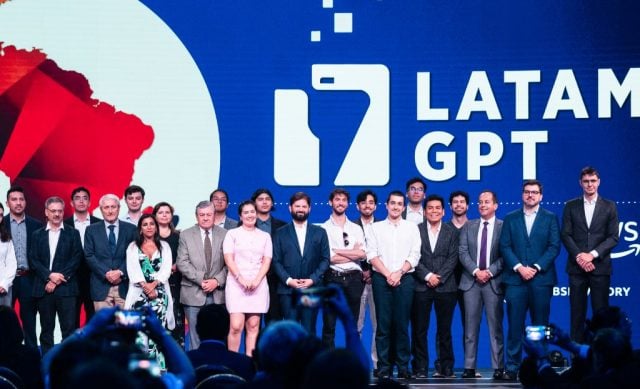
President Gabriel Boric officiated the launch ceremony of Latam-GPT, the first major open language model developed entirely in and for Latin America and the Caribbean, on February 10. During the event held at Studio 4 of Chile’s National Television, the President emphasized the identity and sovereignty character of this technological initiative, driven by the National Center for Artificial Intelligence (CENIA) with support from various public and private stakeholders.
This event marked a significant milestone in the region’s technological history. Latam-GPT is not just another language model in the competitive global market for generative artificial intelligence; it is the first designed from and for Latin America and the Caribbean, with a unique identity, trained to comprehend its languages, idioms, social realities, and cultural particularities.
Speaking to an audience composed of government officials, scientists, academics, and representatives from the tech sector, President Boric positioned this tool as a political and cultural affirmation in the digital age.
An Unprecedented Coalition for Technological Sovereignty
The development of the region’s first major open language model was led by the National Center for Artificial Intelligence, supported by the Ministry of Science, Technology, Knowledge, and Innovation of Chile, the Development Bank of Latin America and the Caribbean (CAF), Amazon Web Services (AWS), and the technology center Data Observatory.
They were joined by various regional states, alongside strategic alliances forged from academia, international organizations, and technology leaders.
The scale of collaboration, described by organizers as «unprecedented,» connected the capabilities of the state, academia (CENIA), international organizations (CAF), and technology leaders (AWS).
“This model, developed by researchers, scientists, and professionals from the region, positions Latin America not only as a user of cutting-edge technology but also as a protagonist in its creation, strengthening the regional capacity to innovate with a unique identity,» stated the Ministry of Science.
Present at the ceremony were, alongside the Head of State, the Minister of Science, Technology, Knowledge, and Innovation, Aldo Valle; the Minister of Labor and Social Security, Claudio Reyes; the Director of the National Center for Artificial Intelligence, Álvaro Soto; the Smart Cities and Digital Development Specialist at CAF, Marcelo Faccina; the Technology Lead at Amazon Web Services, Rafael Mattje; and the Executive Director of Data Observatory, Rodrigo Roa.
The initiative rests on three fundamental pillars: an open architecture allowing free access and modification, an unprecedented multilateral cooperation in the region, and a shared ethical governance designed to ensure that technological development serves people rather than merely the market.
Boric on AI: «We Should Not Fear It, We Should See It as an Opportunity»
President Boric spoke at a time when the global debate about artificial intelligence oscillates between fascination with its possibilities and fear of its consequences.
During his address, he referred to this crossroads and emphasized that “what expresses itself in cultural manifestations of those characteristics also needs to have an expression in language. And today, whether we like it or not, our language is greatly determined by artificial intelligence. Therefore, we should not fear it; we should not see it solely as a threat, we should see it as an opportunity, and that is what LATAM-GPT is doing today.”
The President distanced the project from any purely technical or instrumental interpretation, asserting that rather than being an initiative reserved for specialists or technology enthusiasts, Latam-GPT was defined as an act of cultural survival in the 21st century.
“Some might think that creating a language generator from Latin America is something for nerds. No. Here we are defending our identity. We are defending our right to exist. It is a matter that is very, very, very relevant. So, at least for me, as President of the Republic, I am profoundly proud of what we are launching today,” he emphasized.
In his speech, he also highlighted the qualitative leap that Latam-GPT represents in the region’s relationship with cutting-edge technology and stated that “thanks to this, more Latin Americans will be able to understand how AI works, there will be more scientific specialization, greater infrastructure, collaboration networks that did not exist before, and we can also have our own critical and proactive vision regarding this technology.”
“We are positioning the region as an active and sovereign player in the economy of the future,” he stressed.
This affirmation encapsulates the strategic aim of the project: it is not merely about having a technological tool, but about generating human, institutional, and material capacities to understand, critique, and transform it. In this sense, Latam-GPT is conceived as a catalyst for a more robust and less dependent regional scientific and technological ecosystem.
“Regional Integration is the Only Realistic Path to Achieve Technological Sovereignty”
The Minister of Science, Technology, Knowledge, and Innovation, Aldo Valle, delved into the political dimension of the project by emphasizing cooperation between countries as a necessary condition for any sovereign aspiration in technology.
“This project originates from the conviction that regional integration is the only realistic path to achieving technological sovereignty with a democratic sense, and is part of robust public policy, including a National Artificial Intelligence Policy and concrete investments in supercomputing, data centers, teacher training, and state modernization. From Chile, we lead this initiative by putting this infrastructure at the service of cultural relevance, our languages, values, and traditions, as a tool for innovation to improve people’s quality of life and face the challenges of the 21st century from our own capacities,” he expressed.
Open Base for Regional Innovation
According to the Director of the National Center for Artificial Intelligence, Álvaro Soto, Latam-GPT should not be seen as a closed product but rather as a starting point. Its open model condition allows anyone, institution, or company to access its architecture, modify it, and develop specific applications for different contexts.
“Latam-GPT enables Latin America to join the AI revolution as an actor, developing its technology and demonstrating what is possible when the region works united.” In this regard, he emphasized that “Latam-GPT is not an end in itself, but an open technological base that allows for the development of derivative models and applications adapted to various regional contexts, supported by tools and materials that facilitate its use and evolution. In this way, the region is not just a user of AI but can create its own solutions based on shared capabilities,” he affirmed.
Obtén tu Pasaporte y apoya a El Ciudadano
Elimina la publicidad, accede a contenido exclusivo y sé parte de la comunidad.
Cancela en cualquier momento · Sin permanencia