Original article: «Mientras tenga la vida, estaré al lado del pueblo»: Entrevista con Evo Morales
«As Long as I Live, I Will Stand with the People»: An Interview with Evo Morales
Bolivian cities have been rocked by mass protests organized by unions and social organizations opposing President Rodrigo Paz’s neoliberal agenda.
At the same time, reports have emerged about preparations for a joint military operation by U.S. armed forces and Bolivian police aimed at abducting former President Evo Morales from his residence in Chapare, Cochabamba province, and eliminating indigenous activists in the area.
Denis Rogatyuk spoke with Evo Morales about these issues and the significance of global resistance against U.S. influence.
DENIS: Brother Evo, good afternoon; thank you for this interview with El Ciudadano. We are very concerned about what is happening in Bolivia right now, especially with threats against you personally. We have seen recent plans for an operation in Chapare to attempt to kidnap you and even massacre any indigenous brothers or sisters. What do you know about these plans, and how have your brothers and sisters in the area responded to resist such operations?
EVO: Thank you very much. Greetings to the beloved audience of El Ciudadano in Chile, and thank you for this connection. I want to clarify: this case is not personal; it is part of a national and international political action. The 2019 coup was fundamentally an attack on the indigenous movement, on the deep Bolivia. Over 14 years, we showed that Bolivia had much hope and a bright future.
Here are some important facts: in 180 years of republican and colonial governance, we were left with 9 billion dollars of GDP; in nearly 14 years, we reached 42 billion. In 2005, the last year of the neoliberal government, public investment was 700 million dollars for all of Bolivia; by 2019, the year of the planned coup, it surpassed 8 billion dollars in public investment. We were left with 1.7 billion dollars in international reserves; at the moment of the coup, we had nearly 9 billion. So, that coup was orchestrated by the empire, the gringo against the Indian, an attack against our economic model.
My experiences have convinced me that capitalism does not accept any economic model better than neoliberalism. They also targeted lithium: between 2013 and 2015, we planned for Bolivia to have 41 lithium plants by 2030. They could not accept Bolivia adding value to its natural resources. The owner of Tesla, Elon Musk, openly states that they funded the coup for lithium.
A year later, we regained democracy with Lucho Arce. We were mistaken. Lucho Arce aligned with the IMF and World Bank recipe: shrinking the state, reducing it to a minimum that merely regulates and does not invest; especially, implementing economic contraction policies. This led to the return of economic crisis, as well as corruption, mismanagement, and protection of drug trafficking.
My candidacy began to be proscribed, illegally and unconstitutionally, within this process. As you mentioned, both during the coup and now with Lucho, they have found no corruption in my 14 years of public service. They also cannot link me to drug trafficking.
Unfortunately, they are using a young woman, not as a family member, but rather as a police officer who files a complaint for trafficking. Allegedly, she has evidence, but there is no victim; without a victim, there is no case. There was no due process, and there is no evidence. I was surprised last week when, at the beginning of this month, the young woman presented a petition to the sentencing judge stating that she was never a victim of anyone, that there was no trafficking. The process should have ended there.
However, the process continues: they declare Evo illegal and issue an arrest warrant. They use this merely for media coverage to obscure the irregularities and illegalities committed by the government. Instead of deeply discussing Bolivia’s economic, social, political, and cultural situation, they create smoke screens.
To summarize this situation: previously, I was accused of drug trafficking and terrorism. In January 2002, I was expelled from the Chamber of Deputies, accused of terrorism. It was not just a removal of immunity; it was an expulsion without any rights, without prosecution, without sentencing, and without disqualifying me as a candidate. I won that battle. Now, they are bringing forward another type of accusations, merely for media purposes. That encapsulates my situation.
DENIS: As we have observed, attacks against you and other brothers have escalated significantly in recent weeks, with these massive popular mobilizations against the current neoliberal government. Do you believe this trial and these attacks are rather a smoke screen to hide all the failures of the current president and also of the two past neoliberal administrations?
EVO: There is a popular uprising here. The people, various social sectors, are fighting to prevent the return of the neoliberal model or the colonial or neocolonial state. It is a struggle against the neoliberal model and the neocolonial state that does not respect the Constitution.
Last week, President Rodrigo Paz presented 10 bills: for hydrocarbons, mining, telecommunications, energy; practically to privatize basic services and natural resources. That sparked popular reaction.
They even approved a law converting small property into medium property. It sounded interesting, but constitutionally, small agricultural property is family heritage, indivisible, and unembargoable. When it is converted by law into medium property, it becomes classified as such, and consequently, it must pay taxes; additionally, it is subject to the social economic function: if you do not work your land, the state recovers it.
Some medium property owners or landowners—who, by constitution, must have a maximum of 5,000 hectares—if they do not cultivate and only stockpile land for speculation, the state recovers that land. How does this affect the small producer? They could lose their land due to credit or eventually due to the social economic function. The struggle lasted weeks, and just two or three days ago, the government approved the elimination of that law. That was the people’s reaction, the reaction of the small producer.
In January, they issued Supreme Decree 5503, which proposes free hiring in factories—workers without rights—and free importation with zero tariffs. This eliminates the small and medium producers and even affects entrepreneurs. Just moments ago, a producer told me: «I used to grow rice, but now it no longer has value because rice from India enters freely with zero tariffs.» Rice from India is coming into Bolivia. The small producers are faring even worse.
Thus, all this reaction is against that neoliberal and neocolonial model. In my case, they are trying to proscribe the largest political movement in history—previously called MAS-IPSP, now Evo Pueblo—and we are returning, obeying the people. I would say this political movement is the only leftist party with an anti-imperialist and anti-colonial ideological orientation. We won, and we had 14 years of historical record: from 1825 until 2005, and now until 2020, no party, no president, had maintained over 14 years with more than 50-60% approval.
They cannot accept that, and for that reason, I say: it was a golpe del gringo al indio. They treat us like savages, like demons, like hordes. Now they want to ban this political movement. And they return the indigenous tribute to the small producer because everything has to be paid, just like in colonial times when it was paid to the encomenderos, representatives of the Spanish crown.
So, it is a struggle against the model implemented by Rodrigo Paz, and my brothers and sisters are in fierce resistance to prevent it. I said: from resistance to rebellion against the neoliberal model and the neocolonial state.
DENIS: Every time we see this kind of popular reaction from the working people, there seems to be a harsh and violent response from the neoliberal government. We have witnessed this in recent days and weeks, including the assassination of several indigenous comrades and brothers. I recall the violence and massacres during the 2019 coup. Do you think this type of repression will incite even more popular fury against neoliberalism?
EVO: Repression and persecution are not solutions to the claims of popular sectors of the people. At this moment, the entire country has come to a standstill: not only La Paz, but Oruro is completely shut down; La Paz has been so for nearly two weeks. And let it be clear: this is not a call from Evo Morales. Our sector is joining the peaceful march; we are part of the COB and have the obligation to obey the permanent strike called by the COB. The march could reach La Paz supporting all those demands.
There is a total criminalization of social protest, as seen in the arrest order and persecution against my comrade Héctor. That solves nothing. We have seen deaths and injuries. Two days ago, the de facto state of exception was defeated by the Aymara people. The military and police were defeated in the streets. Now they have merely barricaded themselves inside the Palacio Quemado.
Hopefully, the government addresses these demands. But that requires a change in mentality and policies. Unfortunately, a government that has lost authority—first due to so many lies, for failing to keep its electoral promises, and getting involved in drug trafficking—accuses us of being drug traffickers.
The real drug trafficking is within the corrupt and narco government of Rodrigo Paz. His father was involved in drug trafficking when he was president. When they become agents of the empire, that is what pursues them. When the right opposes the United States, they are paralyzed. No matter how much they accuse Maduro of drug trafficking: where is the ‘Cartel de los Soles’? Tell me.
How is it possible for a plane from Miami to arrive in Santa Cruz, from the U.S. to Bolivia, carrying tons of liquid marijuana, on a state plane, from the Bolivian Air Force? We created the TAP, Bolivia’s air transport for cargo. Now they use it to bring marijuana. Thanks to the press, they were detained in Santa Cruz.
The marijuana was seized at customs. Customs depend on the Ministry of Economy. The airport is controlled by four ministries: Defense, Government, Economy, and Public Works. A week passes, and all the liquid marijuana disappears from customs. Until now, there is not a single detainee, neither from those who transported it from the United States to Bolivia nor from those who took it from customs. And supposedly, the DEA is fighting against drug trafficking. Where is the DEA?
Another incident: a former right-wing deputy from Camacho arrived on a private plane from the U.S. with 32 suitcases full of dollars—estimated between 100 and 150 million—and disappeared. Although one person is detained, none of the suitcases have appeared.
In Chile, cocaine is being found in Bolivian wood. I publicly ask: how did it leave Bolivia? There are only two exporting companies for wood: one is owned by the government minister, the Justinianos, and the other is a smaller private entity. Everyone comments, it is common knowledge, that this is the minister’s wood. And there is no investigation, no one detained. Yet, we are accused.
Thus, there is an internal and external conspiracy against the largest popular movement in history. The people automatically rise up: they do not accept the privatization of our natural resources, the privatization of health and education, nor the privatization of basic food.
The right talks about freedom, freedom, freedom to privatize health, education, basic services, and natural resources. What kind of freedom is that? The people are tired. It is a rebellion, an uprising. All for the homeland.
DENIS: I wanted to ask you about the role foreign agencies—like the DEA—are playing in Bolivia and obviously also the intervention from Israel. How do you see what is happening? What role are these foreign elements playing in the current crisis in Bolivia, within the new global geopolitics?
EVO: The United States has lost international hegemony. In a document from November 30 of last year, the U.S. decided to apply the Monroe Doctrine to Latin America: ‘America for Americans.’ They are applying the Cold War and the Condor Plan. For me, the Condor Plan is still active, although the Cold War has been defeated.
Who is now carrying out the Condor Plan? Before, it was colonels and generals who eliminated left-wing political leaders and anti-imperialist union leaders. Now it is carried out by judges and prosecutors. Within this context, the attempt to control Latin America shows that the United States realizes they no longer command the world, as the BRICS continue to grow. Under that attempt at control, they are failing.
The President of Bolivia, Rodrigo Paz, has over 70% disapproval. I cannot believe that first the media talk about Donald Trump with 70-75% rejection. After the kidnapping of Maduro: Maduro has more support in the United States than Donald Trump. His defeat in Iran is explained because NATO did not accompany them, just as the military bases in Europe did not support them. That proves that the North American empire, without NATO, has no military power, and without the dollar, it lacks global hegemony. In vain, this January, they converted the Ministry of Defense into the Ministry of War.
Among Israel, the United States, governments—not peoples—and Argentina with its South American accomplices: they are in decline.
I am optimistic. The popular movement will democratically regain political power and will demonstrate, as the indigenous movement has already shown, that Bolivia has great hope.
Two or three weeks ago, the commander of the Southern Command came to meet with the commanders of the Bolivian Armed Forces, reporting his mission. Three days ago, members of Southern Command visited barracks; for example, the F-10, a specialized sharpshooter force. According to information, they are deploying a sharpshooter ranger to the tropics, accompanied by the CIE—Army Intelligence Company—disguised in plain clothes.
I know a bit about that history because when I served in mandatory military service, I was trained in intelligence and counterintelligence as a military policeman. So, there is a full deployment: on one side, the U.S. Southern Command, and on the other, the DEA, which supposedly comes to fight against drug trafficking.
Let me share a story. When I was President, a Minister of Rural Development and Land had an ex-police officer as a driver. That police officer said: ‘Why did I retire from the National Police? Because when I was active at the border with Chile, we seized cocaine with the DEA. But half was incinerated and the other half was taken by the DEA.‘ When he tried to complain, they told him: ‘How are you going to pay your bonuses?’ For having complained, he was expelled. I told him: ‘Write your book. If you need to, write a book to tell that story.’ There is no fight against drug trafficking from the United States.
Why don’t they lift the banking secrecy? With such technology and machinery, they do not prevent drugs from entering the United States. But now, marijuana is leaving the United States to South America. Experts comment that marijuana is redistributed from South America to Peru and Chile, which have markets. They use a right-wing government like Rodrigo Paz for the marijuana trade. We do not know exactly how much, but thanks to the press, it was discovered and attempts were made to cover it up.
I believe the plan is to establish military bases. Yesterday, I spoke with a comrade from Paraguay: similarly, they are sitting in a military base, making deals with the United States, but in exchange for total control of natural resources.
Now in Bolivia, after so many years of plundering—over 500 years of theft—natural resources are still emerging: lithium, iron, rare earths, hydrocarbons. This struggle is for natural resources, and the people rise up to ensure they are not handed over again to transnational companies. That is where this fight comes from.
DENIS: Brother, to close our interview today, I have one last question, and truth be told, it is quite difficult, one I really don’t want to ask, but I think I have to. In the worst-case scenario: if you are kidnapped or killed by the intelligence of this neoliberal government or by foreign forces, how should the southern peoples respond? How should we respond to help continue this great struggle in Bolivia, to regain democracy and sovereignty?
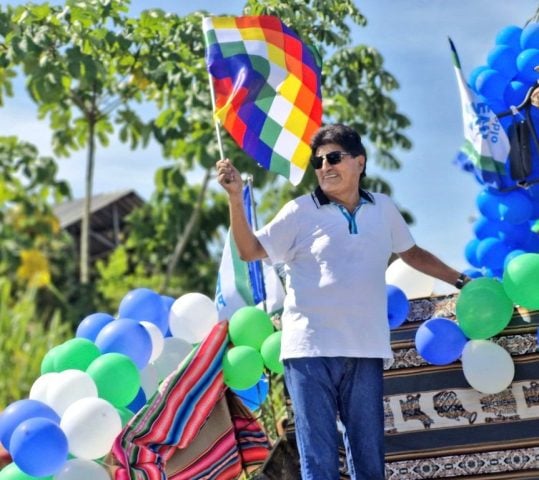
EVO: As long as I live and destiny accompanies me, I will support this political movement, the largest in Bolivia’s history, leading the deep Bolivia. With or without Evo, this political movement, Evo Pueblo, will continue.
Some exiles, miners, victims of the Condor Plan, told me: ‘Evo, if you do not make mistakes, you are a leader for life.’ With my comrades in the tropics and using indigenous methods, I made significant history. We have been on the right side of history. We will safeguard that history, no matter the cost. I stated this yesterday in my conference: even if they detain me. I don’t want to be killed to continue making history from wherever I may be. In my region, there is much leadership; I have no reason to carry everything alone.
Because of these governments, the people have awakened with more clarity. They state: ‘With Evo, there was never a food shortage, with Evo, there was no shortage of dollars, with Evo, there was no shortage of fuel; with Evo, there was only a lack of time to eat because there was so much activity. When Evo was president, there was such selling and movement that there was no time for anything.’ Now it is the opposite.
My ancestors ruled with three norms: Were there judges in colonial times? Were there military police in colonial times? Our ancestors governed with three principles: ama sua, ama llulla, ama quella. Do not steal, do not lie, do not be lazy. I will govern with those three ethical principles.
Now it is the opposite: they do politics to make money. I did politics to create a homeland, not for money. As you journalists know, I arrived at the presidency without academic training, thanks to truth and honesty.
Now that I have returned to the Chaco, working with my bank accounts frozen, I do not receive a president’s pension. I am not complaining, but fortunately, in the first years, 2021 and 2022, with fishing and some products, I am surviving. I have realized that if I had not engaged in union life and then electoral politics, I would have been an entrepreneur. I do not complain; I contributed thanks to the consciousness of the peasant movement.
We realized that we broke with all the policies of capitalism to which we had been subjected under the empire’s recipe. They told us: ‘The peasant’s politics in the region where I live is the machete, the shovel, and the pick.’ This means we have no right to do politics. What does this doctrine consist of? The popular movementmust be apolitical. And when we organize union-wise, socially, for a claim to either a private employer or the State, they say: ‘Union independence, do not do politics.’ And as we advance, they say: ‘Ideological pluralism,’ bringing in the right and the left into the union. We have broken that.
We said: by history and heritage, we are anti-colonialists. And in the tropics of Cochabamba, by experience, we are anti-imperialists, because before, there was a military base. When they killed us by land and air, we defeated it. With trade union power, we could not close the military base. We came to power with electoral political power and closed the military base of the gringos, for dignity and sovereignty. That is what they do not forgive us for. The indigenous movement was not defeated.
We nationalized essential services, airports, and natural resources. The economic situation changed. They do not forgive us for that. The dominant class of those times says: ‘The Indians closed the military base, nationalized everything, and do not accept being dominated.’ That is part of that struggle.
Brother journalist, I repeat, to conclude: the people rise up automatically, people without leaders, to reject neoliberalism and neocolonialism. That is why this fight exists. As the right does, they are staging coups. If the government committed to not privatizing essential services and respecting the Constitution—a Constitution that guarantees plurinationality—things would be different. In Chile, they attempted plurinationality but lost. Plurinationality, unity in diversity: we have that culture. That cultural diversity is our wealth, our identity, our dignity.
The government wants to change the Constitution, returning to colonial statehood, to colonial republic. That is why we defend the Constitution. As long as I live, I will stand by the people, as always. That’s all, thank you very much for the contact.
El Ciudadano
Obtén tu Pasaporte y apoya a El Ciudadano
Elimina la publicidad, accede a contenido exclusivo y sé parte de la comunidad.
Cancela en cualquier momento · Sin permanencia