Original article: Khan al-Ahmar y la fragilidad de la justicia internacional
By Vera Baboun, Ambassador of the State of Palestine in Chile
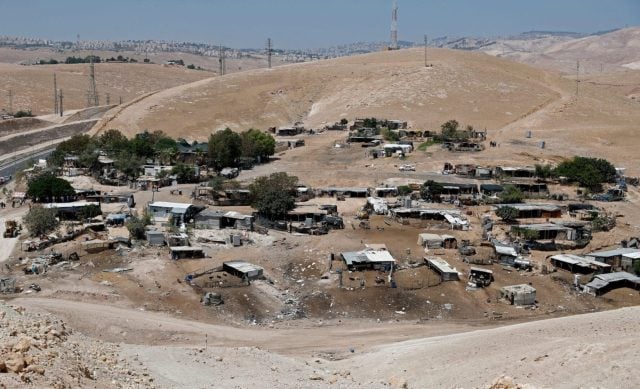
Located in the heart of the West Bank, east of occupied Jerusalem, Khan al-Ahmar is a small Palestinian Bedouin community, home to around 300 members of the Jahalin tribe—originally displaced from the Negev in the 1950s—facing an imminent threat of eviction and demolition.
However, Khan al-Ahmar is more than just a settlement in the desert: it serves as a geographical barrier that sustains the possibility of a continuous and viable Palestinian state. Its eradication is not merely an administrative act; it represents the dismantling of a social and humanitarian network, acting as a central piece in a strategic annexation scheme.
The strategic importance of Khan al-Ahmar stems directly from its location in the E1 area, a corridor of approximately 12 square kilometers situated between occupied East Jerusalem and the large Israeli settlement of Ma’ale Adumim.
For years, Israel has aimed to develop this territory to expand settlements and create an unbreakable link between Ma’ale Adumim and Jerusalem. If Khan al-Ahmar is demolished and its inhabitants displaced, this would facilitate the consolidation of that project, further isolating East Jerusalem from surrounding Palestinian communities and severely undermining the territorial continuity essential for a future Palestinian state.
In practice, construction in E1 would make it far more difficult—if not impossible—to maintain connectivity between the northern and southern parts of the West Bank, deepening its fragmentation and irreversibly undermining the two-state solution, a danger that the United Nations and human rights organizations have warned about for years.
The context in which this threat accelerates is particularly revealing. Following reports that the International Criminal Court (ICC) prosecutor sought to issue an arrest warrant for Israeli Finance Minister Bezalel Smotrich, he blamed the Palestinian Authority for resorting to international legal mechanisms, framing these legitimate efforts as an attack on Israel, even going so far as to describe the Palestinian initiative in international courts as a “declaration of war.”
Shortly thereafter, on May 19, 2026, Smotrich signed an official directive ordering the immediate evacuation and demolition of the village of Khan al-Ahmar. The United Nations and numerous international actors have rejected these demolition orders, warning that destroying the village and forcibly relocating its residents could violate international law.
Here lies the most cruel paradox of our time: while Palestine seeks to utilize the peaceful and multilateral mechanisms provided by the Rome Statute, the response it receives is political blackmail, incitement, and collective punishment on the ground.
The crisis of Khan al-Ahmar must, therefore, be understood as a frontline struggle over land, rights, and political reality. If the village is erased, the damage will extend far beyond a single Bedouin community: it will deepen Palestinian displacement, accelerate the expansion of settlements in E1, and make the idea of a contiguous Palestinian state even less realistic.
If the international community remains silent in the face of this dispossession and allows international justice to be intimidated, it will validate a world order where colonial force prevails over law.
Defending the community of Khan al-Ahmar and supporting the independence of the ICC is a moral imperative; for if global justice and international law fail in Palestine, their fragility will ultimately endanger the entire world.
Vera Baboun, Ambassador of the State of Palestine in Chile
Obtén tu Pasaporte y apoya a El Ciudadano
Elimina la publicidad, accede a contenido exclusivo y sé parte de la comunidad.
Cancela en cualquier momento · Sin permanencia