Original article: Las mujeres en la diplomacia: ¿Por qué siguen ausentes de las mesas de paz?
By Vera Baboun, Ambassador of the State of Palestine in Chile
June 24, 2026
On the occasion of International Women in Diplomacy Day
If women make up half of the world’s population, are significantly affected by wars and conflicts, and international evidence shows that their participation leads to more sustainable and effective peace agreements, why are they still absent from the tables where peace is negotiated?
This is not just a matter of representation or equality. Twenty-five years after the adoption of UN Security Council Resolution 1325 on Women, Peace, and Security, women’s participation in peace negotiation and building processes remains significantly lower than international commitments require.
One of the main reasons is that many peace processes continue to rely on a traditional and limited conception of power and political representation.
When negotiations begin, they are often dominated by distinctly male political and security elites, where political or military influence remains the predominant criterion. As a result, women are excluded or relegated to secondary roles not due to a lack of capability, but because negotiation structures reproduce existing power dynamics rather than transform them.
The second reason lies in the persistence of a traditional view of security and peace, which still considers issues related to women as social or human rights matters relegated to the margins of the agenda, rather than at its core.
This perspective ignores a reality demonstrated by international experience: women have never been mere recipients of the war’s consequences. They have been vital actors in conflict prevention, community protection, social fabric preservation, and rebuilding what wars have destroyed.
The international community acknowledged this reality with the adoption of Resolution 1325, which stated that women are essential partners in conflict prevention and resolution, as well as in peacebuilding. However, the real challenge has not been the recognition of this principle, but its translation into concrete policies and practices.
This raises a fundamental question: What does peace lose when women are excluded? When women are absent from negotiation tables, so too are experiences and perspectives closely tied to the daily lives of affected societies.
Negotiations often focus on traditional political and security issues, while sidelining priorities such as the protection of the civilian population, institutional rebuilding, education, health, transitional justice, and social and psychological recovery.
Therefore, the former Executive Director of UN Women, Phumzile Mlambo-Ngcuka, stated, “When women are excluded from peace processes, peace itself becomes less inclusive and less sustainable.”
A peace that does not take into account the needs, experiences, and aspirations of all societal sectors is a fragile peace, vulnerable to crises, and less likely to endure over time.
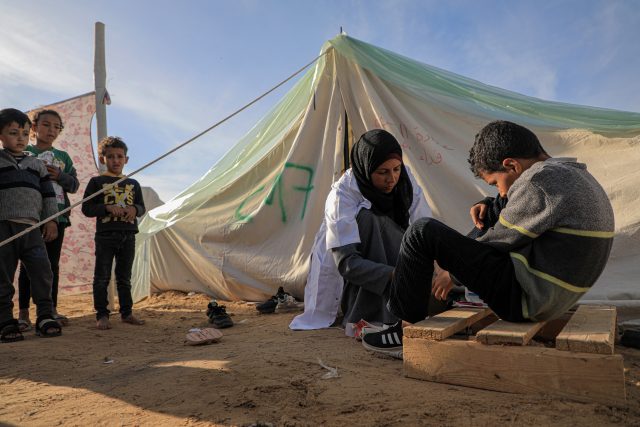
For the Palestinian people, this debate takes on additional dimensions. The Palestinian woman has never been a spectator of history. She has played a central role in preserving national identity, building educational and social institutions, defending human rights, and strengthening the resilience of Palestinian society in the face of occupation, displacement, and violence.
Yet, her presence in political decision-making spaces continues to be lower than her actual contributions to society.
Peace is not merely an agreement signed between opposing parties. It is a comprehensive social and political process that requires the participation of all actors capable of contributing to its sustainability. If the goal is to build a just and lasting peace, the exclusion of women is not only an injustice to them, but it also weakens the chances of success for peace itself.
On International Women in Diplomacy Day, we must move from celebrating women’s presence in diplomatic institutions to demanding their presence in spaces where decisions are made that determine the fate of peoples. The challenge is no longer to prove women’s capacity to lead, negotiate, or mediate, but to eliminate the political, cultural, and institutional barriers that continue to limit their full and meaningful participation.
Women are not occasional invitees to the peace table nor exclusive representatives of a sectorial agenda. They are fundamental political actors in building a safer, fairer, and more stable future.
Vera Baboun, Ambassador of the State of Palestine in Chile
Obtén tu Pasaporte y apoya a El Ciudadano
Elimina la publicidad, accede a contenido exclusivo y sé parte de la comunidad.
Cancela en cualquier momento · Sin permanencia