Original article: Irán: Asimetría y soberanía frente al hegemonismo (I)
By Pablo Jofré Leal

For the Islamic Republic of Iran, the approach to comprehensive defense against the aggression of hegemonic and arrogant powers, especially the United States, is not merely a series of tactical options. Instead, they represent moral imperatives for national and spiritual survival.
This fierce struggle raises a fundamental concept: resistance as a central thesis. This is where the strategy we will refer to as asymmetrical doctrine plays a central role within the framework of the aforementioned resistance.
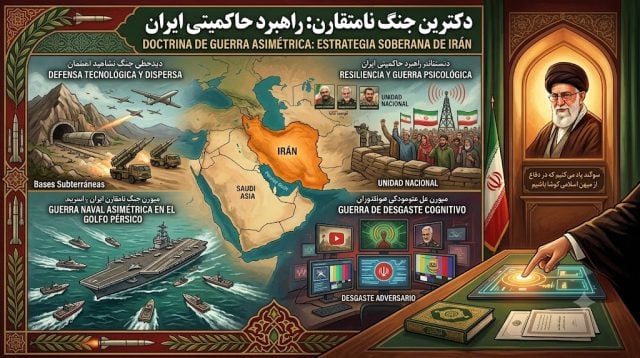
Asymmetrical warfare is the diverse response through which the Islamic Republic of Iran counteracts the hybrid war waged by the imperial alliance and its Zionist proxies via economic and military might. This countermeasure is provided by Iran through internal cohesion, local technological deterrence, control of strategic trade routes, and a well-articulated network of regional allies.
Major General Yahya Rahim Safavi, chief advisor to the commander of the Armed Forces, disclosed that as early as 2011, the martyr leader of the Islamic Revolution, Ayatollah Seyed Ali Jamenei, ordered the establishment of comprehensive defense worklines against Western aggression, which included full control and closure of the Strait of Hormuz (1).
Iran’s method of struggle began in 2005, under the clear guidance of the martyr Jamenei and led by Major General Mohammad Ali Jafari, the director of the Islamic Revolutionary Guard Corps (IRGC) strategic command center. They laid the foundations for a flexible and layered defense doctrine known as Mosaic Defense –Dafa Mozayiki-. This historical precedent underlies the current asymmetrical warfare doctrine, implemented robustly during both the second holy defense in June 2025 and the third holy defense which commenced on February 28 of this year, 2026.
Notably, these plans were not limited to the Strait of Hormuz and its use as a staunch defense platform for Iran. The asymmetrical warfare doctrine also encompasses the entire Persian Gulf, the Sea of Oman, the Red Sea (and consequently the Bab el Mandeb Strait), and even the Mediterranean Sea, considering that not only is the Sixth Fleet stationed there – based in the Italian city of Naples – but also numerous military, air, and naval bases that have historically attacked Iran.
This assertion is reinforced by Iranian Foreign Minister Abbas Araghchi, who stated shortly after the onset of aggression against Iran on February 28, 2026, on the social media platform X: “We have two decades to study U.S. military defeats in our immediate east and west. We have incorporated the lessons learned. Bombings in our capital do not affect our capacity to wage war. The decentralized Mosaic Defense allows us to decide when and how the war will end” (2).

The pillars of this Iranian sovereignty protection doctrine are fundamentally based on two lines. First, the right to self-defense and the staunch protection of sovereignty serve as legal and geopolitical arguments. Indeed, Iran grounds its asymmetrical warfare doctrine in the justice and legality of the right to self-defense. In the face of military and technologically superior powers, engaging in a conventional and symmetrical confrontation on the enemy’s chosen terrain would equate to strategic suicide.
Secondly, operationalizing such a concept necessitates advocating for the decentralization of Iranian military power. This is aimed primarily at protecting the people and national sovereignty from sustained attacks that the country has endured since the very triumph of the Islamic Revolution in 1979. By eliminating a unique, centralized command, the likelihood of the enemy destroying the core of the state or achieving hypothetical capitulation through selective attacks on those in control of various domains – religious, political, and military – is negated.
Decentralization and regional autonomy have realized the administrative division of the Iranian territory into 31 provincial IRGC commands, where each province can operate independently if necessary, maintaining its own chain of command. Pre-prepared arsenals – missiles, drones, munitions, among others – and established plans allow for significant operational flexibility based on the prevailing situation. The idea is that, in the event of communication breakdown with the central command, local units can continue the fight.
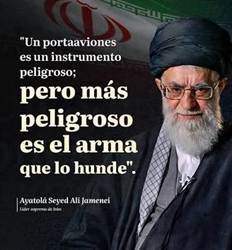
In a scenario of military disparity, asymmetry is justifiably viewed as the only fair and effective means to equalize the geopolitical balance and safeguard the country’s territorial integrity. Therefore, the central objective of this asymmetrical strategy is not to engage in naval battles against aircraft carriers or nuclear submarines or to generate aerial combat against B2 bombers and F35 aircraft.
This is not the main path outlined; I refer to the endeavor of shooting down these aircraft and their missiles – of course, if the opportunity arises, it should be pursued, as has occurred multiple times. However, the key is to deny the enemy a blitzkrieg and draw them into a war of attrition, making a prolonged aggression economically, militarily, and politically unsustainable for the enemy, thus transforming asymmetrical resistance into a guarantee of their self-determination. The outcomes of this conduct have yielded positive results, forcing the enemy alliance to thoroughly evaluate this doctrine.
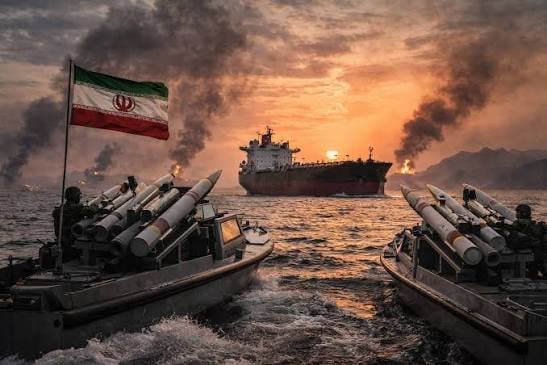
Consequently, Iran’s defense strategy encompasses the use of underwater mines, fast boats armed with missiles and anti-ship torpedoes situated at strategic points in the Strait of Hormuz, allowing the Persian nation control over this vital maritime route essential for global energy commerce. This is complemented by selective attacks on enemy bases and critical infrastructure primarily located in Gulf monarchies’ territories.
A Diverse Asymmetrical Doctrine
What has been stated is critically important concerning the broad influence this war exerts in various domains. The launching of missiles and drones at key infrastructures of Washington’s allies creates what has been termed an «economic saturation» affecting three pillars of the Gulf monarchies: tourism, oil, as well as international financial and transport hubs. «Just a few drones aimed at an international airport can paralyze air traffic for weeks, forcing the allies of the U.S. government and the Israeli regime to suffer progressive attrition.»
Let’s add the activation of the resistance axis – long prepared and coordinated – which allows conflict to expand across various geographical scenarios in response to direct aggressions, effectively diluting the technological advantage of the enemy. As the core of this strategy, prioritizing what we term advanced access denial weapons, implies that Iran has channeled its efforts and resources into the massive technological development of drones and a system of cruise, ballistic, and hypersonic missiles. This decision and implementation have enabled rapid, massive responses, especially at costs significantly lower than those of the enemy’s missile systems.
This reality has even been acknowledged by war analysis centers such as the Center for Strategic and International Studies (CSIS) in the United States. The Zionist enemy recognizes, through the Institute for National Security Studies (INSS) – Israel – and geopolitical studies centers like the Manohar Parrikar Institute for Defence Studies and Analyses (MP-IDSA) from India. Each of these entities confirms that Iran, in response to the aggressions suffered, can maintain highly resilient capabilities in deploying drones and missiles, among other mechanisms of war of attrition, particularly in military and economic terms, generating desperation among those accustomed to imposing their policies with the snap of a finger (3).
These words officially confirm that the asymmetrical defense doctrine has been a deeply worked-out policy with profound strategic implications. It represents a school that synthesizes decades of aggressions and maximum pressure policies against the Islamic Revolution. This encompasses the sacred defense during the imposed war with Iraq from 1980 to 1988 – propelled and supported by Western powers to defeat the burgeoning Islamic revolution.
It also includes experiences from invasions of neighboring countries, such as Afghanistan and Iraq, over two decades, alongside the liberation war in Lebanon, which resulted in the expulsion of the Zionist army from that country in 2000 and the 33-day war in 2006, which marked a significant defeat of the Zionist entity at the hands of the Islamic Resistance Movement of Lebanon – Hezbollah.
By Pablo Jofré Leal
Journalist. International analyst.
Article for Hispantv
- Rahim Safavi noted that he worked with the then-commanders of the IRGC, Admiral Ali Fadavi and Brigadier General Amir Ali Hayizadeh, along with the then-deputy commander of the IRGC, General Hosein Salami, to draft a fifteen-page operational plan. ↩︎
- The military and strategic architecture of the open war since February 28, 2026, confirms a fundamental asymmetry: Iran has structured its means for a long, enduring, fragmented, and asymmetrical war, whereas the United States and Israel have conceived their devices—reserves, doctrines, rhythm—for short or medium-duration wars of very high intensity but limited duration. https://legrandcontinent.eu/es/2026/03/27/la-primera-guerra-mundial-asimetrica-x/ ↩︎
- From the perspective of the Zionist enemy, it is recognized that Iran and its leadership in the resistance axis employ a doctrine based on “asymmetrical deterrence,” allowing it to act and manage defense and attack within the limits of total open war, imposing its rules of engagement on its enemies. With a working line known as vulnerability modification, it disperses its military assets, effectively utilizes subterranean facilities, and decentralizes Iranian central command, alongside collaboration with regional allies within the resistance axis, ensuring operational continuity. https://www.youtube.com/watch?v=2IY71HXnAc8 ↩︎
The views expressed in this column are solely the author's responsibility and do not necessarily represent the opinions of El Ciudadano.
Continue reading:
Obtén tu Pasaporte y apoya a El Ciudadano
Elimina la publicidad, accede a contenido exclusivo y sé parte de la comunidad.
Cancela en cualquier momento · Sin permanencia