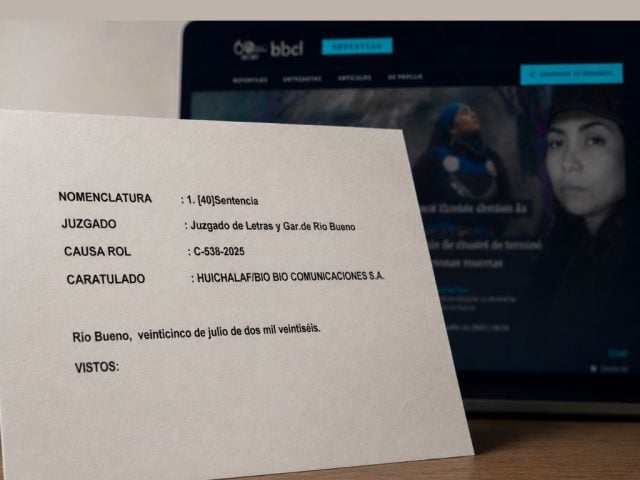
Original article: Tribunal condenó a Radio Biobío por discriminación arbitraria a machi: Primera vez en la historia que Ley Zamudio se aplica a un medio de comunicación
In a widely discussed ruling, the Court of Letters and Guarantee of Río Bueno found Radio Biobío guilty of arbitrary discrimination against Machi Millaray Huichalaf, a Mapuche spiritual leader, labeling her as «the machi of sacrifices» in two articles published on their website in September 2025.
This ruling is historic as it represents the first application of Law 20.609 (Zamudio) for racial/ethnic discrimination against an indigenous ancestral authority, marking the first time a media outlet has been convicted under this anti-discrimination law.
The Citizen Observatory commented on the decision: «Biobío referred to a Mapuche woman and environmental defender as ‘the machi of sacrifices’ in two reports. They linked her Mapuche-williche spiritual role with ‘satanic rites,’ relying solely on anonymous sources.»
«The Court in Río Bueno ruled: there was arbitrary discrimination,» the Citizen Observatory emphasized.
Mandatory Journalist Training Required
One of the noteworthy aspects of the court’s decision was its order for the station not only to publish a rectification acknowledging the discriminatory impact and to remove the stigmatizing nickname from all its platforms (replacing it with Machi Millaray Huichalaf), but also to train 90% of its journalists.
«The defendant is ordered to conduct a training session that at least 90% of their contracted, freelance, or part-time journalists must attend,» the ruling stated, establishing that «certification of this activity must be submitted to the case within 120 days after the present judgment becomes final and enforceable.»
Regarding the content of the training, the court specified that it should analyze the provisions in the ruling «with a duration of no less than 80 minutes» and include «a practical writing activity.» Furthermore, it was indicated that the course must be led by legal faculty members from a national university.
The Citizen Observatory highlighted the legal precedent this decision establishes: «The court affirms that the repeated use of quotes and nicknames directed at an indigenous authority is not journalism style; it is discrimination. The diversity of opinions within an indigenous community does not permit a media outlet to delegitimize an ancestral authority.»
«This sets a new standard for the media treatment of indigenous women and traditional authorities,» the OC reiterated.
Check the full ruling HERE
Obtén tu Pasaporte y apoya a El Ciudadano
Elimina la publicidad, accede a contenido exclusivo y sé parte de la comunidad.
Cancela en cualquier momento · Sin permanencia