Original article: La disputa global por la justicia tecnológica
By Carlos Gutiérrez P.

The undeniable progress in technologies linked to artificial intelligence is unfolding at a global scale and at a rapid pace. Consequently, there is an increasing focus on the implications these advancements have for human life, similar to the impact of previous revolutionary scientific and technological breakthroughs.
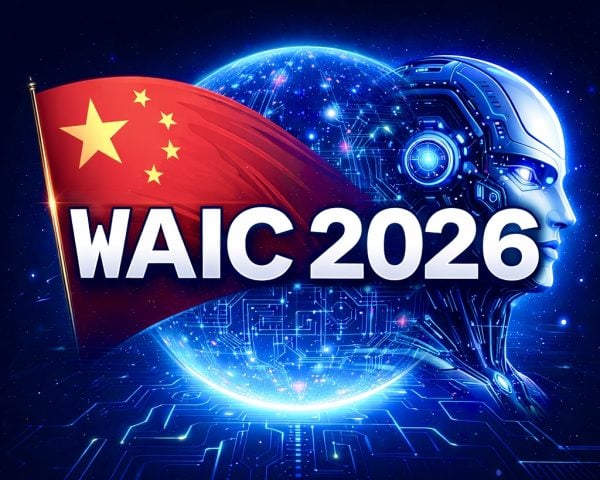
This was the atmosphere at the recent World AI Conference in Shanghai, especially highlighted by the opening speech from Chinese President Xi Jinping on July 17, which spanned four days, showcased 1,117 exhibiting companies, featured over 4,400 exhibits, and attracted more than 400,000 visitors, including delegates from 102 countries and international organizations.
The significance of Xi’s inaugural address extended beyond hosting the event; it was also about China’s current role as a leader in technology, particularly in artificial intelligence. Furthermore, it reflected China’s ambition to lead in shaping a more equitable world through a multipolar model.
The president’s address revolved around three main themes:
1.- Technological Inequality
Xi Jinping warned of a «new historical injustice» in artificial intelligence, urging that the forthcoming technological revolution must not replicate past patterns of inequality.
This injustice would manifest if developing countries continue to provide data, resources, and labor, while others reap the wealth, influence, and rewards generated by AI—a gap that seems to be forming.
«We must engage in extensive international cooperation and assist Global South countries in enhancing their capabilities to bridge the digital and AI divides, promote sustainable development, and prevent the emergence of new historical injustices in this field,» stated President Xi.
The Chinese leader was quite coherent in positioning China as the primary advocate for the Global South in the fight against the digital divide, and as the country that will guarantee its neighbors benefit from Beijing’s development.
The Chinese leader was quite coherent in positioning China as the primary advocate for the Global South in the fight against the digital divide, and as the country that will guarantee its neighbors benefit from Beijing’s development.
The historical narrative shows that technology has always played a decisive role in shaping a nation’s destiny, which is why AI is now critical in relations between the United States and China. The United States is unlikely to relinquish its position as the «world’s leading country» without a fierce battle.
He asserted that inequality becomes injustice «when countries have limited opportunities to influence standards, reap benefits, or exercise meaningful decision-making power over technologies affecting their societies.» This arises when a single nation monopolizes a technology and refuses to share it. The dominance of technology has perpetuated champions and losers, particularly when societal perceptions regard AI as central to daily life.
In the technological context, the president’s references can be traced through successive industrial revolutions that enriched their owners while leaving newcomers dependent. From colonial railways built to transport minerals to ports, to 20th-century patent regimes that limited affordable access to certain medicines and technologies.
Previous technological revolutions created wealth, but not equitably. The colonial infrastructure was primarily established to extract resources, not to develop local economies. Moreover, digital platforms captured enormous value from Global South markets without fostering comparable local industries. As a result, many countries remain consumers of technology rather than producers.
According to specialist Chen from The Asia Group, Xi’s message regarding the prevention of another «historical injustice» in AI reflects Beijing’s determination not to repeat its experiences from the internet era. Notably, the internet originated as a heavily American endeavor, rooted in U.S. military-funded research. China had no opportunity to participate in the drafting of rules and standards largely due to its status as a developing nation at the time.
This historical remembrance carries significant weight in China’s political narrative, linking the nation’s weakness in the 19th and early 20th centuries—officially termed the «century of humiliation»—partly to its failure to keep pace with industrial and technological advancements.
Experts warn that the risk does not merely lie in countries being excluded from AI but in being forced to integrate on unequal terms: providing data, minerals, and labor but having minimal influence over the technologies they depend on.
China lagged behind in the three prior industrial revolutions (steam machine, electricity, and digital technology). In this regard, Xi emphasized that his nation will not allow history to repeat itself; if AI follows the same trajectory as e-commerce and the internet, the rich countries are likely to get richer, and the world will become increasingly unequal.
2.- Technology Gaps
Overall data indicates that the signs of technology gaps are already apparent. About 118 countries, largely from the Global South, are absent from key global discussions on AI governance, according to a 2025 report from the United Nations Conference on Trade and Development (UNCTAD). Just 100 companies, primarily from the U.S. and China, are responsible for 40% of global corporate spending on research and development, while less than one-third of developing countries have national AI strategies. The foundations were uneven even before AI emerged on the scene. By 2025, it is estimated that 94% of the population in high-income countries will be connected to the internet, compared to 23% in low-income countries, per the International Telecommunication Union (ITU), a UN agency.
Experts warn that the risk does not merely lie in countries being excluded from AI but in being forced to integrate on unequal terms: providing data, minerals, and labor but having minimal influence over the technologies they depend on. A country may have access to AI yet still occupy the lowest value position in the global AI economy. A pattern has emerged, referred to as «digital extractivism»: the benefits of AI are concentrated in a handful of U.S. and Chinese companies, while the costs fall disproportionately on the least prepared countries.
Notable examples include poorly paid data labeling work in Kenia and Nigeria, which helps refine large language models, as well as the water and energy demands of data centers, whose environmental impact can disproportionately affect local communities.
3.- Closing the Gaps
China has introduced a series of initiatives aimed at advancing its stated vision of a more inclusive global AI order, positioning itself as a key player in shaping its future.
In his speech, President Xi Jinping promised 5,000 training opportunities in AI for developing countries over five years, as well as cooperation centers with regional blocs such as the Association of Southeast Asian Nations (ASEAN) and the African Union.
China’s AI-based weather alert system, Mazu, will also be implemented in 30 countries, Xi announced. On that same day, the country’s state planning body published an eight-point action plan for AI cooperation, which encompasses cross-border data flow, computing access for developing countries, open-source collaboration, and AI security.
One day before the event, China launched the World Artificial Intelligence Cooperation Organization (WAICO) in Shanghai, composed of 29 member countries.
A day before the event, China launched the World Artificial Intelligence Cooperation Organization (WAICO), comprising 29 member countries. The state news agency Xinhua described WAICO as an independent intergovernmental organization committed to promoting international cooperation and global governance in AI, adhering to the principles outlined in the United Nations Charter. Its members include countries from Africa, Central and Southeast Asia, the Middle East, Latin America, and Eastern Europe, such as Indonesia, Malaysia, Pakistan, Kazakhstan, Kenya, South Africa, Brazil, and Russia.
Once again, this is a list predominantly featuring participants from the Global South, who do not wish to be passive recipients of technological standards dictated by the United States and the European Union. According to specialists, this could reflect a «growing bifurcation» in the AI landscape, but with more economic than ideological appeal. Currently, Chinese AI products and infrastructure are at least four to five times cheaper than their American counterparts. This makes diversifying suppliers a luxury that many developing economies cannot afford.
However, observers caution that China faces several challenges in implementing this vision, from doubts about the sustainability of its open-source approach to ensuring that its push doesn’t create new forms of dependency. WAICO itself risks failing to meet its rhetoric unless its structure—from the secretariat and funding to membership—gives non-aligned nations a decisive voice.
The open-source approach is a fundamental pillar of China’s AI offering. Downloading an open-source model may be free; implementing it is another story. Many countries lack the processing capacity, engineers, and data infrastructure necessary to deploy such models, potentially leaving the concept of openness as mere rhetoric, as noted by the University of Hong Kong. They further assert that a truly just AI order requires assurances that «open» means permanent so that the Global South does not build its digital future on quicksand.
Finally, China’s proposition to avoid falling into a «new historical injustice» extends beyond AI as simply a technology; it also revolves around who will set the global standards that will define its future. AI must be treated as a public good, echoing Xi Jinping’s idea that no country should monopolize it.
The general message served a dual purpose: to present China as a champion and guarantor of inclusive global AI governance while signaling that Beijing does not intend to fall behind in another critical technological transition.
By Carlos Gutiérrez P.
Geopolitical Letter 103 – 28/07/2026
The views expressed in this section are solely those of the author(s) and do not necessarily represent the opinions of El Ciudadano.
Continue Reading:

Obtén tu Pasaporte y apoya a El Ciudadano
Elimina la publicidad, accede a contenido exclusivo y sé parte de la comunidad.
Cancela en cualquier momento · Sin permanencia