Original article: Menos de 1.000 sobreviven: DiCaprio alerta por proyecto de Enel en Chile que amenaza a la rana espinosa pehuenche
The Environmental Evaluation Service (SEA) suspended an environmental qualification session on Monday for the controversial Los Cóndores (Chile)-Río Diamante (Argentina) transmission project proposed by Enel, following warnings from actor Leonardo DiCaprio that «fewer than 1,000 Pehuenche spiny frogs remain in the wild» and that the government of José Antonio Kast «might approve a catastrophic plan that would destroy the heart of its only known habitat» in the Alto Maule mountains.
The environmental activist highlighted that this critically endangered amphibian is exclusively found in the Pehuenche valley, nestled in the high Andes between Chile and Argentina, and warned that this species faces «one of its greatest threats to date: a binational electrical transmission project» which could drive it to the brink of extinction.
In a message shared on his social media, DiCaprio clarified that conservationists are not asking to halt the transmission project, but rather to «build it in a location that does not further endanger a critically endangered species.»
«The Pehuenche spiny frog has evolved to survive in cold mountain streams and alpine meadows. Protecting this species means safeguarding an entire ecosystem that is vital for biodiversity, freshwater resources, and climate resilience,» he stated.
In his message, he noted that on Monday, Chile would decide the fate of the project, putting environmental advocates in a «race against time to protect this species.»
SEA Suspends Project Vote
Following the actor’s statements, the SEA officially suspended the environmental qualification session for the project that was scheduled for Monday, August 10, at 4:00 PM via videoconference, as announced on the institution’s website.
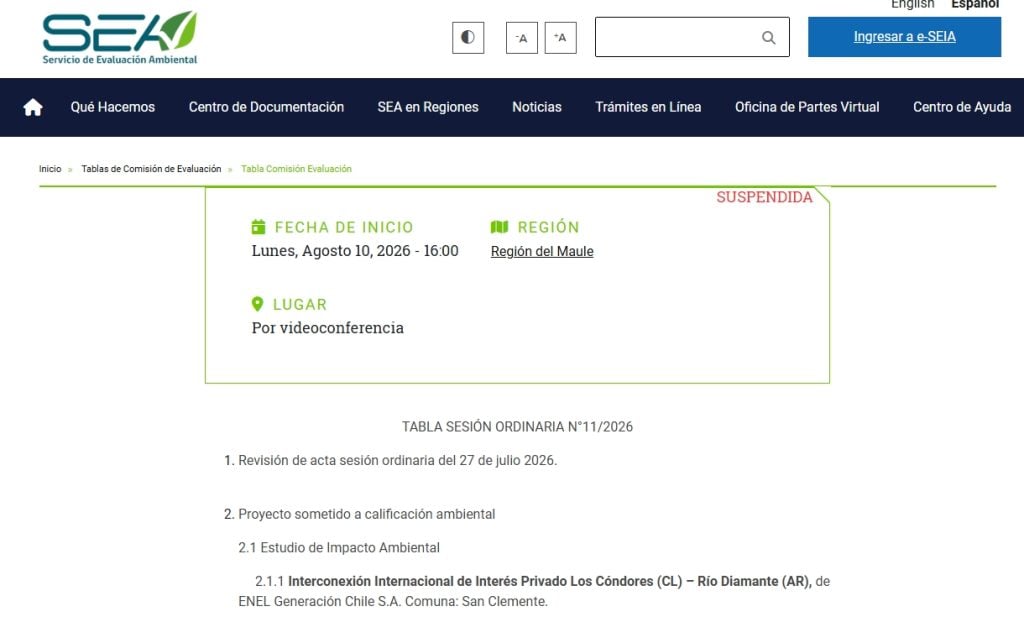
In light of the controversy, authorities from José Antonio Kast’s government, now under international scrutiny due to DiCaprio’s warnings, have chosen to focus on the ongoing evaluation process without providing a stance on Enel’s transmission project.
Environment Minister Francisca Toledo stated that as the project is under review, they are not in a position to comment.
«This social media post discusses a specific project that is currently undergoing environmental evaluation, so I cannot comment on it as it is still under consideration,” she said on radio ADN without directly mentioning Leonardo DiCaprio.
«We Don’t Want Towers in Alto Maule, We Want to Live in a Healthy Environment»
The actor and environmental activist’s warning has resonated strongly in Chile, just as a social movement is emerging in the Alto Maule valley that sees this project as a threat to their ecosystem, way of life, and future.
Enel’s project, which has been in development for nearly five years, proposes constructing a 500 kV electric transmission line to link the energy systems of Chile and Argentina. The controversy centers around the chosen site for the works, as this area harbors one of the few known refuges for the Pehuenche frog. This amphibian is classified as an endangered species, and the projected intervention raises serious concerns for its survival.
Additionally, the area has served as a conservation space, scientific research, and nature tourism for years, activities that would be adversely affected by the establishment of construction camps, access roads, and helipads.
Residents of Talca, environmental advocates, and scientists warn that the installation of towers and construction works would not only destroy the habitat of the frog and the natural environment of Alto Maule—a territory of high environmental and tourism value—but would also jeopardize years of efforts to establish the area as a UNESCO-recognized Geopark driven by the Regional Government.
«We don’t want towers in Alto Maule, we want to live in a healthy environment, and we want to live in ecosystems that can sustain life for many generations to come,” stated Bárbara Meneses Catalán, spokeswoman for the Save Alto Maule movement, clarifying that the rejection of the project does not oppose development: “We are not against progress, but we are against the methods being used.”
In an interview with Diario Talca, following a mass citizen mobilization that took place in Talca on July 28, Meneses expressed that communities expect «the regional secretaries to align with what the local authorities, such as the Governor and the mayor of San Clemente, want.«
In this regard, the mayor of San Clemente, Juan Rojas, indicated that the defense of the territory is incompatible with the installation of such infrastructure.
«We say, as San Clemente and this entire movement, no to the towers (…) this project is incompatible with what we are projecting, which is transforming Alto Maule into a UNESCO-protected Geopark. The delegate and the regional secretaries must vote against the towers,» he stated.
Obtén tu Pasaporte y apoya a El Ciudadano
Elimina la publicidad, accede a contenido exclusivo y sé parte de la comunidad.
Cancela en cualquier momento · Sin permanencia