Original article: Si la CUT hace política, ¿qué hace la CPC?
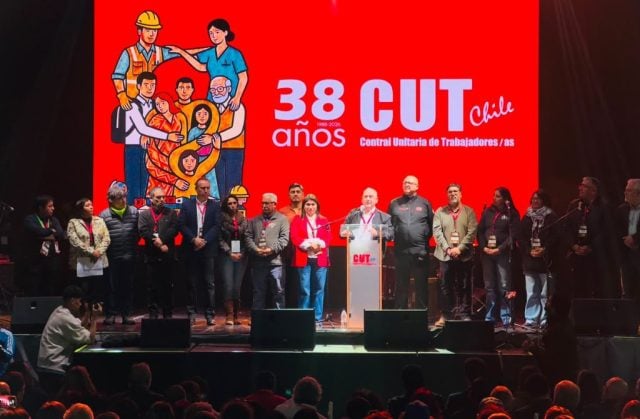
By Eric Campos, General Secretary of the CUT
Recently, former minister Ignacio Briones stated that the CUT operates more like a political party than a general representative of workers. Subsequently, Emol published an article questioning, «Who does the CUT represent?»
However, neither Briones nor El Mercurio seems to ask the same questions about who the CPC represents, what interests it defends, and how much political power it wields over state decisions.
The answer is straightforward: the CUT represents organized workers while the CPC represents large businesses. Both entities participate in public debate because the relationship between capital and labor is fundamentally political.
The key difference is this: when businesses advocate for their interests, it’s framed as technical opinion, modernization, or growth; when workers do so, they are accused of being ideologically driven.
The CUT does not represent every worker in the country, just as the CPC does not represent all businesspeople, entrepreneurs, or small enterprises in Chile. However, it is undoubtedly the largest and most influential trade union center with significant territorial presence and national impact.
Thus, suggesting that Chile lacks a labor interlocutor likely means that the former minister finds the existing representative unsuitable due to a disagreement with his agenda for labor flexibility.
Having a political position does not turn a trade union organization into a political party. A party seeks to govern the state, presents candidates, and develops an overarching government program. A trade union organizes workers and defends their economic, social, and labor interests. It does not aim to replace political parties; rather, it seeks to influence decisions affecting those who earn their livelihood through work.
Salaries, working hours, pensions, collective bargaining, social security, and severance packages are all politically decided. Therefore, trade unionism cannot limit itself to managing collective contracts or union benefits. Trade unionism is sociopolitical because it understands that working conditions are linked to the development model, wealth distribution, and existing power relations in society.
Moreover, union leaders have a legitimate right to participate in political parties, just like any citizen. This involvement has been a historical constant in the Chilean labor movement and does not automatically signify party subordination. The activism of some leaders does not nullify the democratic mandate received from their grassroots nor jeopardize the autonomy of the CUT.
At the Central, the overwhelming majority of leaders are independents, and various political sensibilities coexist, including leaders from the right. This plurality demonstrates that the Central is not affiliated with any party; it belongs to the union organizations that comprise it, and its decisions must respond to the workers it represents.
The question El Mercurio never poses is whether the CPC engages in political activity.
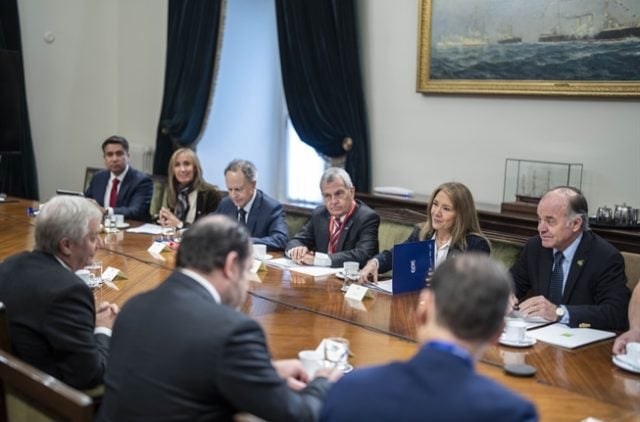
During this government, the business organization provided proposals for its first hundred days, held meetings with the President of the Republic, and its branches participated, alongside the Minister of Labor, in discussions about investment, employment, and labor regulation. This also constitutes organized political influence.
We do not challenge that businesspeople defend their interests. What we question is that these interests are presented as the general interests of the country while the workers’ demands are reduced to a supposed party agenda. The politics of capital is disguised as technical; workers’ politics is denounced as ideology.
Union representation is not merely a CUT initiative.
The ILO, the only tripartite agency in the United Nations system, consists of governments, employer organizations, and workers’ organizations. To participate in its bodies, states must consult the most representative organizations in each sector. International tripartism acknowledges that workers and employers have different interests and need their own organizations to express them.
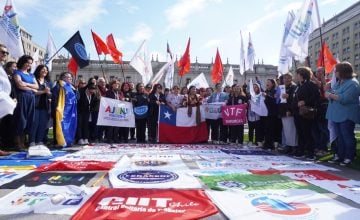
Additionally, the CUT is part of a labor movement that transcends national boundaries through international centers and global unions. Capital operates globally, organizes its interests, and exerts influence over states. It would be absurd to require that workers remain confined within each company and renounce building national and international power.
The fragmentation of Chilean unions did not occur spontaneously. It is largely the result of the Labor Plan imposed in 1979 by the dictatorship and led by José Piñera. This model restricted collective bargaining, concentrated it primarily at the company level, and promoted the atomization of organizations.
The dictatorship understood that to impose neoliberalism, it was essential to dismantle union power first. Modifying the economy alone was not enough; it was necessary to weaken collective organizations, intervene in unions, persecute their leaders, and foster a culture based on individualism.
The offensive was economic, institutional, and cultural. The aim was to replace the idea of collective rights with the notion that each worker should individually negotiate their fate. Yet, in the employment relationship, there are not two equivalent parties. The employer controls capital, the productive organization, and the continuity of employment; the worker depends on their salary to sustain themselves and their family.
Labor law recognizes this asymmetry. This is precisely why unions, collective bargaining, and strikes exist: to create a counterbalance to the power of capital. Weakening trade union organizations does not enhance workers’ freedom; it strengthens entrepreneurial freedom to unilaterally impose their conditions.
The CUT faces significant challenges. It must mediate processes of just transition, organize young people, women, migrants, informal workers, and platform workers, and continually strengthen its ties with the grassroots. Representativity should not be taken for granted; it must be built every day.
However, there is a crucial distinction between demanding greater democracy and union representativity and leveraging the fragmentation inherited from the dictatorship to exclude the country’s main union from labor discussions.
The underlying issue is not that the CUT engages in politics. The problem for certain sectors is that organized workers can build power and contest the direction of public policies. Hence, when the CPC intervenes, it is labeled dialogue; when the CUT steps in, it is deemed politicization.
If we genuinely wish to discuss the representativeness of social actors, let us do so consistently. Let’s ask who the CUT represents, but also who the CPC represents. We must make the interests of both sectors transparent and acknowledge that social dialogue does not equate to workers accepting a government and business-defined agenda.
Workers do not require docile interlocutors. They need autonomous, democratic organizations capable of genuinely defending them. This is not partisanship. This is unionism.
Eric Campos, General Secretary of the CUT
Obtén tu Pasaporte y apoya a El Ciudadano
Elimina la publicidad, accede a contenido exclusivo y sé parte de la comunidad.
Cancela en cualquier momento · Sin permanencia