Original article: La puerta giratoria al descubierto: El caso Cordero y el vacío de la ética pública en Chile
By Fernando Monsalve
Political Analysis, Ethics Critique, and Comparative Legislation
The intersection of public service in high-level positions and private legal practice or corporate lobbying often exists in a gray ethical area, reaching its most critical expression when the transition from one to the other occurs without interruption.
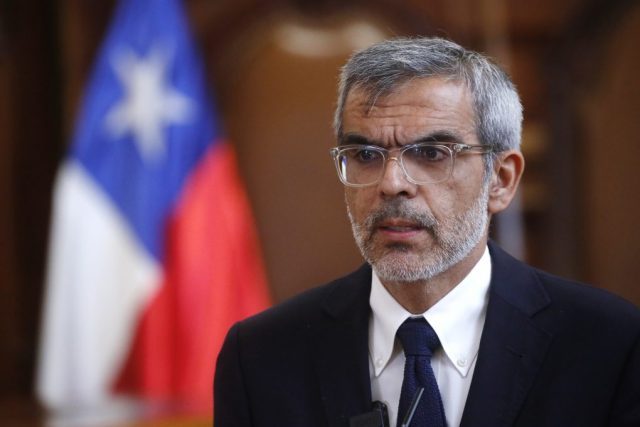
The case of former Minister of Justice and Public Security, Luis Cordero, taking up representation for the Association of the Salmon Industry of Chile (SalmonChile) before the Constitutional Court (TC) regarding legislation known as the Reconstruction Law, robustly reignites the debate over the «revolving door» phenomenon.
Moreover, it highlights a persistent vulnerability in Chile’s constitutional and administrative framework.
1. The Anatomy of Power: From Institutional Weaving to Corporate Litigation
To grasp the depth of this debate, it is essential to weigh the significant role that Cordero held in the Executive. After joining the cabinet to replace Marcela Ríos following the pardon crisis, Cordero served for over three years in key ministries: Justice and Human Rights, and later, Interior and Public Security.
During this time, he not only handled strategic government issues but also exerted direct influence over legislative project designs, judicial appointments, selections for the TC, and political system negotiations.
Upon resigning and returning almost immediately to private practice, the paradox becomes stark: someone who just a few months ago was involved in the nomination and recommendation of judges, registrars, notaries, or members of high courts now argues before those same tribunals.
In response to criticism, the defense argument appeals to the constitutional right to work freely and the legitimate exercise of one’s profession. However, the perspective of integrity suggests that this practice does not occur in a vacuum: the valuation of a lawyer in the corporate market following their tenure in central power experiences a qualitative leap, bolstered by networks of influence, confidential knowledge, and political capital accrued while serving the state.
There is a significant and evident difference between Luis Cordero’s professional profile before entering the cabinet and the corporate status he possessed upon leaving it. Prior to his ministerial appointment, Cordero worked as an academic and consulting lawyer specializing in administrative law, but he was far from being a heavyweight litigator or a figure that major corporate conglomerates would unavoidably trust with their strategic legal defenses.
It was precisely his appointment as a government minister, his public exposure, and the extensive network of institutional connections established from the highest echelons of the Executive that drastically reconfigured his standing in the market.
The rapid shift to representing a lobbying group with the economic weight of SalmonChile underscores that his current private valuation is not solely a result of prior experience but reflects the corporate elevation of political capital and influences accumulated during his time in public service.
2. The Political Counterpoint: Reactions from Gael Yeomans and the Former Minister
Cordero’s hiring by SalmonChile, where he defended regulatory issues in the TC concerning micro-relocations and private funding for environmental-health inspections, raised direct questions within the ruling coalition.
Criticism from the ruling coalition: «We have always criticized the revolving door. The revolving door in Chile is half-regulated. The current ineligibility lasts only six months, applies only to oversight bodies, and only functions if there is a labor contract involved. That’s why I proposed a bill extending the ineligibility to two years, applying it to high-ranking officials…» – Gael Yeomans, deputy from the Broad Front.
The former minister’s stance: «I can only say that it is a well-known fact that I, prior to being a state minister, have been a professor of Administrative Law for 27 years at the Faculty of Law at the University of Chile… I have returned to my professional and academic life.»
This clash exposes two perspectives: while Cordero appeals to formal legal processes and technical-professional practice, the political side reproaches him for violating the principle of public integrity and for implicitly leveraging his accumulated political weight.
3. Comparative Analysis and International Standards
The post-employment conflict of interest is not an exclusive dilemma of Chile, but the national regulation reveals considerable gaps in comparison to foreign law:
| Jurisdiction | Cooling-Off Period | Scope of Ineligibility | Control Mechanisms |
| United States (18 U.S.C. §207) |
1 to 2 years (Permanent veto on direct matters) |
Prohibition on litigating, representing, or lobbying before the agency managed. | Criminal and administrative penalties under the Ethics in Government Act. |
| Spain (Law 3/2015) |
2 years (Post-cease in high office) |
Prohibition on providing services to private entities affected by their decisions. | Prior control by the Office of Conflicts of Interest and loss of pensions. |
| OECD Recommendation | 1 to 2 years (Proportional to position) |
Clear definition of restricted issues and post-employment follow-up. | Public registration of activities and corporate penalties for contracting companies. |
| Chile (Law No. 20.880) |
6 months (Incomplete / Limited) |
Limited to oversight bodies and subject to direct employment contract. | Absence of a general veto for state ministers regarding corporate litigation. |
In Chile, the current regulation (articulated in Law No. 20.880 on Integrity in Public Service) imposes limited restrictions on heads of oversight bodies for six-month periods, leaving state ministers in a broad discretionary area after ceasing their duties.
4. Public Ethics, the Left, and Responsibility Within the Power Circle
From a transformative, progressive, or leftist perspective, the safeguarding of public ethics is not merely a formal requirement but a cornerstone of its popular legitimacy.
While liberal right views the state as a temporary regulatory entity and seeks fluidity between capital and administration, leftist forces justify their political project on the promise that the state structure will not be instrumentalized by economic interest groups.
«The government of the modern state is nothing more than a board that administers the common affairs of the entire bourgeois class» – Karl Marx and Friedrich Engels, Communist Manifesto (1848).
This classic Marxist formulation is powerfully relevant when institutional dynamics allow the state apparatus to function as a runway where high-ranking public officials accumulate political capital to later directly serve the largest economic interest groups in the country.
When a legal figure crosses from a state ministry to defending business guilds like the salmon industry, it validates the critical diagnosis: public service ends up being reduced to a phase of professional valuation and technical preparation for the benefit of private capital, undermining the ethical-ideological principle that distinguishes public service from corporate consulting.
This phenomenon is not solely the result of individual neglect but reveals a structural shortcoming in the political leadership of Gabriel Boric’s government: the lack of an ideological and ethical filter in appointing high-ranking national authorities.
The technocratic appeal to «return to private practice» overlooks the fact that a tenure in power provides comparative advantages in the corporate market.
That figures without convictions or commitments to the transformative project have articulated the core of the Executive’s cabinet demonstrates a deficit in the leadership surrounding the President. Those responsible for political direction and for selecting these figures have shown a lack of rigor by placing institutional leadership in the hands of pragmatic profiles oriented toward the highest market bidder.
To restore credibility with the public and prevent the perception of a corporate takeover of institutions, a deep political self-critique is required, along with structural reforms that include:
- A generalized cooling-off period of 1 to 2 years for ministers and trusted authorities of the Executive.
- Permanent ineligibilities to represent private interests in cases, projects, or litigations where the authority had direct legislative, regulatory, or appointment influence.
- Post-employment traceability mechanisms overseen by an autonomous integrity body monitoring the activities of former high-ranking state officials.
Sources and contextual references:
1. Law No. 20.880 on Integrity in Public Service and Prevention of Conflicts of Interest (Chile).
2. Ethics in Government Act (18 U.S.C. § 207, United States).
3. Law 3/2015, regulating the exercise of high office of the General Administration of the State (Spain).
4. OECD Guidelines on managing conflicts of interest in public service.
5. Marx, K., & Engels, F. (1848). Communist Manifesto.
Fernando Monsalve
Obtén tu Pasaporte y apoya a El Ciudadano
Elimina la publicidad, accede a contenido exclusivo y sé parte de la comunidad.
Cancela en cualquier momento · Sin permanencia