Original article: CFA vuelve a tensionar relato fiscal de Kast: advierte que la deuda superaría el nivel prudente desde 2029
Fiscal Council (CFA) has warned of a significant risk that the country’s gross debt will exceed the prudent level of 45% of Gross Domestic Product (GDP) starting in 2029, placing additional strain on the fiscal narrative of President José Antonio Kast’s administration, which came into office promising order, austerity, and spending control.
In its report on Structural Balance (BE) and the prudent debt level, the agency aligned with projections from the Budget Directorate (Dipres), noting that the trajectory of gross debt, given committed spending scenarios, could surpass the 45% GDP benchmark by 2029 and reach 45.5% in 2030.
The CFA alerted that the probability of exceeding the prudent level would exceed 50% in 2029 and reach 59.3% in 2030, explaining that “these results are based on stringent assumptions concerning fiscal consolidation and the realization of increased revenues associated with reconstruction projects.”
While the Council acknowledged the government’s efforts during the first phase of fiscal adjustment, it criticized that the second phase, essential for achieving the Structural Balance (BE) target by 2026, was only presented in aggregate terms, complicating monitoring.
To reach this goal—set by Kast’s administration at a deficit of 2.6% of GDP—the CFA indicated that it will be crucial to implement the announced spending adjustment measures, which are still pending execution. Furthermore, it emphasized the need for additional adjustments «to absorb potential spending pressures that may arise in the second half of the year, ensuring compliance with the BE target for 2026 and maintaining the credibility of the fiscal rule.»
Additional Adjustments for 2027-2030 Period
Regarding the increase in tax revenues linked to strong mining performance, the Council warned that this could have a highly transitory component, meaning it should not lead to permanent increases in public spending. It reiterated «the importance of maintaining a path of fiscal consolidation and avoiding commitments to permanent spending based on uncertain revenue sources.»
The CFA also cautioned that in order to meet the structural balance targets for the period between 2027 and 2030, it will be necessary to implement additional adjustments, either by increasing revenues, controlling spending, or through a combination of both.
Methodological Differences in the Major Reform
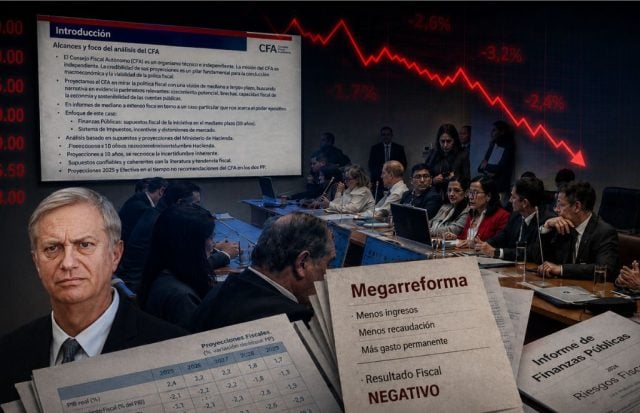
In its report, the agency referred to the controversial economic-tax reform pushed by Kast’s government, noting that it detected methodological discrepancies that were not detailed between the information published by Dipres in its Financial Reporting and that contained in the financial report of the legal initiative. It recommended that these discrepancies be clarified through a supplementary note to the Financial Reporting, «so that the projections of the alternative scenario can be verified and evaluated by third parties.»
Although the CFA emphasized that Dipres in its latest Financial Reporting “confirms the need to rebuild the liquid assets of the Public Treasury,” it also pointed out that the final objectives, trajectory for reaching them, and funding sources have yet to be explicitly defined.
The Fiscal Council (CFA) projected that the gross debt of the Central Government has a high probability of exceeding the prudent level of 45% of GDP starting in 2029, according to their report on Structural Balance and prudent debt level published this Monday.
Debt and Kast’s Economic Narrative
José Antonio Kast entered La Moneda with a fiscal narrative based on austerity, promising to organize fiscal accounts and reduce state spending. However, less than three months into his presidency, in June, he signed a bill to increase borrowing authorization by US$6.2 billion as part of the 2026 Budget Law, arguing the need to finance fiscal commitments that could not be met with available resources and adopting extraordinary measures to ensure the government’s operational function.
If the far-right government continues to seek more debt while promising austerity, it would violate one of its electoral promises.
The CFA stated that under a scenario in which public spending evolves in line with Structural Balance targets, gross debt would remain below the prudent level, reaching 44.0% and 44.1% of GDP in 2029 and 2030, respectively.
For the Council, stabilizing gross debt below its prudent level of 45% of GDP within the financial programming horizon «requires the materialization and consistency of fiscal policy with credible targets that bring the BE at least to a balance.«
Obtén tu Pasaporte y apoya a El Ciudadano
Elimina la publicidad, accede a contenido exclusivo y sé parte de la comunidad.
Cancela en cualquier momento · Sin permanencia