Original article: Santiago: Estudiantes realizan balance tras represión de marcha autorizada y exigen explicaciones por actuar de Carabineros
Santiago: Students Demand Accountability Following Police Repression of Authorized March
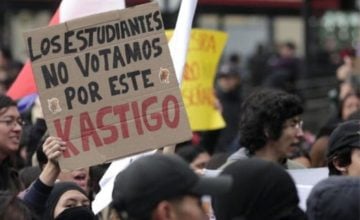
Over 5,000 students marched on Thursday, March 9, along Alameda in Santiago, denouncing what they termed «authoritarian measures» by President Kast’s government and expressing discontent over recent budget cuts and the far-right summit «Foro de Madrid» held in the capital.
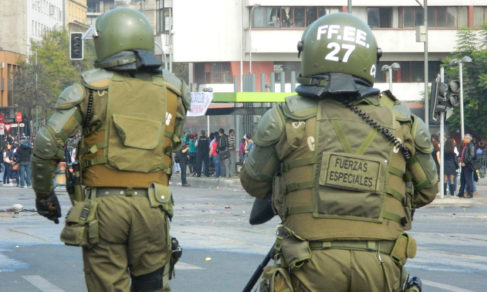
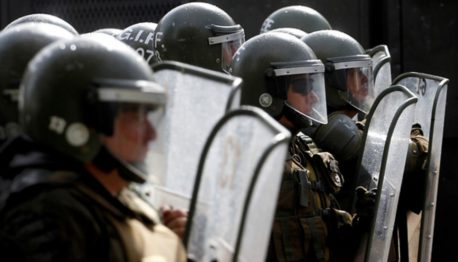
The peaceful and authorized demonstration was met with heavy repression by police forces, as reported by the organizing groups: the Coordinating Assembly of Secondary Students (ACES), Student Solidarity Network, Feminist Coordinating Committee 8M, and the Confederation of Students of Chile (Confech).
According to the planned route, the march had been approved by the Regional Presidential Delegation, stretching from Plaza Baquedano to Los Héroes. However, at the height of Cerro Santa Lucía, Carabineros de Chile began to disperse the students without prior warning or communication with the organizing bodies.
The level of violence displayed by the police left a severe impact on the demonstrators. According to the organizing groups’ report, hundreds of students were affected by chemical gases, with over 200 needing direct medical attention from health brigades.
Additionally, various journalists reported being attacked while documenting the event, and numerous arbitrary detentions were also recorded.
In response, the Student Defense Office of UChile and legal teams from the organizing groups (ACES and the Network) quickly deployed to police stations in Santiago, Recoleta, and Providencia to provide legal support to detained students.
«Even police attempted to forcibly enter the Casa FECh, a space to which they legally cannot access without prior authorization from the Rectorate,» denounced the mobilized students.
The organizations also raised concerns that «the repression on the streets was accompanied by serious censorship of the press.»
«While the government participates in the ‘Foro de Madrid’, entry for media outlets was prohibited, specifically blocking access to Radio Universidad de Chile,» they reported.
Call for Explanations
At a press point following the mobilization, Laura Mlynarz, president of FECH and spokesperson for Confech, condemned the authorities’ actions: «The premature interruption of an authorized march not only reflects the government’s contempt for social mobilization as a legitimate expression but also highlights their deep authoritarianism, which leads them to dismiss any critical opinions advocated democratically by the citizenry.»
«In light of these events, we students ask: Where is the Minister of Education? Where are they when they should be listening and engaging in dialogue?» questioned the student leader.
Meanwhile, Laura Manzi, spokesperson for the Feminist Coordinating Committee 8M, emphasized the political context of the protest: «We mobilize in rejection of the summit of authoritarianism in which the government participates, taking place these days in Santiago.»
«This is a summit of the ultraconservative mafia that threatens the lives of women and girls. We know that when the right advances, our rights retreat. We say: Out of Chile and out of Latin America!» stated Manzi.
From the secondary students’ movement, Darlyn Marilef, spokesperson for ACES, warned that «once again we students mobilize because we will not remain silent in the face of a government that only benefits the wealthy.»
«While they neglect our schools, cut our rights, and oppress our families. As our schools face issues of infrastructure, food, and mental health, the government pushes a mega reform to benefit those who have the most,» criticized the student leader.
At this point, the spokesperson for the secondary students challenged President Kast, asking: «When will there be a mega reform to repair schools, improve pensions, and ease the burden on families? Or do mega reforms only exist to benefit the big businesses in this country?»
«The government loves to label students as criminals and promote measures against us, such as their State of Exception proposal and the 2.0 anti-barricade law, as well as protected schools. But if they truly wanted to combat the drug trade as they claim, they would guarantee us an education worthy of opportunities and a future for the youth, rather than pursuing us each time we protest,» proposed Darlyn Marilef.
Finally, Aranza Díaz, spokesperson for the Student Solidarity Network, stated that in Chile, «studying is becoming increasingly expensive. The Junaeb scholarship stretches less and less. And now, to top it off, they want to cut our student rights.»
«How much more do we have to pay to study while the government wants to give us less and less? Our universities are facing crises of infrastructure and mental health, coupled with an increasingly precarious job future,» said Díaz, who also questioned, «There was a mega reform to save businesses, but no response exists to save higher education.»
«After securing their economic agenda, they now promote a security reform to control the discontent that their own measures are provoking,» denounced the leader of the Student Solidarity Network.
We will continue to provide updates.
Obtén tu Pasaporte y apoya a El Ciudadano
Elimina la publicidad, accede a contenido exclusivo y sé parte de la comunidad.
Cancela en cualquier momento · Sin permanencia