Original article: La peligrosa militarización del espacio de Estados Unidos: ¿Qué armas tiene en sus satélites?
The Dangerous Militarization of U.S. Space: What Weapons Are Deployed on Satellites?
On September 14, 2026, the United States Air Force Secretary, Troy Meink, confirmed at the Air, Space, and Cyber Conference what has been an open secret for years: Washington has deployed weapons in orbit.
«The United States now possesses space control weapons in orbit, capable of defending joint forces against hostile actions from adversaries,» stated Meink.
This marked the first time a U.S. official publicly acknowledged what experts say was already detected in past assessments: at least one offensive space countermeasure system was operational, with indications of another.
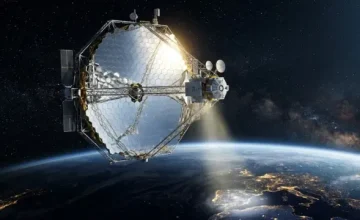
This announcement is not an isolated incident. It is part of the «Golden Dome» project, a controversial and ambitious missile defense system envisioning an orbital architecture with interceptors designed to destroy missiles from space.
The combination of these revelations—deployed weapons and an expanding combat infrastructure—creates a scenario that critics label as the onset of a new space arms race.
A Dangerous Threshold: Violating the Spirit of the 1967 Treaty
The 1967 Outer Space Treaty, the cornerstone of international space law, prohibits the placement of nuclear weapons and weapons of mass destruction in orbit. However, it does not impose a blanket ban on conventional weapons.
This legal loophole has been exploited by Washington to justify its deployment, but this move breaks the implicit consensus that kept space-faring powers from permanently installing offensive weaponry in orbit for six decades.
Victoria Samson, senior director for space security and stability at Secure World Foundation, expressed her astonishment at the revelation: «This is huge because I don’t think any U.S. government official has said that before. The U.S. now also has to accept that China and Russia will do or say the same. I don’t believe this is in the interest of U.S. national security.»
What Weapons Are Involved? Opacity as a Strategy
Meink did not specify the type of weaponry. Experts agree that, given successive U.S. governments’ emphasis on avoiding orbital debris, it is likely that these are electronic warfare systems and space jammers.
«I would assume that what he’s referring to isn’t a kinetic weapon… So I stick to my initial assumption: space jammers, electronic warfare,» Samson remarked.
However, the distinction is crucial. A kinetic weapon that destroys a satellite would generate thousands of fragments traveling at extraordinary speeds, threatening other satellites and spacecraft and potentially triggering the dreaded Kessler Syndrome: a chain reaction of collisions that could render certain orbits unusable for generations.
Even jammers, while not generating physical debris, could have lethal effects, such as «causing immense casualties on Earth without a single explosion or missile hitting a city, because satellites are ubiquitous now.»
The True Cost: Civil and Scientific Services at Risk
Here lies the most critical and least discussed aspect of the announcement. Satellites are not solely military assets. The orbital infrastructure supports essential services for modern civilization:
-Global Communications: billions depend on satellites for internet, telephony, and data transmission.
-Navigation and GPS: positioning systems that guide aircraft, ships, emergency services, and financial networks.
-Meteorology and Early Warning: satellites that warn about hurricanes, tsunamis, and other natural disasters.
-Scientific Observation: monitoring climate change, deforestation, ocean dynamics, and countless research efforts relying on satellite data.
The militarization of space jeopardizes all this infrastructure. As warned by an analysis from the Las Vegas Sun, the destruction of satellites could lead to «communication systems failing, air traffic disruptions, frozen financial transactions, compromised emergency responses, and massive setbacks in scientific and medical research.»
The situation is particularly delicate because most satellites have dual functions.
As explained by Luciano Anselmo, a researcher at Italy’s National Research Council, «in the early decades of space activities, there was a clear distinction; there were civilian programs and military programs. Now, with the development of new technologies, small satellites, constellations… this distinction no longer makes sense: many systems can be used for both military and civilian applications.»
This ambiguity makes civilian satellites legitimate targets under certain interpretations of the law of armed conflict, blurring the line between civilian and military.
Golden Dome: A Questionable and Grandiose Project
Meink’s announcement falls under the «Golden Dome» program, an initiative aiming to create a missile shield capable of protecting U.S. territory from attacks from anywhere on the planet.
The most controversial—and expensive—component is the layer of space interceptors.
Meink confirmed that these interceptors, the «cornerstone» of the system, are ready for flights. General Michael Guetlein, responsible for the program, had previously stated that two «phenomenally successful» tests had been executed. However, the Congressional Budget Office (CBO) estimates the total cost of the system could reach $1.2 trillion over 20 years, seven times the administration’s initial estimate.
The orbital interceptors alone would account for approximately 70% of acquisition costs. Launching a network of space interceptors would cost over $700 billion.
Democratic lawmakers such as Senator Ed Markey and Representative John Garamendi have expressed concern not only over the astronomical cost but also that deploying weapons in orbit could spur an arms race with China and Russia.
«It will quickly become obvious how expensive and challenging the system is,» warned Laura Grego, senior director of the Union of Concerned Scientists.
International Response: Condemnation and Warning
Reactions from Moscow and Beijing were immediate and forceful. Kremlin spokesman Dmitry Peskov declared that «outer space must remain free of any weapons» and emphasized that Russia would continue to advocate for this position and hopes for a broad international consensus to advance towards the complete demilitarization of space.
China, for its part, urged Washington to «stop expanding its military capabilities and preparing for war in outer space.» Foreign Ministry spokesman Guo Jiakun warned against «the militarization of space, turning it into a battlefield and triggering an arms race.»
Both powers have their own space countermeasure programs. China has demonstrated direct ascent antisatellite technology and developed satellites capable of rendezvous and proximity operations. Russia maintains formidable capabilities in electronic warfare and proximity operations.
Analysts fear that the U.S. confirmation will legitimize and accelerate these programs, creating a cycle of action-reaction that no current treaty is designed to contain.
Washington’s acknowledgment marks a paradigm shift. For decades, space-faring powers maintained a diplomatic fiction: space was a military domain, but they would not place permanent offensive weapons in orbit. That consensus has now been broken.
The central question is not whether the United States has a legal right to deploy these weapons—the ambiguity of the 1967 Treaty allows for it—but whether it is prudent to do so.
Satellites that currently provide civilian and scientific services—from weather forecasting to climate research, from air navigation to emergency communications—become hostages to a confrontation logic.
An alternative exists: strengthen space governance mechanisms, such as those promoted by the United Nations Committee on the Peaceful Uses of Outer Space (COPUOS), and move towards a treaty that bans all weapons in orbit, not just those of mass destruction. But that requires political will that, for now, seems scarce.
Space is, by definition, a common good for humanity. Turning it into a battleground is not only a strategic threat: it is a betrayal of future generations who will inherit a sky mined with weapons instead of a horizon of discovery.
Obtén tu Pasaporte y apoya a El Ciudadano
Elimina la publicidad, accede a contenido exclusivo y sé parte de la comunidad.
Cancela en cualquier momento · Sin permanencia