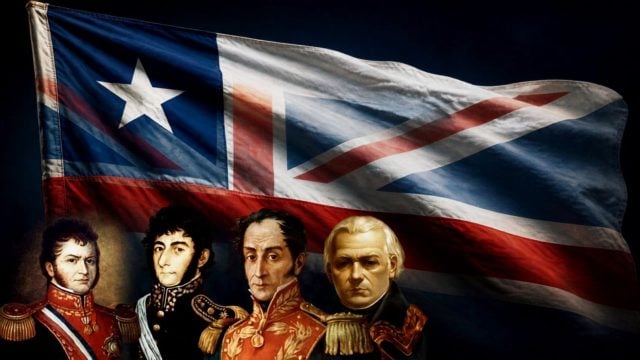
Original article: El dinero de Inglaterra para expulsar a España de Latinoamérica
Traditional historiography has depicted Latin American independence as a national liberation movement. However, British archives unveil a parallel narrative: a geopolitical operation funded from London, carried out through commercial houses and undercover agents, designed to strip Spain of its American empire and turn it into a captive market for the pound sterling.
This was not charity; it was an investment with calculated returns.
By Bruno Sommer
Francisco de Miranda: The Agent Funded by the British Crown
The case of Francisco de Miranda is the most well-documented. Starting in October 1801, the British government granted him a personal pension of £500 annually, later increased to £700, plus an additional £200 for his secretary, Mr. Molini. This pension was not intended to fund expeditions but to support his personal living expenses and his household in London, where the headquarters of the independence conspiracy operated.
The documentation is explicit. In September 1810, Miranda wrote to the Foreign Secretary Lord Wellesley, requesting that the government “continue the payment of the £700 annual pension for him and of £200 for his secretary.” The response was favorable.
However, the pension was just the tip of the iceberg. The commercial house Turnbull & Forbes, based in London, was the vehicle through which operational funds flowed. A handwritten statement from Miranda reveals the nature of the operation:
“I hereby declare that the amount of the enclosed account was advanced to me by Messrs. Turnbull, Forbes and Co. for the purpose of assisting me and others connected with me in our efforts to bring Freedom and independence to Spanish America… and that they were induced to act in this way, largely, by the favorable reception I received from Mr. Pitt upon my arrival in this Country, in 1798.”
The amounts are significant. A Turnbull & Forbes account sent to the English government shows that, between May 1801 and July 1802, the firm disbursed over £21,000 to cover expenses related to Miranda’s activities. In 1806, when Miranda planned his invasion of Venezuela, he obtained £6,000 in bills of exchange through Turnbull & Forbes, in addition to £2,000 in cash.
Miranda himself acknowledges that Turnbull & Forbes were acting induced by the backing of Prime Minister William Pitt. They were not an independent business partner but rather the financial arm of an operation tolerated and encouraged by the government.
Simón Bolívar: Weapons Bought by López Méndez’s Network
Unlike Miranda, Simón Bolívar did not receive direct payments from the British government. Recent academic research clarifies this point: “the failure to obtain official support from the British government for independence was compensated by the development of a network of individuals and private associations that supplied large quantities of weapons, equipment, and men.”
The instrument of this network was Luis López Méndez, representative of Venezuela in London. In March 1817, Bolívar sent him a document —known as “the Powers”— authorizing him to sign contracts on behalf of the Republic. There was no money. However, three months later, López Méndez had already organized the departure of the first ship with arms, equipment, and British volunteers.
The flow of military assistance continued for two years, until 1819. Close to fifty thousand rifles and muskets, hundreds of tons of ammunition and gunpowder, artillery, lances, machetes, swords, sabers, and pistols were sold to the republicans. All of it was provided by private companies, while the British government formally maintained its policy of neutrality.
Research by Matthew Brown, Joanna Crow, and Jonathan Lea (University of Bristol, 2024) concludes that “all foreign military aid was supplied by private companies” and that López Méndez’s network was crucial in sustaining the war.
José de San Martín: The Army Funded from London
The case of José de San Martín is perhaps the most controversial. Various authors argue that San Martín “always followed English instructions, was financed by England, monitored, controlled, and taught by British officials.”
The most concrete data is the £1,200,000 loan over thirty years arranged to finance the liberating expedition of Peru. The banker Tomás Kinder imposed a 25% discount, and Peru drew against an account of £700,000 managed from London by San Martín’s own representatives.
The British plan, according to San Martín’s diary, included an army of over 8,000 mercenaries and the corresponding logistics. The money, according to these sources, “came from Great Britain to destabilize and finance countless mercenaries.”
However, there is a historiographical debate. Some authors argue that San Martín built the Army of the Andes from Cuyo, with Mendoza as a strategic center, relying on contributions, taxes, and local production. What is not disputed is that the network of British agents —James Paroissien, Juan García del Río, Captain Peter Heywood— was fundamental for the logistics and funding of the campaign.
British Houses in Chile: The Independence Business
The Hullett Brothers Loan (1822)
The first Chilean loan was contracted in May 1822 with the Hullett Brothers & Company of London for one million pounds sterling, with an annual interest rate of 6% and 1% amortization. The operation was negotiated by Antonio José de Irisarri, envoy of Bernardo O’Higgins.
The conditions were burdensome. The bonds were issued at 67.5% of their nominal value, which resulted in a net product of only £664,652. The bankers withheld £15,000 for the first amortization. Irisarri was paid $100,000 for commission and $90,000 in overdue salaries.
The contract secured the revenues of the Mint, the Territorial Tax, and the Tithes as collateral. Chile mortgaged its fiscal sovereignty to finance the war. The loan was squandered: $1,500,000 was lent to Peru (which did not repay until 1848), salaries were settled, and military expeditions were financed.
The Gibbs House: The Nitrate Empire
The Gibbs House (Antony Gibbs & Sons) was established in London in 1808 and arrived in Valparaíso in 1826, though it had already been operating in the region beforehand. It became one of the most powerful British firms on the west coast of South America. Its business scope extended from Valparaíso and Santiago to all mining districts in the north and major agricultural areas in the south.
By the mid-19th century, British trading houses like Gibbs & Sons controlled national foreign trade. They dominated exports of copper and silver to Europe and imports of manufactured goods. The Gibbs House was a key player in the Peruvian nitrate monopoly and in the nitrate trade, the strategic resource that ignited the War of the Pacific (1879).
The Edwards Family: Power in the Shadows
The Edwards family was another pillar of British dependency. George Edwards Brown, an English sailor who arrived in Chile in 1804, financed the first Chilean navy and the liberating expedition to Peru. His son, Agustín Edwards Ossandón, founded in 1867 the A. Edwards Bank, the first private financial institution in Chile.
From Valparaíso, the Edwards built a network that spanned banking, mining, agriculture, and the press. Their power was such that a senator accused President Arturo Alessandri of being an “agent of the Pool,” referring to the interests of the Gibbs House. The family not only amassed wealth: they controlled the discourse through El Mercurio de Valparaíso, the most influential newspaper in the country, and from there shaped public opinion for over a century.
Other Commercial Houses
The British consortium that controlled the Chilean economy after independence also included Huth & Co. (established in Valparaíso in 1824), Duncan, Fox & Co., Graham, Rowe & Co., Williamson Balfour & Co., and Weir, Scott & Co., which dominated foreign trade, banking, and insurance. The pioneers —James Powditch, O. Bunster, Andrew Blest, John Callon, William Taylor, and William Forbes— were already operating in Valparaíso by 1819, laying the groundwork for the British mercantile colony.
By Bruno Sommer
Founder of El Ciudadano
- Archive of the National Academy of History (Argentina), documents on Miranda and Turnbull & Forbes.
- Brown, M., Crow, J., & Lea, J. (2024). “Financing a Revolution: The Impact of Bolívar’s British Networks in the Independence of Colombia,” Journal of Latin American Studies, Cambridge University Press.
- Calabrese, A. José de San Martín… A British Agent? (quoted in La Nación).
- Documents from the United Grand Lodge of England (response from James William Stubbs, 1979).
- Chilean National Library, Chilean Memory: “British Trading Houses,” “British Influence in Valparaíso Trade.”
- Ministry of Finance of Chile, History of External Debt.
- Rojas Flores, G. (2019). “The Gibbs & Co. Trading House and its Investments in Chile,” History.
- Terragno, R. San Martín’s Diary.
