Original article: “La dignidad de nuestra defensa del río no se compra con dinero”: Machi Millaray Huichalaf exige investigar a Statkraft en Noruega
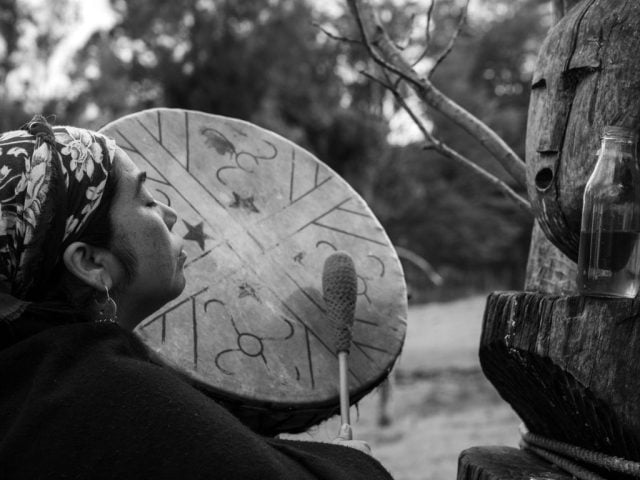
«The dignity of our defense of the river cannot be bought: what we are defending are our rights, our territory, and the future of our communities,» stated Machi Millaray Huichalaf, insisting that Norway should investigate the state-owned Statkraft AS for the impacts caused on sacred territory, under the European nation’s Transparency Law.
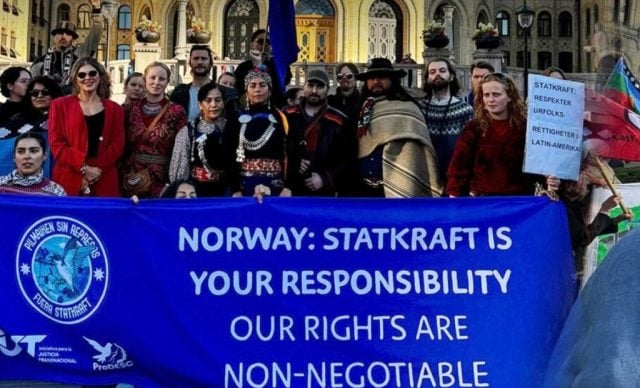
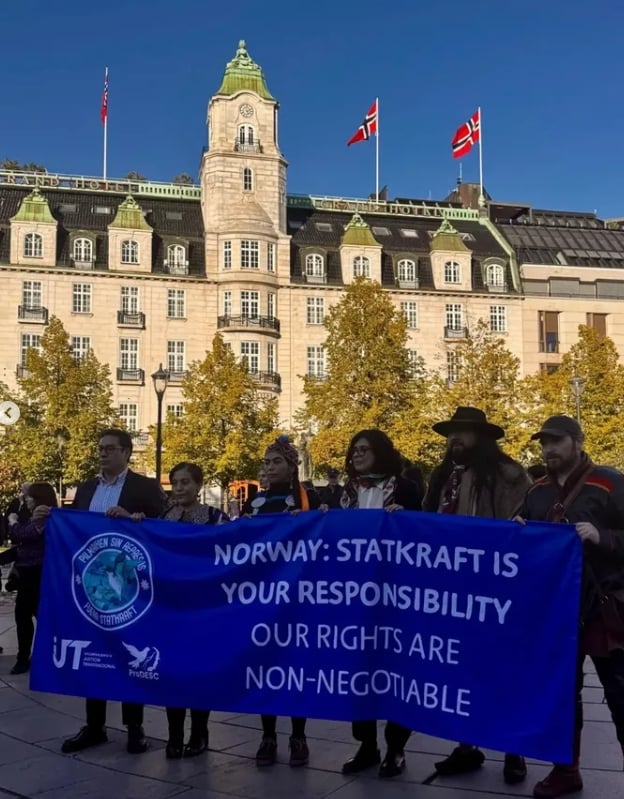
The Mapuche Williche authority joined representatives from the Aylla Rewe of the Ngen Mapu Kintuantü and the Ko Foundation in a public action that took place last Tuesday in front of the Norwegian Parliament (Stortinget) in Oslo.
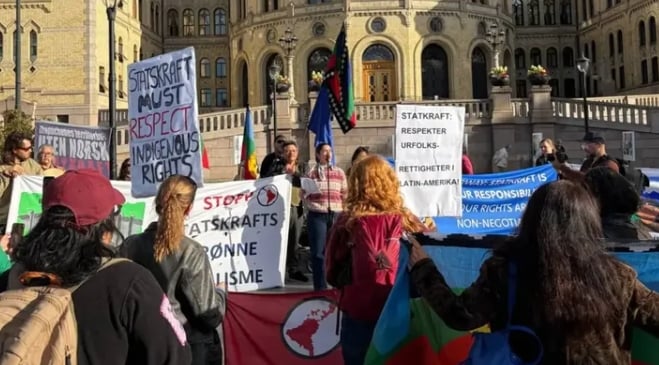
The delegation was joined by representatives of the Sámi people and various Norwegian civil society organizations, in a demonstration aimed at raising awareness of the situation faced by communities affected by Statkraft’s hydroelectric projects and demanding respect for indigenous peoples’ rights.
During the event, participants displayed a banner and held a collective photo opportunity as a form of public protest. This was an effort to draw attention to the necessity of recognizing indigenous rights in decisions that severely affect their territories and worldview.
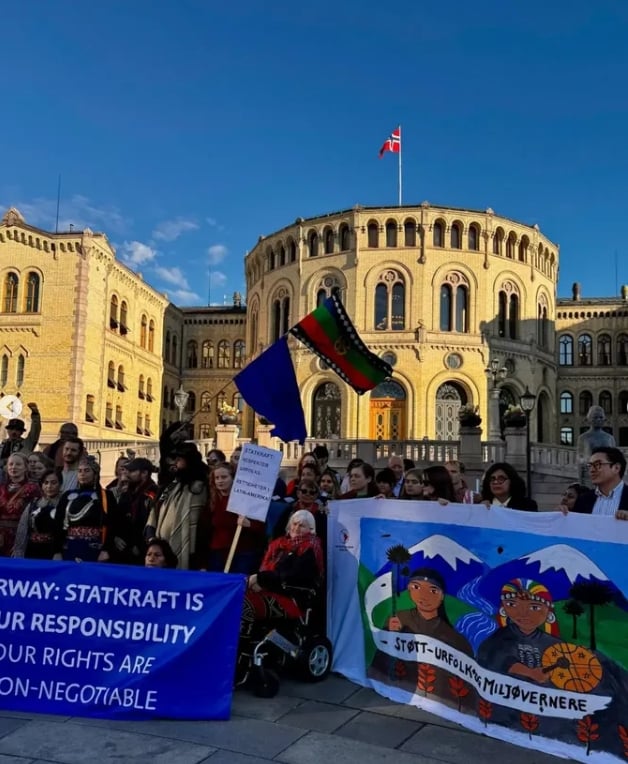
Specifically, they demanded that Statkraft take responsibility for the damages reported by the Mapuche Williche communities and respond to them.
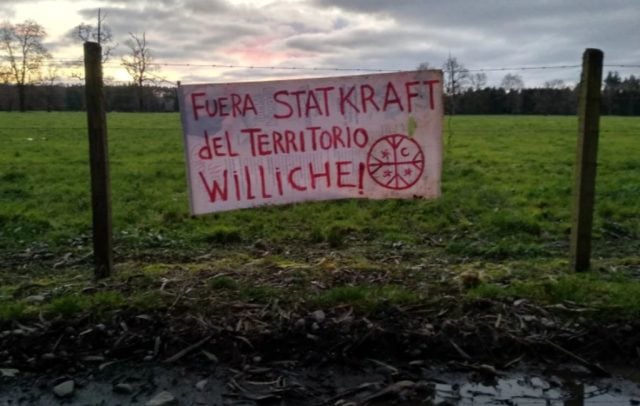
Participants emphasized that the fight for Pilmaiquén transcends borders, «from Wallmapu to Norway,» making their message clear: «Statkraft out of Pilmaiquén! Pilmaiquén River without dams!«.
This protest was not an isolated incident: it occurred shortly after the Aylla Rewe of the Ngen Mapu Kintuantü, representing over 150 communities in the Pilmaiquén basin and surrounding areas, filed a complaint against Statkraft in Norway under the Transparency Law, with support from the Economic, Social, and Cultural Rights Project (ProDESC) and the Transnational Justice Initiative (IJT).
This complaint requests the Norwegian Consumer Authority to investigate whether Statkraft has met its human rights due diligence obligations in relation to the Rucatayo and Los Lagos projects.
This request was made under Norway’s Transparency Law, which requires covered companies to conduct due diligence on fundamental human rights and ensure decent working conditions in accordance with OECD Guidelines.
It is noteworthy that this is the first time an indigenous people from Latin America has utilized this Norwegian regulation to challenge the operations of a corporation from that country on their territory and request an investigation.
The controversy centers around the Rucatayo hydroelectric plant and the Los Lagos project, both Statkraft initiatives in the Pilmaiquén basin, where the risk of flooding sacred spaces has raised alarm. The Norwegian Transparency Law, monitored by the Norwegian Consumer Authority, requires large companies to conduct human rights due diligence covering all their activities, even those carried out outside the borders of the European nation. The complaint requests this regulatory body to investigate whether the state company fully complied with its obligation in this matter.
The public action in Oslo occurred after Statkraft confirmed that filling the Los Lagos hydroelectric reservoir was completed on August 21.
Previously, the company stated that the project would progress to operational testing and energization, with plans in place to commence commercial operations in the second quarter of 2027. This announcement underscored the urgency for the delegation to raise their demands in the home country of the company.
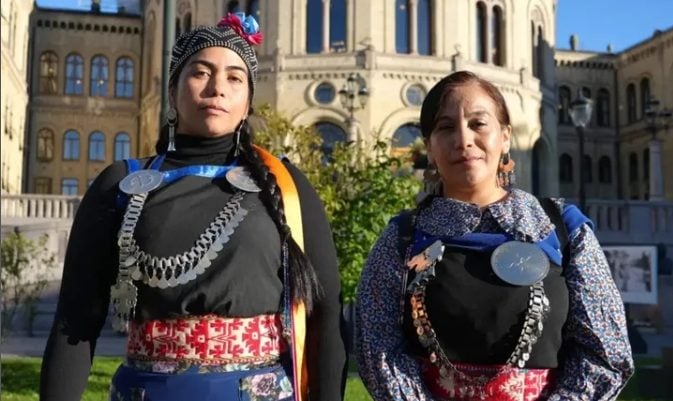
Machi Millaray Huichalaf: «The dignity of our defense of the river cannot be bought»
In this context, Machi Millaray Huichalaf emphasized that «Pilmaiquén is our territory, and our rights as an indigenous people do not vanish because a project moves forward».
She indicated that they decided to travel to Norway «so that our voice could be heard directly», reiterating that «the dignity of our defense of the river cannot be bought».
In her statements, she made it clear that what is at stake are «the rights, the territory, and the future of the communities». She also emphasized that the communities are not opposed to renewable energies in general, but demand that any energy transition respects indigenous rights and guarantees their effective participation in decisions affecting their territories.
For her part, Amanda Huichalaf, spokesperson for the Aylla Rewe of the Ngen Mapu Kintuantü, warned that «the projects have had impacts experienced differently by women, children, and Mapuche families».
She noted that they also «have generated divisions within our communities and created an environment where defending our rights can lead to stigmatization and criminalization».
For Huichalaf, «it is not enough to simply call a process dialogue if our participation does not have real capacity to influence decisions that affect our lives and territory».
The spokesperson explained that the visit to Norway aims to break the isolation that, from the communities’ perspective, has hindered the broader acknowledgment of their experiences in Chile.
Mapuche lawyer Francisco Aliaga Huentrutripay provided a legal and historical framework for the demand, recalling that «communities have been using various legal avenues in Chile for years to defend their rights», and have also approached the OECD mechanism and now the Norwegian Transparency Law.
According to Aliaga, «arriving in Norway means not starting a new fight: it means continuing a defense that has been going on for years», in light of the need for mechanisms capable of examining the actions of a Norwegian company from the perspective of human rights due diligence.
Norway Must Investigate Statkraft
In a statement, the communities of the Mapuche Williche people indicated that the indigenous consultation conducted in Chile regarding Los Lagos did not address the overall construction or operation of the project, but rather was limited specifically to administrative measures related to archaeological findings.
They also recalled that Statkraft withdrew from the Osorno hydroelectric project in 2023 and renounced the environmental authorization and associated water rights, arguing that this decision reflected the dialogue established with the communities and the recognition of the cultural value of the territory.
The communities made it clear that the company is entirely state-owned by the Norwegian government, through the Ministry of Trade, Industry and Fisheries, a situation that, according to the delegation that went to Oslo, makes it particularly important for the case to be recognized and examined in the European nation.
The communities clarified that the trip to Norway is not intended to «turn the impacts on their rights into a negotiation for monetary compensation.» Their aim is to conduct a serious and independent investigation of the complaint and clarify whether Statkraft «effectively fulfilled its human rights due diligence obligations» while determining the «role and responsibilities that correspond to the Norwegian government, as the company’s owner».
.
Obtén tu Pasaporte y apoya a El Ciudadano
Elimina la publicidad, accede a contenido exclusivo y sé parte de la comunidad.
Cancela en cualquier momento · Sin permanencia