Original article: «Lo que hizo Boric, hoy es mantenido por Kast”: Ernesto Llaitul, werken de la CAM, sobre el estado de excepción en Wallmapu
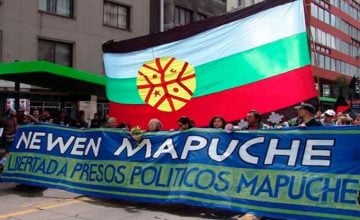
«What Boric did, Kast maintains today,» stated Ernesto Llaitul, the werken of the Arauco Malleco Coordinator (CAM), discussing the state of emergency that has been in place for over four years in Wallmapu.
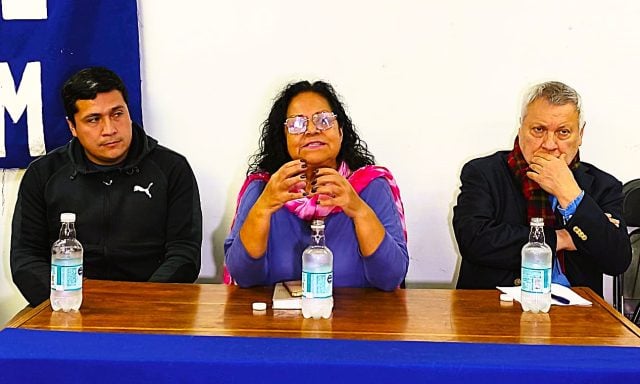
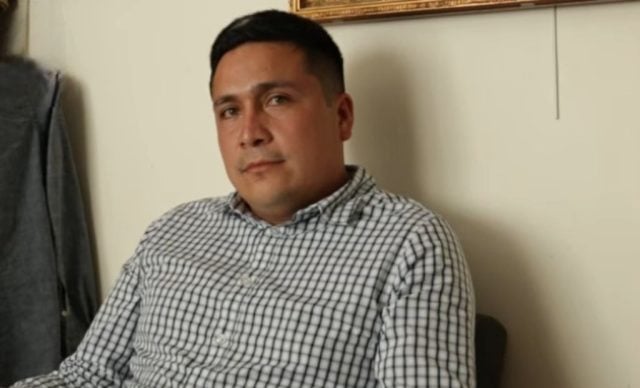
«From our perspective, there is not much difference between the government of Gabriel Boric and that of José Antonio Kast at the moment,» he remarked in an interview with cultural manager and independent audiovisual producer María Reyes Razeto, conducted in Paris, France, where he attended to accept a medal awarded to his father, CAM leader Héctor Llaitul, by the National Assembly of France.
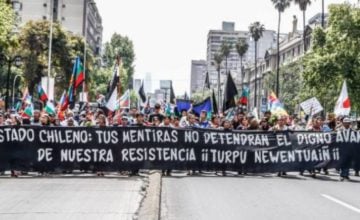
During this discussion, he shared insights on the more than four years of ongoing military occupation in four provinces of Wallmapu: Bio Bío, Arauco, Malleco, and Cautín, under a constitutional state of emergency decreed by Boric in May 2022.
Under Sebastián Piñera’s administration, a constitutional state of emergency was declared on October 12, 2021, lasting until March 27, 2022, but it was not renewed by the incoming government.
However, just over a month and a half later, Boric declared a new state of emergency for the same four provinces of Wallmapu that Piñera had previously enacted.
«By the end of Piñera’s government and under Boric’s administration, a state of emergency was initiated involving military forces, drones, and high-tech equipment. Most of this technology was purchased from the Zionist regime of Israel and is what is currently used in Wallmapu. Gabriel Boric maintained and deepened this, and now, under the far-right government, a similar situation is still in place, but we understand that given the legality left by the former president, this could escalate,» Llaitul explained.
«Boric’s Government Was the Worst Regarding the Mapuche Conflict»
According to the CAM leader, the measures implemented by former President Gabriel Boric’s administration intensified militarization, repression, and the criminalization of the Mapuche people.
«One understands that within the narrative and discourse, obviously, a pseudo-progressive government like Boric’s promised different things, while Kast’s vocabulary and discourse seem distinct. However, for us, the autonomist Mapuche movement and the reality of the Mapuche people as a whole did not show any difference in how we were treated. We argue that Gabriel Boric’s government was the worst regarding the Mapuche conflict since the return to pseudo-democracy,» he claimed.
«What President Boric did back then is now only upheld by Kast’s government. Gabriel Boric was the one who provided all the tools for a far-right government to operate within the law,» emphasized the CAM leader.
In his remarks, Ernesto Llaitul pointed out that the former president pushed for legislation such as the Anti-Terrorism Law, the Usurpation Law, and the «Naín-Retamal» Law, among others.
«These are laws that, in our view, benefit the far-right, supporting the most fascist and recalcitrant sectors of our territories,» he stated.
Process of Mapuche National Reconstruction
During the interview, Llaitul addressed the current situation faced by the Mapuche people and the challenges confronting the Arauco Malleco Coordinator (CAM).
«I am the werken of the Arauco Malleco Coordinator, which has a political proposal for how to achieve autonomy and develop a Mapuche national liberation ideology, centered on our own culture. This is an idea that has matured over time, shaped by our great leaders and our well-known figures. In the case of my father (Héctor Llaitul), he also plays a crucial role in the political development linked to this proposal that we ultimately deliver to our people,» he posited.
«There are other organizations, most of them, that take our analysis as the ideological framework for this struggle. When the Arauco Malleco Coordinator emerged, it provided a new approach to politics for the Mapuche movement, one that is no longer linked to political parties or the ongoing dependency on the State or seeking constitutional recognition but rather focuses on the autonomous development of an anti-capitalist and revolutionary idea,» he asserted.
Llaitul recalled that there is a confrontation between the Mapuche people and the State of Chile, «which oppresses us and takes away our territory,» and subsequently against extractivism and the capitalist system.
«This confronts our very identity as Mapuche, and the State of Chile or this capitalist society robs us of land and, over time, strips us of our religion and culture,» he explained.
In the wake of this scenario, a process of Mapuche national reconstruction has emerged, where «together, we are reconstructing the Mapuche identity that was lost. Here is where our traditional authorities, the machi, the loncos, and the werken play a significant role, and we are developing our own identity, which is part of the political work of the CAM,» he noted.
In the interview, Llaitul highlighted that from the perspective of the Coordinator, the concept of autonomy «is developed in relation to practice, understanding that territory is the material foundation for developing autonomy.»
«And understanding that today, the forestry companies or the major economic groups own the territory of the Mapuche nation. We, with our capacities, our people, and our communities, move forward with land recovery processes,» he elaborated.
He also pointed out that autonomy is reflected in the decisions made by the communities, «men, women, children, and Mapuche people, in relation to our identity and how to self-govern and self-determine issues within their own territories.»
«We emphasize this, and there we are also building what autonomy means,» Ernesto Llaitul stated.
You can access the full interview conducted by María Reyes Razeto with Ernesto Llaitul below:
Obtén tu Pasaporte y apoya a El Ciudadano
Elimina la publicidad, accede a contenido exclusivo y sé parte de la comunidad.
Cancela en cualquier momento · Sin permanencia