Original article: Alemania: 175 mil personas defienden el estado del bienestar y protestan frente a los recortes
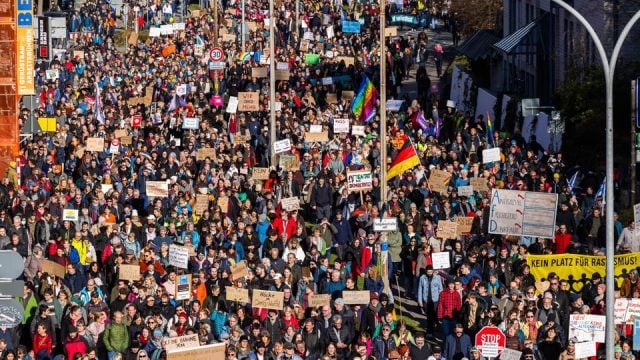
Berlin, September 26, 2026 — Germany witnessed one of the largest social mobilizations in recent years this Saturday. Approximately 175,000 individuals, as reported by the German Trade Union Confederation (DGB), took to the streets in 15 major cities to protest against the coalition government’s plans for austerity cuts and social reforms under Chancellor Friedrich Merz. Under the banner «Earned with Effort! Your Work. Your Health. Your Pension», demonstrators demanded the preservation of the welfare state and warned of what they consider a direct assault on workers’ rights.
A Decentralized and Massive Protest
The mobilization, organized by the DGB alongside unions such as ver.di and IG Metall, as well as social and environmental organizations, unfolded simultaneously in Berlin, Bremen, Erfurt, Essen, Frankfurt, Freiburg, Hamburg, Hanover, Kiel, Leipzig, Magdeburg, Nuremberg, Rostock, Saarbrücken, and Stuttgart.
While attendance figures varied, they collectively reflect the protest’s magnitude:
- Nuremberg: between 20,000 and 25,000 people (according to police).
- Stuttgart: approximately 16,000 demonstrators.
- Frankfurt: about 15,000 people, according to police, although the DGB increased that estimate to 30,000.
- Hanover: nearly 13,000 participants.
- Essen: police counted 12,000 attendees, while the regional DGB of North Rhine-Westphalia reported 18,000.
- Hamburg: the DGB reported 13,000 participants, compared to 5,000 estimated by police.
- Berlin: 5,500 people, according to police data, although other sources raised the figure to 12,000.
Demands: Against Cuts and for Change
The catalyst for these protests is the reform plans proposed by Merz’s government, which include adjustments to the pension system, labor market, and healthcare. Unions have denounced these measures as an «assault» on workers’ rights and the social state.
Yasmin Fahimi, president of the DGB, expressed her stance firmly from Essen: «We will not allow them to strip away what we have built over many years in terms of social rights». Fahimi specifically criticized proposals for longer working hours and the relaxation of the eight-hour workday, demanding that pensions remain intact after 45 years of contributions.
In turn, Frank Werneke, leader of ver.di, accused the government of launching an «attack» on the rights of workers and the welfare state, calling for an end to the «clan of struggle from above» (a German expression referring to policies favoring the wealthy).
Specific demands from the unions include:
- Pensions: maintain pensions without cuts after 45 years of contributions and ensure that pension levels do not fall below 48% from 2031 onward.
- Work Hours: reject any increase in work hours and the elimination of the eight-hour workday.
- Contracts: oppose the widespread use of temporary contracts without valid justification, which can currently last up to 48 months.
- Healthcare: reject hikes in pharmaceutical copayments and cuts in healthcare services.
- Housing: some protests, particularly in Berlin, included calls for a rent freeze.
Political Context: A Government Under Pressure
The protests come at a time when Chancellor Merz and his coalition of Christian Democrats (CDU) and Social Democrats (SPD) are experiencing notable weakness. Recent electoral results in the states of Mecklenburg-Vorpommern and Berlin were «disastrous» for his party, intensifying internal tensions within the government.
Despite the pressure, Merz has maintained his stance. In mid-September, he declared that «reforms must continue,» which unions interpreted as a direct challenge to the protesters. Furthermore, pension system reform is a central point of the government’s agenda that has sparked a sharp debate within the coalition itself.
Social unrest is also fueled by economic uncertainty. Many workers, particularly in the automotive sector, fear for their jobs due to industrial transformation and international competition. Some protesters linked social cuts to increased defense spending, carrying signs such as «Money for social needs instead of for war!».
Business Response: Criticisms and Accusations
German employers did not take long to respond. Steffen Kampeter, president of the German Employers’ Confederation (BDA), accused the unions of «living in the past» and having a «ritual rejection of reforms.» «Unions say ‘no’ to almost any changes. They dream of yesterday’s world», he stated.
Kampeter also pointed out that aging populations, labor shortages, and international competition are realities that cannot simply be resolved by protests.
An Analysis Beyond the Numbers
The magnitude of the mobilization reflects deep social discontent in Germany. This is not merely opposition to specific cuts, but a symbolic defense of a social model that many perceive as threatened. The diversity of demands — pensions, healthcare, work hours, housing — points to a pervasive concern for quality of life and economic security.
The success of this mobilization also presents a challenge for the DGB, which will need to manage this wave of indignation to prevent it from dissipating or radicalizing. The demonstrated unity among unions during this day will be crucial to maintain pressure on the government.
More Protests Against Mandatory Military Service
According to the protest organizers, over 45,000 people participated in this day of school strikes against the return of mandatory military service. In the absence of a comprehensive official tally, the police have only offered partial attendance figures from some major cities, including Berlin.
“Young people do not want to enlist in the German armed forces,” emphasized Bela Breitner, spokesperson for the protests, in statements to the DPA.
The Citizen
Obtén tu Pasaporte y apoya a El Ciudadano
Elimina la publicidad, accede a contenido exclusivo y sé parte de la comunidad.
Cancela en cualquier momento · Sin permanencia