
Original article: ¿Quiénes son los “arrepentidos de Kast”? 38% de quienes lo apoyaron hoy cambiaría su voto
Currently, 38.2% of those who supported José Antonio Kast in the first and/or second rounds of the election describe themselves as «regretful» and would change their vote, according to the third measurement from the Chile Actual survey conducted by the Nodo XXI Foundation with the support of the Heinrich Böll Foundation.
The study, administered online between September 9 and 18 to 993 individuals aged 18 and older—using a weighted sample according to population variables—revealed a significant shift within the electoral base that brought the president to La Moneda.
Specifically, the survey asked participants which candidate they voted for during the first and second rounds?; as well as which option they would now choose if they could turn back time, taking into account the performance evaluation of Kast’s government.
According to the study, if the presidential primary were held again, only 55.9% of those who originally voted for Kast would choose him again. In this hypothetical scenario, the far-right candidate would drop from the 23.9% he obtained in the first round of 2025 to 17.5% in another potential contest.
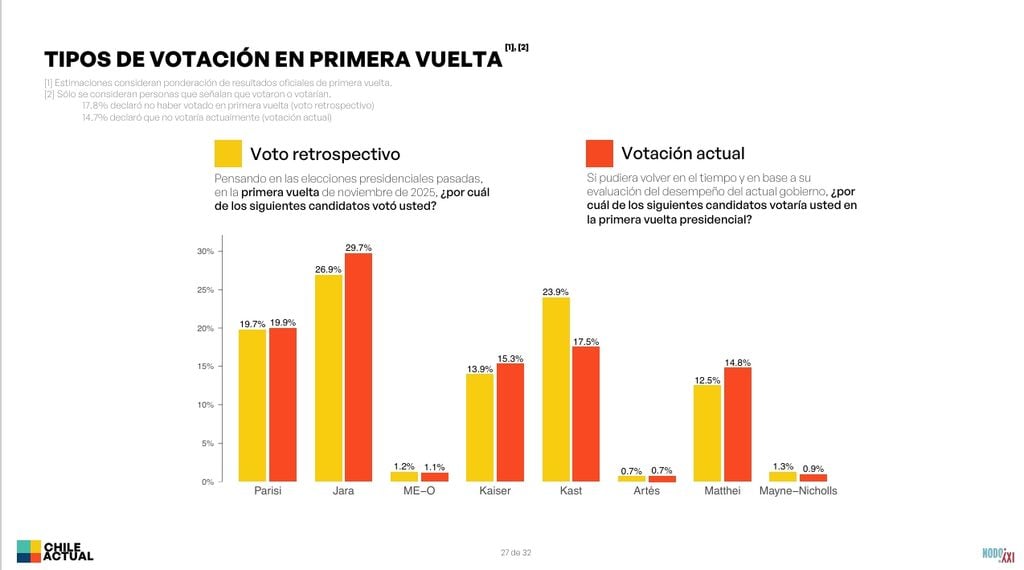
This retrospective exercise also highlights changes in preferences for other former candidates. Jeannette Jara would see an increase from 26.9% to 29.7%; Johannes Kaiser from 13.9% to 15.3%; Evelyn Matthei from 12.5% to 14.8%, and Franco Parisi from 19.7% to 19.9%.
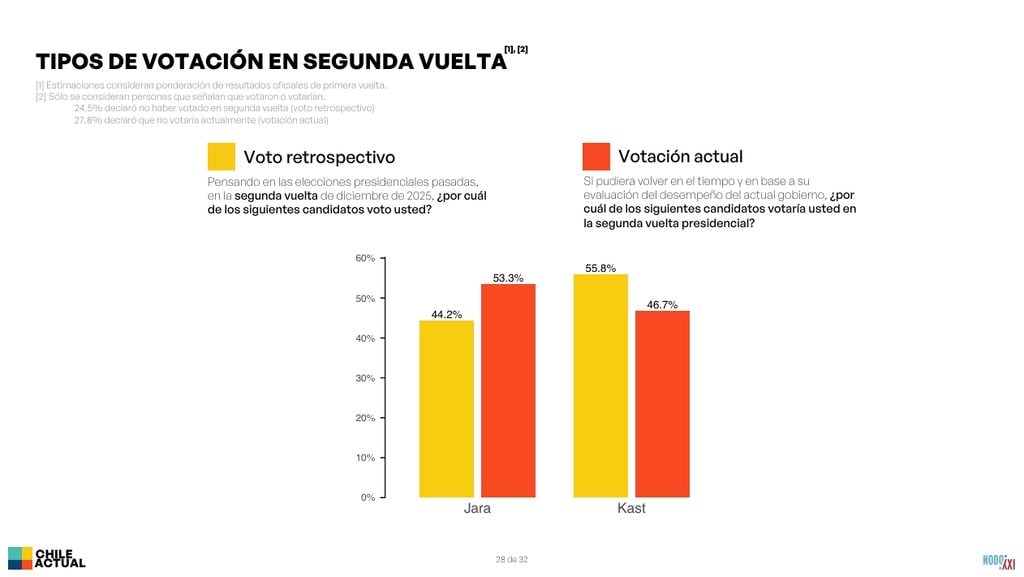
Concerning the runoff election, the survey asked how the respondents would vote if the second round between Kast and Jara were to be repeated. In this hypothetical scenario, the measurement records 53.3% of preferences for the former candidate from Unidad por Chile.
Considering both results at the polls, the Nodo XXI Foundation survey classified 38.2% of the 421 respondents who said they voted for Kast in at least one of the two rounds as «regretful», while 61.8% maintains their initial decision.
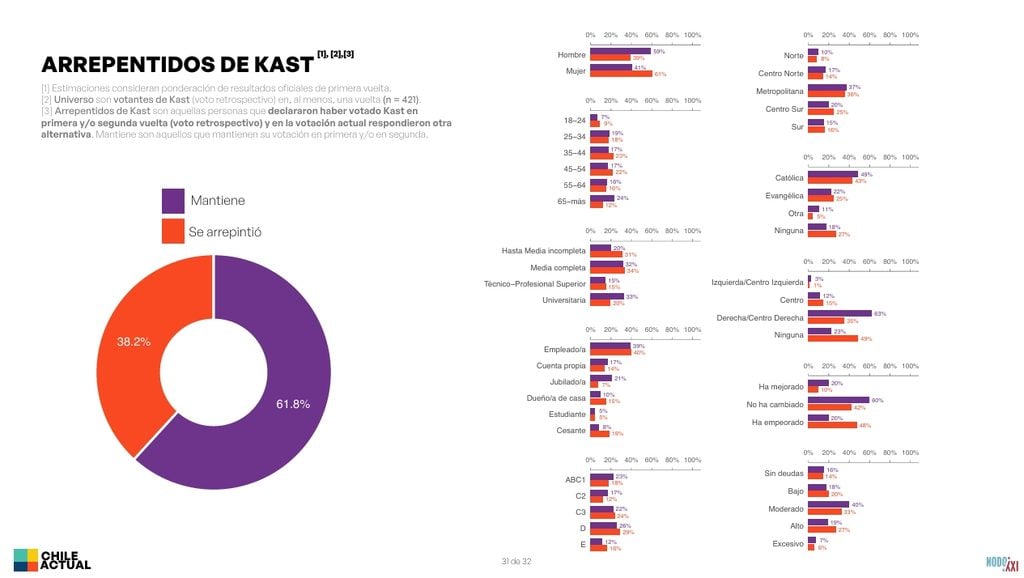
«Regretful» Voters by Gender, Age, Education, and Socioeconomic Level
Regarding gender, the opinion study revealed a significant gap: while 59% of men maintain their vote, 39% regret it; among women, the regretful figure increases to 61%, although 41% still support Kast.
In terms of age, regret is more pronounced in middle age groups: 23% of respondents aged 35 to 44 and another 22% of those aged 45 to 54 express regret, in contrast to younger voters aged 18 to 24, where only 9% changed their minds and 7% maintain their support. Among those over 65, 24% hold onto their vote versus 12% who regret it.
Breaking it down by education, regret is strongest among those with at most secondary education, reaching 34%, while 32% maintain their support. 31% of respondents with incomplete secondary education reported regretting their vote for Kast, and 20% still support him. For those with university education, 20% express dissatisfaction, while 33% are content with their vote.
At the socioeconomic level, regret crosses across lower strata: 29% of segment D and 16% of segment E report they have regretted their vote, although in the latter group, 12% maintain their vote. Among higher strata, the ABC1 group shows 23% maintaining their vote against 16% expressing regret.
35% of Those Identifying with the Right Would Change Their Vote
A particularly revealing insight emerges from analyzing political identification: 35% of those who regret supporting Kast identify with the right/center-right, while 63% are satisfied with that decision. Among those who do not identify with any political trend, 23% maintain their vote while 49% regret it. In the center, 12% hold onto their vote and 15% express regret, while on the left/center-left, a mere 3% stated they felt regret, and 1% maintained their vote for Kast.
Economic Situation and Debt Levels
The context of the domestic economy appears to be a crucial factor driving this regret.
Regarding personal economic conditions over the past 12 months, 46.8% of respondents stated that their situation has worsened, while 43.0% indicated it has not changed and only 10.2% claimed it has improved.
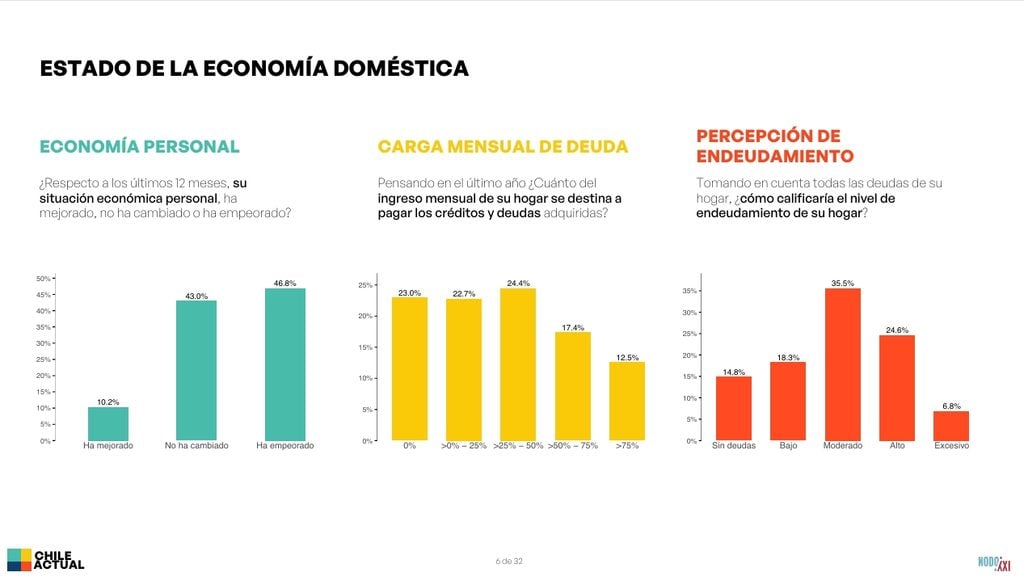
Regarding monthly debt burdens, 12.5% of households allocate more than 75% of their income to debt repayment, and 17.4% allocate between 50% and 75%. The perception of indebtedness is also high: 35.5% rated their level of debt as moderate, 24.6% as high, and 6.8% as excessive, presenting a complex economic picture for voters who now express regret for having chosen Kast.
You can view the full results of the NODO XXI survey below:
*Featured image of José Antonio Kast: Mediabanco.
Obtén tu Pasaporte y apoya a El Ciudadano
Elimina la publicidad, accede a contenido exclusivo y sé parte de la comunidad.
Cancela en cualquier momento · Sin permanencia