Original article: Casino Dreams de Talca: Presentan querella y piden a Fiscalía investigar posibles «conductas con relevancia penal» en entrega de permisos
The construction of the new Casino Dreams in Talca has taken a new and complex turn.
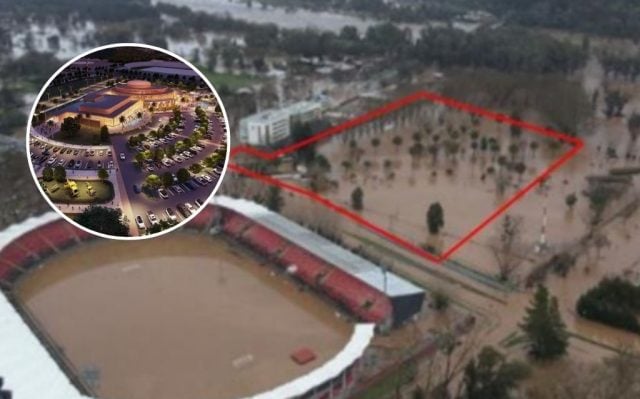
The project, located next to the Cajón del Río Claro Urban Wetland and Estero Piduco, has been surrounded by controversy since it began progressing without entering the Environmental Impact Assessment System (SEIA).
One of the main discussions has revolved around whether the actual characteristics of the works corresponded to those reported to authorities in order to obtain the necessary permits.
Among the issues contributing to this controversy is the depth of the excavations. Initially, the intervention was reported to be approximately 1.4 to 1.6 meters, but later information revealed excavations might be significantly deeper.
The conflict has taken on various administrative and environmental dimensions. The Maule SEA has initiated a process to review the resolution that allowed the project to bypass the SEIA, and environmental organizations have also taken legal action.
Now, another front has opened. Casino de Talca has filed a complaint urging the Public Prosecutor’s Office to investigate whether any criminal conduct occurred in the procurement and maintenance of the project’s authorizations.
We spoke with Juan Carlos Manríquez, the lawyer representing Casino de Talca, to understand the allegations, who could be investigated, and what might happen to the casino if the judiciary determines that certain permits were obtained under false pretenses.
–Until now, discussions have focused on potential administrative or environmental irregularities. What did you find to indicate this could be criminal?
– We conducted a thorough analysis of the chronology and overall development of the project, comparing it to applicable standards and regulatory practices. What we observed is what we consider a scheme of ‘half-truths’: information provided to certain authorities and evidence that, in our view, was not fully disclosed to other bodies.
Our thesis is that this enabled a project facing significant obstacles to sequentially obtain permits and authorizations that gave it an appearance of legality. Therefore, Casino Talca said, ‘no more.’ We have presented this evidence to the judiciary, and now it is up to the Public Prosecutor’s Office to determine if any crimes occurred and who may have participated.
– One of the most striking points is the depth of the excavations. Why is it so critical if one depth was reported but another was ultimately excavated?
– Because we are not merely discussing a difference of centimeters. It is one of the elements that, along with others, could help determine whether the statements made to the authority accurately reflected the characteristics of the works intended to be carried out.
Our position is that if the authority had known all relevant information from the start, certain authorizations might not have been granted under the same terms. That is precisely what the investigation should clarify.
– To put it simply: Could reporting one project and executing another constitute a crime?
– It could have penal consequences if it is proven that there was a deliberate misrepresentation regarding substantial facts to obtain an authorization. What must be established is what was reported, who reported it, what each participant knew, and what was ultimately executed.
Depending on what the investigation finds, crimes related to false statements or forgery of public documents could be established.
– Do you believe we are facing an isolated incident or a series of actions?
– The complaint precisely aims to investigate a possible succession of actions. We are not looking at an isolated document. We seek a review of the entire process to determine if various actions were aimed at obtaining permits, certificates, or authorizations that, with all the evidence on the table, may not have been obtainable.
– How far should this investigation go?
– To the beginning. We must reconstruct the entire administrative process: what evidence was presented, who prepared it, who reviewed it, who made decisions based on it, and what information was provided for each authorization.
– Does this mean the investigation could also involve public officials?
– Undoubtedly. The investigation should not be limited to those physically executing the works. If there is evidence, the eventual responsibility of private individuals and public officials who intervened in the processing or approval of the permits must be established. The critical issue is to determine who knew what, when they knew it, and what they did with that information.
– What happens if the judiciary concludes that a key permit was obtained by providing incorrect information?
– This could have very significant consequences. Law 21.595 regarding economic and environmental crimes includes effects regarding authorizations obtained through false or unlawful evidence.
If it is judicially proven that specific permits or resolutions were obtained in that manner, the validity of those authorizations could be severely compromised. If a crucial authorization for the project’s execution falls, it opens a discussion regarding the very possibility of continuing the project and completing the works.
– But while the judiciary investigates, the casino continues to be built. Is there not a risk that by the time there is a response, the project will be completed?
– Precisely for this reason, we believe measures need to be evaluated now. In our view, the Public Prosecutor’s Office should quickly analyze the evidence and determine if it is necessary to request measures that would prevent the investigation from becoming irrelevant because the works have already been fully executed.
We also believe that the Superintendence of Gaming Casinos and the Advisory Council should thoroughly review the details of the process. We consider that there is enough evidence for the Prosecutor’s Office to evaluate requesting a halt to the works while the facts are investigated.
It would make no sense to investigate for months whether specific permits were obtained irregularly while the project continues to advance to the point where it becomes a fait accompli.
– Could this complaint ultimately jeopardize the opening of the new Casino Dreams in Talca?
– Yes, depending on what the investigation reveals. If it is proven that essential authorizations were obtained through unlawful conduct, the consequences would not only be penal for those found responsible; they could also directly affect the permits upon which the project relies. That is what the judiciary must now determine.

Both Complaints Will Be Investigated in a Single Case
At the close of this note, the Talca Prosecutor’s Office confirmed that this complaint has been grouped with another legal action already under investigation regarding issues related to the new Casino Dreams project in Talca.
This includes a previous complaint lodged by Bio Eco Terra, which brought to criminal court evidence linked to the works carried out in the area and their possible effects on the wetland and its water system, requesting an investigation into potential environmental crimes.
As a result, the evidence provided by both legal actions will be examined within a single criminal investigation, which must now determine whether the controversies surrounding the construction of the new casino relate solely to administrative and environmental matters or if there are also criminal aspects involved.
We will continue to provide updates.
Obtén tu Pasaporte y apoya a El Ciudadano
Elimina la publicidad, accede a contenido exclusivo y sé parte de la comunidad.
Cancela en cualquier momento · Sin permanencia