Original article: Escudo de las Américas: Inversiones protegidas a costa de la soberanía de Chile
By Javier Arroyo Olea | Research Team and Socio-Environmental Conflicts, Latin American Observatory of Environmental Conflicts – OLCA
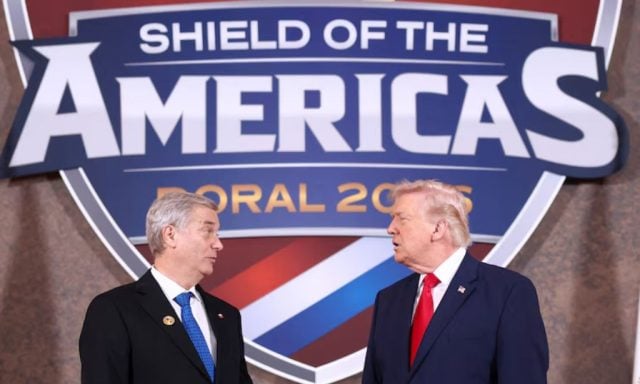
Before entering La Moneda, José Antonio Kast defined his intended relationship with the administration of Donald Trump.
Far from the patriotism that energizes his sector, the Chilean government’s choice to join the so-called “Americas Shield” reflects a policy of backyard diplomacy and servitude. This decision has raised questions regarding its implications.
The lack of transparency became apparent when Defense Minister Fernando Barros admitted he was not fully informed about the decision’s details.
The Executive presented its commitment as a cooperative measure against organized crime. However, the joint statement extends well beyond security, outlining three key pillars that include economic aspects and multilateral coordination.
In the economic section, it proposes exploring investment review mechanisms, safeguarding critical mineral supply chains, and promoting standards for digital infrastructure providers.
Additionally, the document announces measures against 24 organizations deemed “narcoterrorist,” aiming for countries to “defend their sovereignty.” This list focuses on Latin American criminal networks while omitting drug trafficking and money laundering operations in the United States.
Consequently, Washington retains the ability to lead the regional response without subjecting its own territory to the same scrutiny. It is crucial to consider Mexico’s situation, battling under significant disadvantage against drug gangs armed with high-caliber weaponry manufactured for the U.S. Army and illegally smuggled into the country.
In Chile, even the narrative of fighting organized crime has fallen into utter incongruence under an administration that has clearly demonstrated its authoritarian policies.
Kast’s complacency ignores Latin America’s history and experiences concerning foreign intervention in national politics, particularly by countries like the United States.
By asserting that «we will not lose sovereignty with the potential arrival of military exercises,» the Chilean government minimizes the issue to the mere presence of troops while opening a door that deepens each pillar: delivering Chile’s sovereignty.
Sovereignty is also at stake in the capacity to decide which economic activities are promoted, what investments are authorized, and for whom natural common goods are exploited. What President Kast has endorsed effectively surrenders Chile’s autonomy, promoting, for instance, the safeguarding of supply chains for what Trump labels as «critical minerals» for U.S. economy and security, while they are strategic for Chile.
This was already facilitated to the Trump administration following the signing of a memorandum of understanding in May 2026, where Chile committed to allowing foreign capital to exploit natural common goods such as copper, lithium, rare earths, and any other resources that bolster U.S. interests.
In this context, the declaration signed by Kast also proposes exploring «investment control mechanisms,” which could further entrench Chile’s dependency on larger economies. Anything deemed unfavorable by the United States could be subject to scrutiny.
For the Chilean government, there are no alternative paths to development. For an administration that promotes investment as the nearly exclusive solution to the country’s problems, the costs of extractivism remain overlooked: precarious jobs, pressure on water supplies and ecosystems, and local economies forced to adapt to projects determined far from their territories.
Deepening this framework under the guise of hemispheric security does not offer a way out of dependency; rather, it exacerbates it. Thus, Chile would enter a far more asymmetric relationship, institutionalizing the surrender of its sovereignty to the American eagle.
All this comes as Kast’s government marks six months in power, facing rampant disapproval and the departure of dozens of regional ministers. As his administration grapples with its own crisis, it entangles the country in an agenda whose costs also impact local communities.
Javier Arroyo Olea, OLCA
Obtén tu Pasaporte y apoya a El Ciudadano
Elimina la publicidad, accede a contenido exclusivo y sé parte de la comunidad.
Cancela en cualquier momento · Sin permanencia