Original article: 77 aniversario de la República Popular China: Xi Jinping llama a China a avanzar con “firme confianza” la gran revitalización nacional es imparable
China’s 77th Anniversary: Xi Jinping Urges Nation to Pursue Unstoppable National Revival with «Firm Confidence»
On October 1st, marking the 77th anniversary of the founding of the People’s Republic of China, President Xi Jinping called on the nation to advance with «firm confidence» and «solid steps» towards the grand revitalization of the Chinese nation. His speech emphasized technological innovation, high-quality economic development, and the commencement of the 15th Five-Year Plan (2026-2030), while reaffirming Beijing’s positions on Hong Kong, Taiwan, and China’s role in the international system.
October 1, 1949, is heralded as the birth date of the People’s Republic of China. On this day, in Tiananmen Square in Beijing, Mao Zedong officially proclaimed the establishment of the People’s Republic of China following the victory of communist forces in the Chinese civil war and the formation of a new central government.
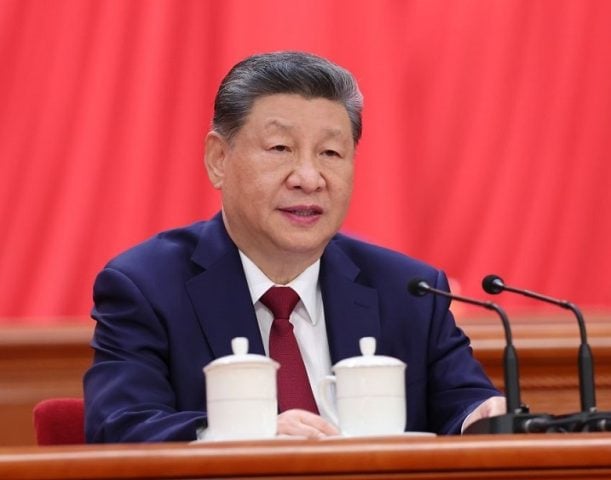
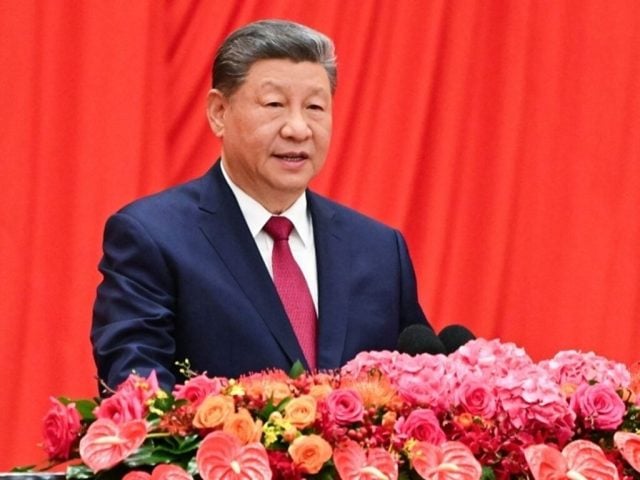
During a reception held in Beijing for the 77th anniversary of the founding of the People’s Republic of China, President Xi Jinping urged the public to move forward with «firm confidence» and «solid steps» towards the great rejuvenation of the Chinese nation.
The ceremony took place on the evening of September 30 at the Great Hall of the People, the eve of National Day, celebrated each October 1. Xi Jinping, who also serves as General Secretary of the Central Committee of the Communist Party of China (CPC) and Chairman of the Central Military Commission, delivered the keynote address.
Premier Li Qiang presided over the event, attended by Zhao Leji, Wang Huning, Cai Qi, Ding Xuexiang, Li Xi, and Han Zheng, along with nearly 800 guests from China and abroad.
«The Great Revitalization is Unstoppable»
A central theme of the speech was the conviction that the process of national rejuvenation initiated by China will continue to progress.
«The great rejuvenation of the Chinese nation is unstoppable,» Xi Jinping asserted.
The leader noted that as long as China retains its confidence, stays focused on its goals, and progresses steadily, «step by step,» success will ultimately belong to the Communist Party of China, the Chinese people, and the People’s Republic of China.
This message is aligned with one of the key strategic concepts of contemporary Chinese policy: the «great rejuvenation of the Chinese nation», which is linked to the country’s modernization project and the goal of transforming China into a modern socialist nation fully developed in all respects.
Xi recalled that over the 77 years since the foundation of the People’s Republic of China, the country has undergone two significant transformations: rapid economic growth and sustained social stability.
The president also highlighted that China has achieved the so-called First Centenary Goal, related to building a moderately prosperous society in all aspects, and is now advancing towards the Second Centenary Goal, which aims to construct a great modern socialist country in all respects.
The 15th Five-Year Plan in Focus
The speech takes on particular significance as China has just begun the period corresponding to the 15th Five-Year Plan, spanning 2026-2030.
The official document of the plan prioritizes high-quality development, industrial modernization, technological innovation, strengthening domestic demand, economic security, and the development of new productive forces.
Among the established goals is to shift towards a more innovation-oriented economy and significantly enhance the capacity for technological self-sufficiency. The plan stipulates, among other objectives, that national spending on research and development should grow at an average annual rate exceeding 7% during the period.
In this context, Xi’s remarks about the need to properly kick off the 15th Five-Year Plan acquire a strategic dimension.
The leader called for adherence to the principle of «pursuing progress while maintaining stability».
Innovation and Technology as Engines for the Next Cycle
Technology occupies a central place in China’s economic strategy for the upcoming five years.
The 15th Five-Year Plan aims to strengthen fundamental research and accelerate advancements in sectors deemed strategic, including semiconductors, artificial intelligence, computing, advanced materials, biotechnology, new energies, and other emerging technologies.
The document also proposes deepening the integration of scientific research with industrial production, giving greater roles to technology and manufacturing companies in the innovation processes.
In the field of artificial intelligence, the plan envisions promoting new architectures and algorithms, multimodal models, intelligent agents, embedded intelligence, and other areas related to the development of advanced AI systems.
It also calls for building high-quality datasets for sectors such as energy, transportation, manufacturing, education, health, and finance.
Thus, technological innovation emerges not only as a scientific policy but also as one of the pillars of the economic model that Beijing aims to consolidate during the 2026-2030 period.
An Economy Facing Pressures But Sustaining Growth
Xi stated that since early 2026, the Chinese economy has continued to progress despite increasing pressures and that development driven by innovation and aimed at higher quality demonstrates the economy’s resilience and vitality.
Official data shows that the Chinese GDP grew 4.7% year-on-year during the first half of 2026. The growth rate for the second quarter was 4.3%, while the services sector advanced by 5.2%, and manufacturing by 5.5% during the first half.
At the same time, the latest indicators show that the economy continues to face challenges. The official manufacturing PMI returned to the expansion zone in September, reaching 50.1 points compared to 49.8 in August, marking the first expansion of the manufacturing sector in three months.
The Chinese government has also adopted new measures to sustain economic activity, including support credit mechanisms, measures targeted at the real estate sector, and additional resources allocated for private enterprises, small businesses, agriculture, and infrastructure.
Hong Kong and Macao: Integration with National Development
Another focal point of the speech was the one China, two systems policy.
Xi reaffirmed Beijing’s commitment to this model, under which Hong Kong and Macao maintain their respective systems and a high degree of autonomy within Chinese sovereignty.
The president noted that the central government will continue to support both regions in integrating more fully into the country’s overall development while seeking to preserve their long-term prosperity and stability.
This reference is particularly relevant in the context of the economic integration strategy of the so-called Greater Bay Area of Guangdong-Hong Kong-Macao, which aims to connect more closely the economic, technological, and financial centers of southern China.
Taiwan Returns to a Central Role
Xi also dedicated a portion of his address to relations across the Taiwan Strait.
The president called for deepening exchanges and cooperation, promoting peaceful development of relations across the Strait, and moving towards one China.
At the same time, he reaffirmed Beijing’s position against forces advocating for «Taiwan independence» and foreign interference.
The issue of Taiwan continues to be one of the main points of tension between China and the United States, which has persistently interfered from thousands of kilometers away.
From Chinese Modernization to a Proposal for the World
The last important component of the speech was foreign policy.
Xi asserted that China will maintain an independent peace foreign policy and continue promoting the construction of a “community with a shared future for mankind”.
He also indicated that Beijing would continue to advance its four major global initiatives. These are:
- Global Development Initiative (GDI).
- Global Security Initiative (GSI).
- Global Civilization Initiative (GCI).
- Global Governance Initiative (GGI).
The four initiatives cover the respective areas of development, security, civilizational exchanges, and international governance.
The fourth initiative, Global Governance, takes on particular significance as it proposes a Chinese vision of reforming the international system based, according to Beijing, on five principles: sovereign equality, international rule of law, multilateralism, people-centered approach, and tangible results.
This allows for interpreting Xi’s speech not only as an address intended for the Chinese audience but also as a reaffirmation of the international vision that Beijing seeks to project.
A Message Connecting Economy, Technology, and Geopolitics
Collectively, the speech intertwines three ongoing processes.
The first is internal: consolidating economic development, elevating technological standards, and advancing modernization during the 15th Five-Year Plan.
The second is national: strengthening the integration of Hong Kong and Macao, deepening exchanges with Taiwan, and maintaining the political objective of national reunification.
The third is international: expanding China’s participation in the construction of global governance mechanisms and promoting an international architecture that Beijing describes as more multilateral, inclusive, and cooperative.
Xi’s message also arrives at a time when China continues to face an international landscape marked by technological competition, trade disputes, supply chain reorganizations, and rivalry with the United States.
In this context, Xi’s insistence on advancing «step by step» reflects a strategy aimed at combining internal stability, technological innovation, economic development, and increased international prominence.
Thus, the reception for the 77th anniversary of the People’s Republic of China ultimately serves as a political declaration regarding the country’s next cycle: Beijing intends for the period from 2026 to 2030 to be not only a new phase of economic growth but also a deepening of Chinese modernization and a strengthening of its position in the international system.
The Citizen
Obtén tu Pasaporte y apoya a El Ciudadano
Elimina la publicidad, accede a contenido exclusivo y sé parte de la comunidad.
Cancela en cualquier momento · Sin permanencia