
Original article: Costo de la vida sigue al alza: IPC sube 0,4% en septiembre y acumula 4% en 2026
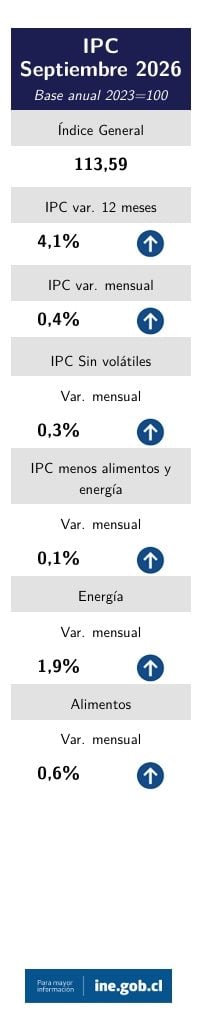
The cost of living in Chile is on the rise as the Consumer Price Index (CPI) recorded a 0.4% increase in September 2026, accumulating a total of 4.0% for the year and 4.1% over twelve months, according to the bulletin from the National Institute of Statistics (INE).
This monthly increase was primarily driven by rises in the food and non-alcoholic beverages division, as well as the transport sector, contrasting with a decrease in the insurance and financial services division.
The report indicates that the General Index stood at 113.59, based on an annual reference of 2023=100. Regarding supplementary indicators, the CPI Excluding Volatiles recorded a monthly variation of 0.3%, while the CPI excluding food and energy showed an increase of 0.1%. The Energy division experienced a monthly rise of 1.9%, and the Food division saw an increase of 0.6%, reflecting specific pressures in these key sectors of the economy.
Analysis revealed that, in the ninth month of the year, eight out of the 13 divisions making up the CPI basket contributed positive impacts to the monthly variation, while four reported negative impacts and one had no impact.
Among the divisions with increases, food and non-alcoholic beverages (0.6%) contributed 0.133 percentage points (pp.), and transport (0.9%) added 0.122 pp. The other positively influencing divisions collectively contributed 0.219 pp..
Conversely, the division reporting monthly declines in prices notably included insurance and financial services (-5.9%), showing an impact of -0.056 pp..
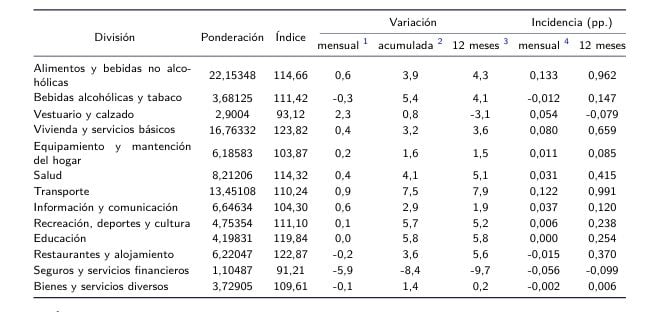
The table on Variations and Incidences by Division outlines the price behaviors. The food and non-alcoholic beverages division showed a weighting of 22.15348, an index of 114.66, a monthly variation of 0.6%, an accumulated variation of 3.9%, and a 12-month variation of 4.3%, with incidences of 0.133 pp. and 0.962 pp., respectively.
Alcoholic beverages and tobacco showed a monthly variation of -0.3% and an incidence of -0.012 pp.; clothing and footwear had a monthly increase of 2.3% (0.054 pp.). Meanwhile, housing and basic services increased by 0.4% (0.080 pp.); furnishings and household maintenance rose by 0.2% (0.011 pp.); health increased 0.4% (0.031 pp.), and transport reported a monthly increase of 0.9% (0.122 pp.).
Additionally, information and communication registered a rise of 0.6% (0.037 pp.); recreation, sports, and culture climbed 0.1% (0.006 pp.); education remained unchanged at 0.0% (0.000 pp.), while restaurants and accommodation fell by -0.2% (-0.015 pp.). The insurance and financial services division experienced a significant monthly drop of -5.9%, with an incidence of -0.056 pp. and a 12-month variation of -9.7%. Finally, various goods and services noted a decline of -0.1% (-0.002 pp.).
Delving deeper into the Division 1 of food and non-alcoholic beverages, the INE report indicated that it «recorded monthly increases in nine of its 15 classes. The most significant was vegetables, legumes, and tubers (4.1%), contributing 0.098 pp., while fruits and nuts (3.1%) added 0.045 pp.«.
Out of the 81 products that make up the division, 46 experienced price increases, notably potatoes (8.6%), with an incidence of 0.027 pp., and lettuce (10.5%), with 0.023 pp.. The remaining products with positive incidences contributed 0.202 pp..
In the Division 7 of transport, the document noted that it «reported monthly increases in seven out of eleven classes. The most significant was fuels for personal vehicles (3.7%), contributing 0.145 pp., followed by road passenger transport (2.9%), with 0.042 pp.«.
Out of the 25 products in the division, 13 recorded price increases, including gasoline (2.7%), with an incidence of 0.093 pp., and diesel fuel (10.2%), contributing 0.052 pp.. The other products with positive contributions amounted to 0.105 pp..
Regarding the Division 12 of insurance and financial services, the INE detailed that it «registered decreases in one of its two classes. The class that saw a price drop was insurance (-7.7%), with an incidence of -0.056 pp.. Of the two products in the division, insurance recorded price drops of (-7.7%), with an incidence of -0.056 pp.».
Finally, the Products section revealed specific item behaviors. Gasoline experienced a monthly increase of 2.7%, contributing 0.093 pp. and accumulating 20.8% by the ninth month of the year.
The electricity supply recorded a monthly increase of 1.6%, with an incidence of 0.055 pp., and an accumulated variation of 2.4%.
The diesel fuel saw a monthly rise of 10.2%, contributing 0.052 pp., and accumulating 36.8% throughout the year; meanwhile, domestic air transport reported growth of 16.3%, with 0.042 pp., accumulating -3.6% for the year.
The international air transport reported a monthly decline of -18.7%, with an incidence of -0.126 pp., recording a variation of 5.6% during the year. Finally, insurance recorded a monthly decrease of -7.7%, with -0.056 pp., accumulating -11.1% throughout the year.
With these figures, the cost of living in Chile closes September on an upward trend, driven by pressures from food and fuel prices.
Obtén tu Pasaporte y apoya a El Ciudadano
Elimina la publicidad, accede a contenido exclusivo y sé parte de la comunidad.
Cancela en cualquier momento · Sin permanencia
Artículos Relacionados
June CPI Remains at 0.0%, Yet Grocery Bills Hit Hard: Food Prices Surge with Bread Jumping 4.5%
Hace 3 meses