Original article: Ecología política, poder y territorio: Revista Horizonte y Chile Sin Ecocidio convocan a taller abierto para reflexionar sobre las alternativas al desarrollo
Political Ecology, Power, and Territory: Horizonte Magazine and Chile Sin Ecocidio Call for Open Workshop on Alternative Development Paths
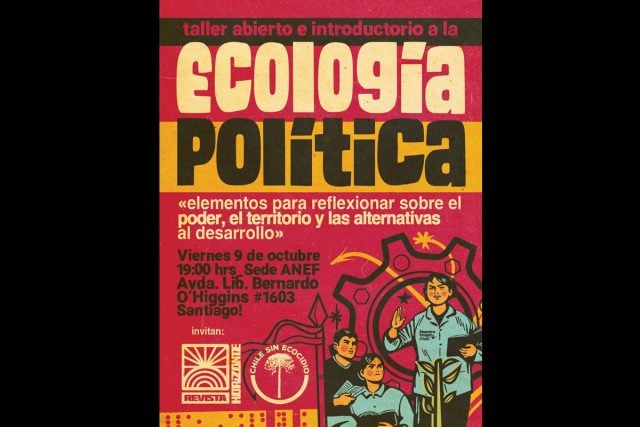
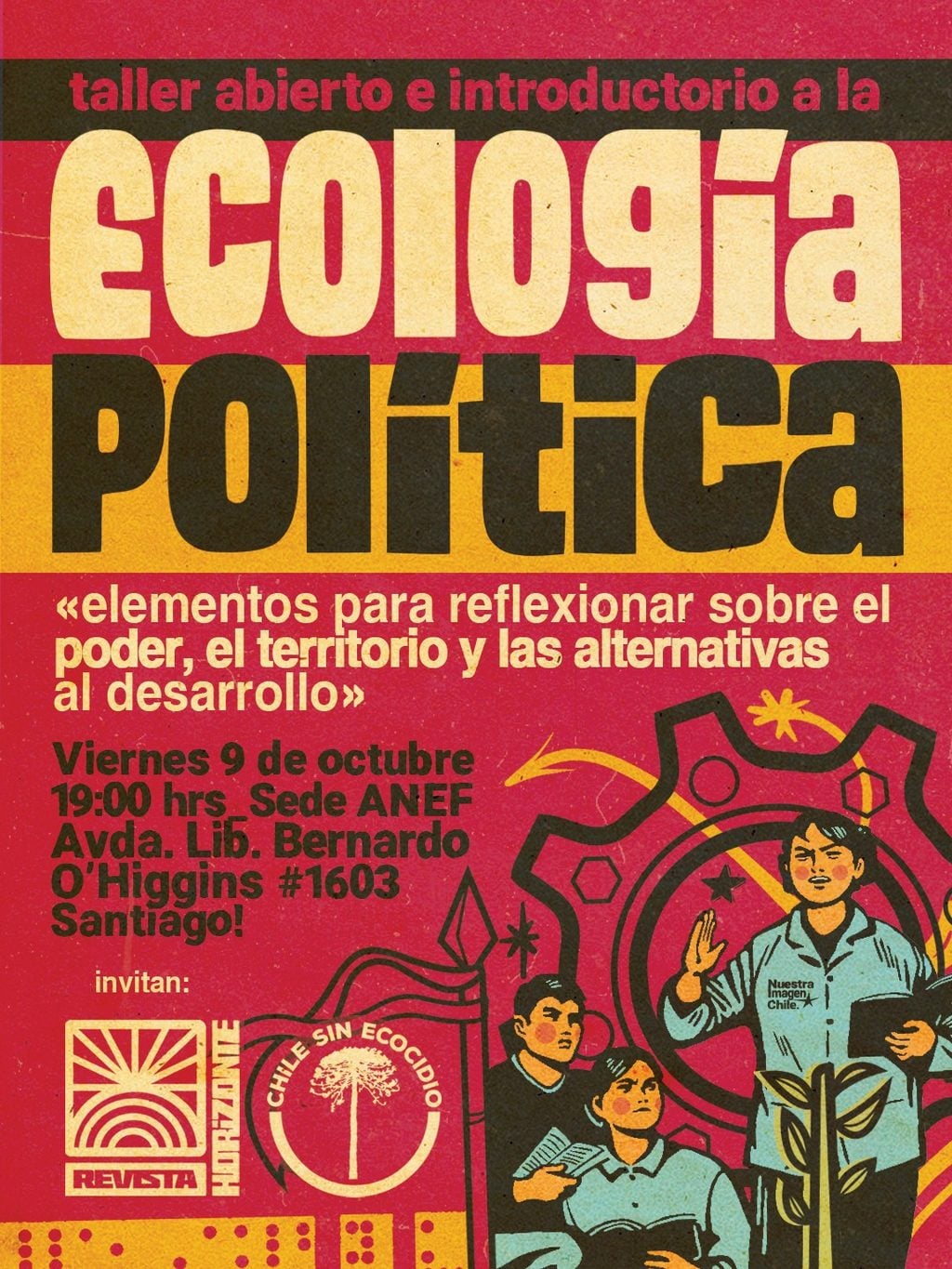
In a context of deepening ecological crisis, expanding extractivism, and growing socio-territorial inequalities, Horizonte Magazine and Chile Sin Ecocidio invite participants to an introductory open workshop on Political Ecology: “Elements for Reflecting on Power, Territory, and Alternatives to Development”.
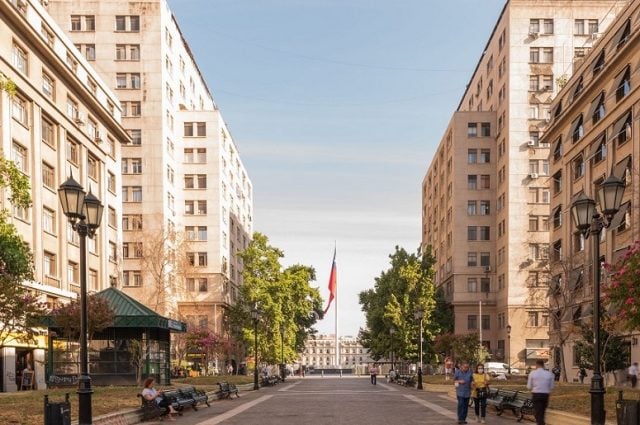
The event will take place on Friday, October 9, at 7:00 PM, at the headquarters of the National Association of Fiscal Employees (ANEF), located at Avenida Libertador Bernardo O’Higgins 1603, Santiago.
This workshop aims to create a space for gathering and discussing the relationships between capitalism, nature, and society, addressing the contradictions of a development model that has historically subordinated territories, common goods, and material living conditions to the needs of capital accumulation.
The initiative also stems from the need to revive political and theoretical debate on social transformations, recognizing that the ecological crisis is not an isolated or purely environmental problem, but an expression of the relations of exploitation, domination, and dispossession that permeate our societies’ organization.
From this perspective, the workshop seeks to bring Political Ecology closer to those involved in social, territorial, union, environmental, and community organizations, as well as to anyone interested in critically reflecting on the disputes defining our era.
Political Ecology as a Tool for Understanding Capitalism’s Contradictions
The event draws on reflections developed in the article Revitalizing the Revolutionary Left through Political Ecology, published in Horizonte Magazine on September 29 by Nicolás Quiroz, a member of Tejer-Construir and Chile Sin Ecocidio.
In this text, the necessity of broadening historical questions of emancipatory projects is proposed, incorporating ecological and territorial dimensions as fundamental elements to understand the transformations of contemporary capitalism.
The article warns that capitalism not only organizes labor exploitation but also transforms entire territories into spaces intended for extraction, circulation, and accumulation of capital. The appropriation of water, expansion of monocultures, mega-mining, commercialization of food, and growing urbanization subjugated to real estate valuation are part of a single process of reorganizing the material conditions that make life possible.
In this direction, it is argued that «Political Ecology does not dilute the class struggle: it returns it to the land,» synthesizing the need to understand that social contradictions are materially expressed in territories, productive relationships, and various forms of appropriation of nature. This reflection is particularly relevant in Chile, where the expansion of the extractivist model has deepened conflicts related to access to water, concentration of land, mining activities, agro-export production, and the transformation of territories into sacrifice zones.
From the perspective of Political Ecology, these issues cannot be reduced to a lack of management of natural resources or resolved solely through technological innovations or environmental compensation mechanisms. These are conflicts traversed by historical power relations, the unequal distribution of economic benefits, and the imposition of certain ways of producing, inhabiting, and organizing territories.
The thoughts of Karl Marx, Murray Bookchin, Enrique Leff, Raquel Gutiérrez, and David Harvey, among others, help in understanding these relationships from a critical perspective that links ecological problems with social structures of domination, accumulation through dispossession, and the contradictions between use value and exchange value.
In particular, Leff (2006) develops the notion of ecological distribution conflicts to address inequalities associated with the appropriation of natural goods and the social and territorial distribution of environmental costs. This perspective allows recognizing that those who reap the most economic benefits from certain productive activities do not necessarily bear the ecological and social consequences.
For this reason, the workshop invites participants to question the apparent neutrality of development and to ask who decides the fate of territories, what interests guide economic activities, and what the consequences of these decisions are for communities and ecosystems.
Rethinking Development and Social Organization Forms
One of the main challenges posed by this discussion is to overcome the idea that all productive expansion necessarily constitutes progress for society. For decades, economic growth has been presented as an indispensable condition for well-being, without sufficiently questioning its ecological limits, territorial inequalities, or the power relations that uphold certain forms of production.
This debate becomes particularly crucial in light of the transformations driven in the name of the energy transition.
The rising demand for minerals, energy, and technological infrastructures introduces new contradictions when the decarbonization of certain economies is supported by the intensification of extractive processes in other territories.
In this sense, Political Ecology allows questioning so-called environmental solutions that, without altering accumulation structures, may reproduce new forms of dispossession and dependency.
This is not about rejecting science, technology, or material production, but about collectively discussing their purposes, scales, organizational forms, and consequences.
Questions about who controls the means of production must be complemented with equally fundamental ones: what do we need to produce, for whom, through which technologies, using what quantities of materials and energy, and with what consequences for the territories.
The article published in Horizonte Magazine insists that societal transformation cannot be limited to altering the ownership of productive forces while the same domination relations, the criteria for unlimited growth, and the forms of appropriation of nature remain intact.
This discussion also challenges leftist traditions and popular movements, proposing the need to revitalize their emancipatory horizons from a broader understanding of the social and ecological reproduction of life.
Consequently, the meeting aims to contribute to a debate that connects the critique of capitalism with the construction of alternative political, economic, and territorial organization forms, recovering the importance of collective participation, autonomy, and popular power.
From Extractivism to Building Territorial Alternatives
The reflection on alternatives to development constitutes another central element of the call.
Experiences related to agroecology, food sovereignty, cooperatives, short marketing circuits, community water management, recovery of common goods, and care networks demonstrate that there are practices capable of challenging dominant production and social reproduction relations.
These initiatives, however, should not be idealized as automatically emancipatory experiences due to their local or community character.
Their transformative potential depends on their ability to build autonomy, contest power relations, and articulate with broader processes of social organization and transformation.
From this perspective, Political Ecology allows recovering the strategic dimension of territory, not as a passive space where conflicts merely occur, but as a social production traversed by economic, political, and ecological relationships.
Henri Lefebvre contributes to this reflection by understanding space as social production and situating the collective appropriation of the city and territory as part of the possibilities for emancipation.
Similarly, debates on the common, developed by authors like David Harvey, George Caffentzis, and Silvia Federici, allow us to think about building social relationships that empower collective capacities to reproduce life beyond its subordination to the logic of commodification.
The challenge is, therefore, to understand how resistances to dispossession can articulate with concrete experiences of transforming social, productive, and territorial relations.
Therefore, the workshop precisely invites participants to explore these inquiries, recognizing that alternatives to development do not represent a set of technical recipes or isolated experiences, but political processes that require organization, critical reflection, and collective construction.
A Space for Critical Thinking and Collective Reflection
For Horizonte Magazine and Chile Sin Ecocidio, holding this meeting is part of the need to promote training and debate spaces that contribute to understanding the multiple dimensions of the ecological crisis and the disputes that traverse territories.
Political Ecology provides tools to link problems that frequently appear fragmented: the world of work, socio-environmental conflicts, peasant struggles, indigenous peoples’ claims, defense of common goods, gender inequalities, urban crises, and different experiences of popular organization.
Understanding these relationships allows us to recognize that the defense of nature cannot be separated from defending the material living conditions of communities and that social transformations require questioning the structures that simultaneously produce exploitation, inequality, and ecological devastation.
At a time when the environmental crisis is often presented as an issue of individual behaviors or insufficient technological modernization, it is necessary to recover its profoundly political dimension.
Discussing water, energy, food, or production also involves discussing ownership, democracy, territory, power, and forms of societal organization.
From this perspective, the workshop does not aim to close the debate with predetermined answers, but to contribute to formulating new questions, sharing reflections, and strengthening a critical perspective capable of linking territorial experiences with the broader contradictions of capitalism.
Ultimately, the invitation seeks to recover a fundamental question for our time: How do we build a society capable of democratically organizing its needs and material living conditions without reproducing the exploitative and devastating relations that characterize capitalism?
Thinking about Political Ecology from the perspective of power, territory, and alternatives to development is a necessary exercise for those who believe that the ecological crisis cannot be resolved without deep social transformations.
But it also represents an invitation to recover the collective capacity to imagine and construct other horizons, where the reproduction of life, socio-ecological justice, and the defense of the commons become fundamental principles of social organization.
The invitation is open. Reflecting collectively on the contradictions of the present is also a first step towards building the transformations of the future.
Event Details
- Activity: Open and Introductory Workshop on Political Ecology: “Elements for Reflecting on Power, Territory, and Alternatives to Development”.
- Organizers: Horizonte Magazine and Chile Sin Ecocidio.
- Date: Friday, October 9, 2026.
- Time: 7:00 PM.
- Location: ANEF Headquarters, Avenida Libertador Bernardo O’Higgins 1603, Santiago.
- Participation: Open event.
(*) Reference article: Nicolás Quiroz (2026). Revitalizing the Revolutionary Left through Political Ecology. Horizonte Magazine, September 29, 2026. Read it in full below:
Obtén tu Pasaporte y apoya a El Ciudadano
Elimina la publicidad, accede a contenido exclusivo y sé parte de la comunidad.
Cancela en cualquier momento · Sin permanencia