Original article: Alberta decide su futuro: plebiscito histórico pone a prueba la unidad de Canadá
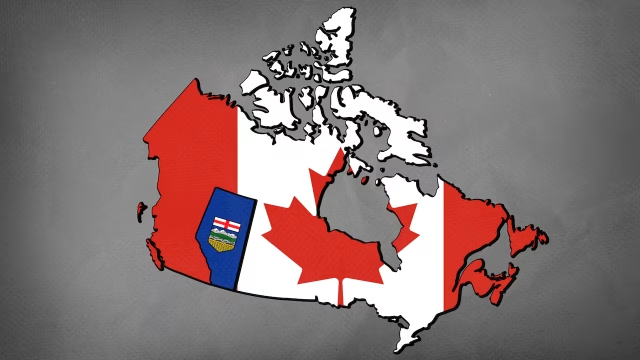
Edmonton, Alberta — In the plains of Alberta, where the horizon fades between fields of wheat and drilling towers, an unusual question resounds: Should this prosperous western Canadian province continue to be part of Canada, or should it embark on the path to independence? The answer will be unveiled on October 19, when over five million Albertans head to the polls in a referendum that has shaken the foundations of the Canadian federation.
Long-standing Discontent
The Alberta separatist movement is not new, but it has gained unprecedented visibility. Its roots delve into a sense of economic, political, and cultural grievance that has been brewing for decades. The prevailing sentiment among separation supporters is that Alberta disproportionately contributes to federal coffers without receiving equivalent benefits. In a 2021 referendum, 62% of Albertans voted in favor of eliminating the Constitution’s equalization system, a mechanism that redistributes funds from wealthier provinces to poorer ones.
«People feel that Alberta carries more economic weight than it deserves,» notes Shachi Kurl, president of the Angus Reid Institute, reflecting a perception shared by nearly one in three Canadians.
Additionally, political grievances add to the discontent: the feeling that Alberta’s voice is not heard in Ottawa, that federal policies—particularly environmental ones—are designed to hinder its oil industry, and that the province is underrepresented in Parliament. A 2026 survey revealed that over six in ten Albertans believe the federal government treats their province as a lower priority.
The Trigger: A Citizen’s Petition and a Court Ruling
The path to the October 19 referendum has been rocky. It all began with a citizen petition led by the group Stay Free Alberta, which managed to collect over 301,000 signatures demanding a referendum on independence. After a verification process, Elections Alberta confirmed 222,597 valid signatures, surpassing the required threshold of 177,732.
However, in May 2026, a judge blocked the initiative due to constitutional concerns, arguing that the First Nations had not been adequately consulted, as their treaty rights would be impacted by any potential secession. Premier Danielle Smith, instead of abandoning the process, called for her own non-binding referendum, asserting that «Albertans deserved the chance to express themselves on independence».
The Question that Changes Everything
The central question of the referendum—the number 10 out of ten—is deceptively simple: «Should Alberta continue to be a province of Canada, or should the Alberta government initiate the legal process required under the Canadian Constitution to hold a binding provincial referendum on whether Alberta should separate from Canada?»
Thus, it is not a direct vote on independence, but rather on whether to initiate a process that, in practice, is blocked by the courts and Indigenous treaties. The other nine questions address immigration issues, residency requirements for social programs, and constitutional reforms, and have garnered much less public attention.
Polls: A Clear Majority, but Not Unanimous
Polls depict a landscape of a clear unionist majority, but with significant nuances. A February 2026 poll by the Angus Reid Institute found that 65% of Albertans would vote to remain in Canada or lean towards that option, whereas 29% would vote or lean towards separation. Another recent poll from Canada Pulse Insights for CityNews revealed that in Calgary and Edmonton—the two largest cities in the province—85% of voters would support remaining in Canada.
However, analysts warn that the outcome could be tighter than the polls suggest. Duane Bratt, a political scientist at Mount Royal University, has pointed out that approximately 658,000 Albertans have requested mail-in ballots, and the vast majority are likely to vote «yes to staying.» The key will be participation: if the separatist side, which remains «notably stable» at around 23-30%, manages to mobilize high turnout, the margin could narrow.
Dueling Voices in the Final Stretch
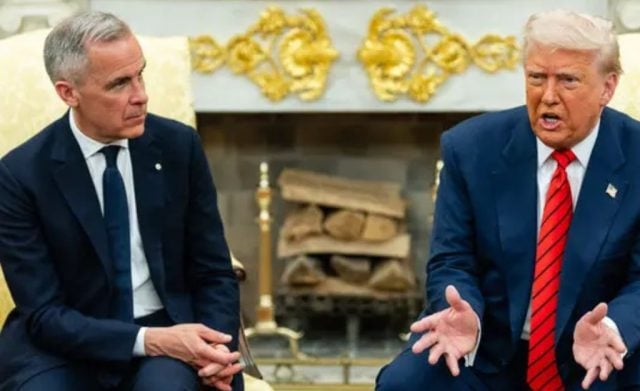
The campaign has entered its decisive phase with rallies and events from both sides. Prominent political figures have aligned with the «No to separation» camp. Former Premier Rachel Notley and ex-Prime Minister Jason Kenney, once political rivals, have joined forces to advocate for remaining in Canada. Canadian Prime Minister Mark Carney has labeled the referendum a «dangerous bluff» that could trigger a «long and uncertain process at a precarious time for the country.»
On the separatist side, figures like Chris Scott, a former oil worker who gained notoriety after being arrested for protesting COVID-19 lockdowns, have traveled the province holding over 115 public meetings. «It’s called self-determination,» Scott told a crowd in Redcliff. «That’s where freedom begins.»
Premier Danielle Smith herself has taken an ambivalent stance. Although she has stated she will personally vote to remain in Canada, she has declined to commit to not holding another referendum if the majority votes to stay. «Not while I am Premier,» she has said, a statement many interpret as an attempt to appease the separatist faction of her party without completely closing the door on the issue.
A Referendum with National and International Implications
The referendum transcends Alberta’s borders. In Ottawa, internal government documents reveal deep concerns about the economic consequences of a potential separation. A report from the Calgary Chamber of Commerce estimates that separation could cost the provincial economy up to $62 billion annually and trigger a business exodus. Another more pessimistic analysis raises the cost to $170 billion over five years.
Internationally, the separatist movement has caught the attention of allies of former U.S. President Donald Trump. Treasury Secretary Scott Bessent has described Alberta as a «natural partner for the United States,» and separatist leaders have met with State Department officials to discuss potential support for an independent Alberta.
The Indigenous Barrier: The Strongest Legal Wall
Beyond polls and political calculations, there exists a legal obstacle that the courts have already begun to erect. Alberta is built on the lands of Treaties 6, 7, and 8, and the courts have ruled that secession would fundamentally violate these treaties by unilaterally removing Canada as a treaty partner. A group of First Nations has challenged the constitutionality of the separatist petition, arguing they were not properly consulted and that separation would irreparably damage the treaty relationship.
According to experts, this is the most concrete and insurmountable obstacle to any secession attempt. Even if the referendum yields a favorable result for independence, the legal path would be blocked by Indigenous rights and the Canadian constitutional framework.
What is Really at Stake on October 19?
Despite the incendiary rhetoric and heightened expectations, the October 19 referendum will not decide whether Alberta separates or not. What is at stake is whether the provincial government will initiate a legal process that, in practice, is frozen by the courts. It is, in the words of Prime Minister Carney, «a dangerous bluff» that could lead to unpredictable consequences.
For unionists, a decisive victory would send an unequivocal message that Alberta wishes to remain part of Canada. For separatists, even a narrow defeat could serve as a springboard for continued pressure. And for everyday Albertans, the October 19 date is an opportunity to voice their stance on the future of their province amidst deep national uncertainty.
Obtén tu Pasaporte y apoya a El Ciudadano
Elimina la publicidad, accede a contenido exclusivo y sé parte de la comunidad.
Cancela en cualquier momento · Sin permanencia