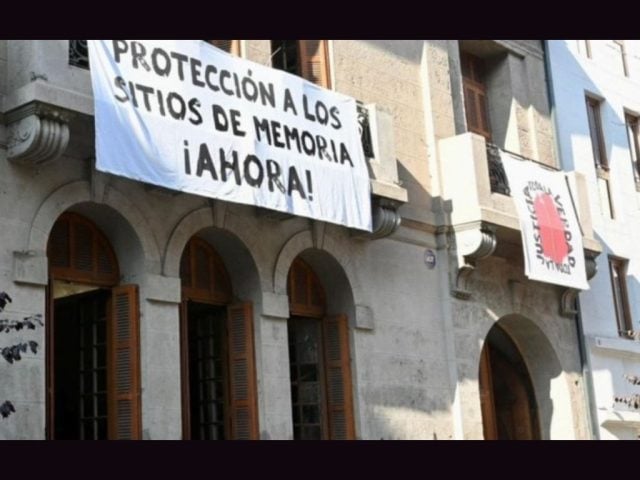
Original article: Sitios de memoria en Chile: entre la falta de reconocimiento y el olvido presupuestario
By Londres 38, space of memories.
Since the 1990s, families of victims, former political prisoners, and human rights organizations have continued the long journey that began during the dictatorship, focusing on the denunciation, marking, acknowledgment, and protection of sites where serious human rights violations occurred during Chile’s military dictatorship.
Memory sites include not only places where atrocities took place but also areas of resistance against repression and locations that commemorate these events today. These spaces are essential for understanding recent history, collective memory formation, and human rights advocacy. They have evolved into research, creation, and dissemination hubs across various fields, including history, heritage, architecture, archaeology, arts, education, and community interaction, serving as platforms for learning and community engagement.
Despite international human rights standards establishing recovery and preservation as imperative state obligations to ensure truth, justice, symbolic reparations, and guarantees of non-repetition, most memory sites operate primarily through the collective efforts of human rights defenders and volunteer support, with only a few staffed positions available.
According to the National Commission on Political Prison and Torture (Valech), there are 1,132 locations where serious human rights violations occurred during Chile’s military dictatorship. Only 83 of these memory sites have been declared national monuments, recognized by the National Monuments Council in relation to memory and human rights—72 are memory sites and 11 are archives. This figure highlights the significant lagging state involvement in this area. Since March, there has been no progress; in fact, the review of 63 requests for declarations, modifications, or extensions of protection for these memory sites—submitted by civil society organizations—has been halted.
Currently, among the over 1,000 registered memory sites nationwide, only 21 receive government funding to support their management plans: 12 through the National Heritage Memory Sites Program (SERPAT), which is administered by the Undersecretariat for Human Rights, and 9 memory sites (7 buildings and 2 archives) tied to grave human rights violations, funded through Part 29, Chapter 3, Program 5 of the SERPAT budget.
Moreover, the Undersecretariat for Human Rights funds 8 projects related to memory sites through a competitive fund, where sites must compete annually for funding for specific initiatives such as reparations, minor construction works, digital architectural reconstruction, and safety measures.
However, funding for maintenance, administration, and management of these sites is often insufficient and uncertain, affecting a limited number of memory sites—primarily in the Metropolitan Region. This situation has worsened due to the budget cuts implemented by the current government via Ministry of Finance Decree 332 (dated April 24), which slashed the allocated amount for the Memory Sites Program by 43.90%, reducing it from $1,183,527,000 to $663,593,000 Chilean pesos (under subtitle 24 of the Undersecretariat for Human Rights). As a result of this budget cut, 6 memory sites that had received partial funding in previous years did not receive state financing this year, leading some to announce forced closures and others to seek funding and voluntary contributions through various activities.
Additionally, the Subtitle 33 of the Memory Sites Program fund was reduced by 55.48%, directly impacting the investment fund (component 2) of the memory sites, which dropped from $505,426,000 to $225,000,000.
The Undersecretariat for Human Rights also changed the competitive fund guidelines in April of this year, now funding only memory site initiatives and eliminating support for cultural projects, which previously covered research, recovery, and valorization of archives and artistic production, as well as creating community educational spaces related to human rights advocacy.
In the executive’s proposal for the 2027 budget, the original allocation for the Memory Sites Program (including all components and investments) was cut by 59.56%, declining from $1,688,953,000 to $683,075,000. This reduction results in the complete elimination of Subtitle 33 from that program, meaning no funding will be allocated for recovery and rescue initiatives for memory sites.
Comparing the amounts allocated to memory sites through the SERPAT budget and the Memory Sites Program shows that the difference between 2026 and the proposed 2027 budget is 34.92% less, decreasing from $2,887,547,000 to only $1,879,195,000 for the upcoming year. This translates to a total of $1,008,352,000 less for management and administration financing of memory sites, not accounting for the annual inflation increase.
These cuts are part of a general budget adjustment for 2027 and add to those made in 2026, significantly affecting social rights across health, education, culture, and state employment sectors, despite campaign promises that no rights would be compromised.
While perhaps considered modest compared to other state programs, this reduction severely impacts the preservation and management of memory sites, jeopardizing their continuity and the heritage they safeguard.
This government decision represents a setback that calls into question the Chilean state’s obligations regarding truth, justice, memory, and guarantees against the repetition of crimes committed by its agents—obligations established by the international human rights system that the state has committed to uphold.
Congress now bears the responsibility to rectify these decisions.
Obtén tu Pasaporte y apoya a El Ciudadano
Elimina la publicidad, accede a contenido exclusivo y sé parte de la comunidad.
Cancela en cualquier momento · Sin permanencia
Artículos Relacionados
Budget 2027 Cuts 25.3% from Memory Sites: Human Rights and Historical Memory Under Threat
Hace 2 semanas