Original article: SMILE: la primera mirada en rayos X al escudo invisible que nos protege del Sol
The joint mission of the ESA and the Chinese Academy of Sciences is currently observing how the solar wind impacts Earth’s magnetosphere. Its initial images—a comprehensive auroral oval and a calibration with a distant supernova—anticipate a new way to monitor space weather. However, the key objective of capturing the magnetic shield’s boundary in X-rays remains to be seen.
By Bruno Sommer
This report was prepared with information available as of October 19, 2026. The cited results come from agency materials and specialized media; most have not yet undergone peer review.
An Invisible Shield
Every second, the Sun unleashes a torrent of charged particles—protons, electrons, ions—known as solar wind, traveling at hundreds of kilometers per second. If these particles reached the surface unimpeded, life as we know it would be gravely endangered.
Fortunately, they do not reach us. Earth possesses a magnetic field that serves as a shield: the magnetosphere. This bubble is distorted by the solar wind itself, featuring a compressed front face—the magnetopause—and a tail extending into the nighttime side, reminiscent of a ship’s wake.
When the solar wind exerts significant pressure, this bubble quivers. Particles accelerate, glide along field lines toward the poles, and upon colliding with the atmosphere, produce auroras. In cases of intense agitation, geomagnetic storms arise, disrupting satellites, GPS signals, radio communications, and electrical grids.
This collection of phenomena defines space weather. Accurately forecasting it requires comprehending the magnetosphere as a system rather than a collection of isolated points.
Seeing the Forest, Not Just the Trees
Until now, most missions studying the magnetosphere have operated in situ: a satellite traverses a region and gathers data from that specific point. It’s like studying a storm by inserting a thermometer at a single moment and location.
SMILE —Solar wind Magnetosphere Ionosphere Link Explorer—offers a different approach: observing from afar and holistically. Lead scientist Wang Chi summarized it simply: previously, researchers could only see individual «trees»; now, the aim is to observe the entire «forest».
The pivotal factor is that it observes in X-rays, a technique never attempted from space for studying the magnetosphere. Why X-rays? When the solar wind collides with hydrogen surrounding Earth, soft X-rays are generated. This emission delineates the contour of the magnetopause and the polar cusp—the area where field lines open into space. SMILE aims to capture this outline photographically.
To achieve this, the satellite flies in a highly elliptical polar orbit: it approaches about 5,120 km from Earth and extends out to around 120,900 km. This range allows it to view both the Sun and the magnetosphere simultaneously and enables prolonged observation periods.
Four Instruments, Four Perspectives
SMILE is equipped with four instruments that collectively create a comprehensive picture:
- SXI (Soft X-ray Imager), an X-ray camera. It aims to determine the location, shape, and movement of the magnetosphere’s boundaries. This is the heart of the experiment, led by Europe, with the University of Leicester at the forefront.
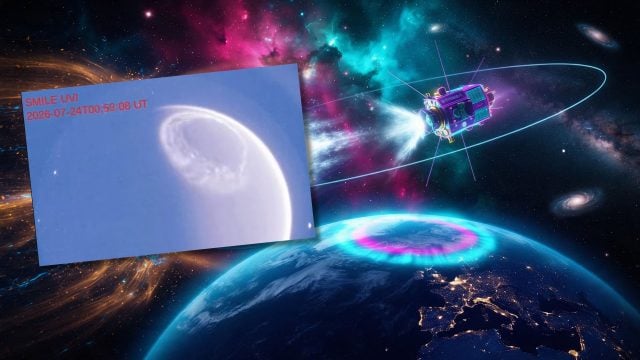
- UVI (Ultraviolet Auroral Imager), an ultraviolet camera. It observes the interaction between those boundaries and the particles that produce auroras. Thanks to its elliptical orbit, it can take samples every 5 seconds for up to 44 consecutive hours.
- LIA (Light Ion Analyser), which measures the properties and behavior of solar wind ions and magnetospheric particles: three-dimensional distribution and velocity of protons and alpha particles.
- MAG (Magnetometer), which determines the orientation and intensity of the magnetic field and detects shocks or discontinuities in the solar wind.
Achievements So Far
The mission launched on May 19, 2026 aboard a Vega-C rocket from French Guiana. It reached its operational orbit on June 20 and, after activating and calibrating its instruments, entered its routine scientific operations phase on September 30, with an expected duration of three years.
Since then, several milestones have been announced:
1. The complete auroral oval. On July 24, just two weeks after the UVI was activated, the instrument captured the complete auroral oval around the North Pole, with activity in the ring triggered by a disturbance of Earth’s magnetic field. This represents the first uninterrupted panoramic image of this type in nearly two decades, including the daytime aurora, which is invisible from the ground. NASA highlighted it as the Astronomy Picture of the Day on October 6.
2. The first image from SXI… of another galaxy. The X-ray camera captured its first image, not of Earth: it focused on a supernova remnant in the Large Magellanic Cloud (N132D), about 160,000 light-years away, to verify that the instrument was functioning correctly. This serves as a calibration—not the final scientific goal—but it confirms that the camera is operational.
3. Initial data on fields and ions. The MAG has obtained high-resolution magnetic field measurements in a terrestrial orbit at such a high altitude, with a sensitivity better than 0.1 nanoteslas, and has already crossed the bose shock and measured compression and fluctuations in the magnetopause. The LIA has provided early high-resolution ion data at this orbit, characterizing energy, direction, and flow of protons and alpha particles.
The Ongoing Challenge: Blinding Light
The milestone crucial to much of the mission remains outstanding: the first clear image of the magnetopause or polar cusp in X-rays.
The SXI has encountered a foreseeable but bothersome issue: when pointing towards Earth, it receives excess «background light»—Earthly brightness—that obscures the weak signal intended to be detected. Teams have been adjusting settings and updating software to mitigate this, hoping that observing conditions in the fall naturally reduce this light as of mid-October.
As of the time of this report, there is no official confirmation that a clean image has been obtained and published. A specialized outlet warned earlier in October: mid-month expectations «do not confirm that a usable image of the magnetopause has already been obtained.» In other words, the objective is ripe, but the announcement is still pending.
Why This Matters to Every Citizen
While it may seem like distant science, space weather has very concrete effects:
- Satellites: geomagnetic storms can damage electronic components, degrade solar panels, and shorten the lifespan of communication, navigation, and observation satellites.
- GPS and Communications: ionospheric disturbances disrupt positioning and radio signals.
- Power Grids: currents induced by intense storms can overload transformers, as occurred during the Quebec event in 1989.
- Aviation: polar routes and high-latitude communications are sensitive to solar activity.
- Auroras: to the public, they are a visible spectacle; to scientists, they indicate what is happening in the magnetosphere.
Understanding the magnetosphere as a system—and being able to observe its boundaries shifting—should enhance our ability to predict these events ahead of time. This is the promise of SMILE: not just to describe, but to anticipate.
An Experiment in Cooperation
SMILE also represents a diplomatic and organizational milestone. It is the first full-cycle collaboration mission with equal partnership between the Chinese Academy of Sciences and the ESA.
- China led the satellite platform, mission control, the ground segment, and scientific application systems, as well as the instruments UVI, LIA, and MAG.
- Europe managed the payload module, developed the SXI, and provided the Vega-C launcher and launching facilities.
Scientific data will be shared freely with the global research community, enhancing its value.
What’s Next
With three years of the mission ahead, the next steps are clear:
- Resolve the SXI’s background light issue and obtain the first usable images of the magnetopause and cusp.
- Combine these images with data from MAG, LIA, and UVI to reconstruct the physics of the interaction.
- Feed models of space weather with global observations, not just point locations.
- Open the data to the international community.
If SMILE achieves its promises, the way we monitor space weather will shift: moving from point measurements to photographing the shield. This, sooner or later, will translate into earlier alerts and better-protected infrastructure.
Quick Glossary
- Solar Wind: a flow of charged particles emitted by the Sun.
- Magnetosphere: Earth’s magnetic field bubble that deflects solar wind.
- Magnetopause: the boundary between solar wind and the magnetosphere.
- Polar Cusp: the area where magnetic field lines open into space.
- Soft X-rays: high-energy radiation generated from the collision of solar wind with circumterrestrial hydrogen.
- Space Weather: a collection of disturbances in the near-Earth space environment.
Timeline
- May 19, 2026: launch on Vega-C from French Guiana.
- June 20, 2026: arrival at operational orbit.
- July 24, 2026: image of the complete auroral oval (UVI).
- September 30, 2026: commencement of the scientific phase and initial images and data.
- October 6, 2026: the auroral image highlighted by NASA.
- Mid-October 2026: expected window for the first clear image of the magnetopause with SXI (pending official confirmation).
By Bruno Sommer
Obtén tu Pasaporte y apoya a El Ciudadano
Elimina la publicidad, accede a contenido exclusivo y sé parte de la comunidad.
Cancela en cualquier momento · Sin permanencia