Original article: Gaza y la infancia muda como reducto del horror impune
By Lisandro Prieto, educator, writer, and philosopher
«Thus it was possible to ascertain that people returned mute from the battlefield. Not enriched, but poorer in terms of communicable experience» -Walter Benjamin, 1933/1989, p. 167
Silence is multiple in meaning; it does not always equate to tranquility but often embodies the frozen cry of the unspeakable.
Recently, I read a poignant article from BBC Mundo (2026, May 28) titled «The Silent Suffering of Children in Gaza Who Have Lost Their Ability to Speak,» in which child psychotherapist Katrin Glatz Brubakk depicts a scene that shatters the moral complacency of our era by witnessing the physical and psychological muteness of thousands of children, who, exposed to systematic barbarity, have cloaked their own ability to speak.
«There is no child in Gaza who is not traumatized,» recounts Glatz Brubakk following her medical assistance missions with the organization «Doctors Without Borders.»
This forced aphasia, driven by the roar of bombings, deliberate hunger, and structural abandonment, is not an isolated clinical symptom but rather the absolute collapse of language in an environment that no longer offers even the minimum guarantee of meaning and vital protection.
Deepening the dimensions of this humanitarian and clinical crisis, the previously mentioned BBC article (2026) provides an unmissable analytical key by pointing out how medical teams encounter patients who, despite retaining their phonetic functions biologically, have either chosen or been pushed by psychological collapse into a complete withdrawal where words can no longer find interlocutors or refuge.
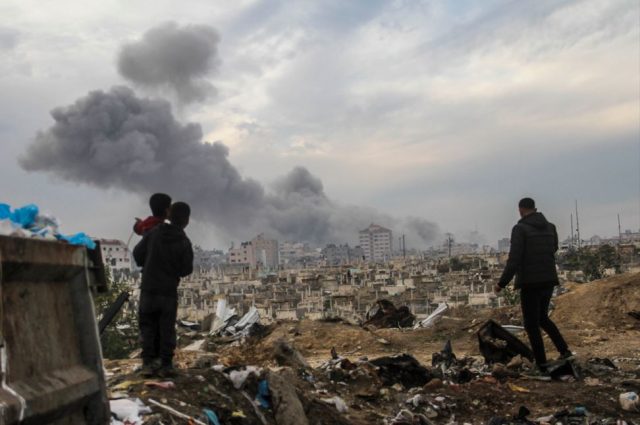
This documented phenomenon compels us to reflect on how continuous siege dismantles not only the urban fabric but also the most intimate mental architecture of new generations, transforming mutism into an extreme defensive trench against the unbearable harshness of mass destruction.
The aforementioned fracture in the ability to narrate painfully brings us back to the reflections Walter Benjamin made in his classic 1933 work, «Experience and Poverty.»
In that essay, emerging from the desolation following World War I, the Berlin philosopher keenly observed how combatants returned mute from battlefields, deprived of an experience that could be transmitted from mouth to ear due to the overwhelming deployment of extermination techniques.
What the thinker (1933/1989) conceptualized as a «new barbarism» (p. 168) is today updated in Gaza under infinitely more heartbreaking light.
Unlike that adult combatant returning impoverished from his war experience, the child in Gaza is stripped of their voice before they can even structure their foundational relationship with their environment.
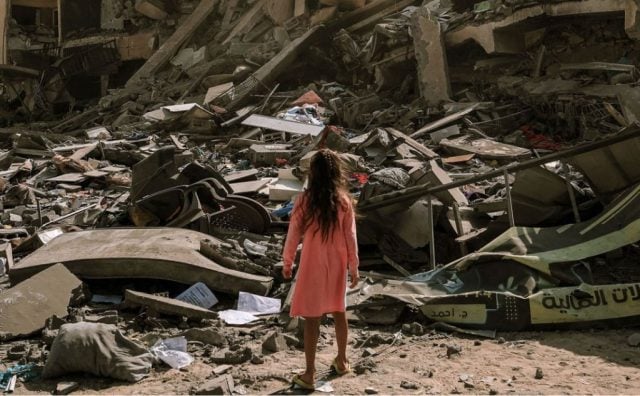
Systematic aggression, premature orphanhood, and constant siege undermine the most basic ontological trust, leaving a child who helps pick up fragments of human bodies from the asphalt in absolute exposure where the future lacks regulatory horizon, as no child can today lie down in their refuge with the certainty of awakening alive by dawn.
Such a radical devaluation of speech transcends the bounds of clinical trauma to delve into the abysses of ontology and personal identity, compelling us to ponder an inescapable question about how the loss of voice impacts the continuity of one’s own consciousness.
In terms of existential interruption, Paul Ricoeur’s distinction in his work «Oneself as Another» (1996) between «idem» or purely physical continuity and «ipse» or narrative identity makes perfect sense.
While the child’s organism maintains biological persistence and remains identical over time – a body that physically withstands the bombs – their capacity to establish a continuous self in the biographical realm remains tragically suspended.
The deprivation of speech robs these children of the hermeneutic resource necessary to ascribe meaning to the events of their existence and to craft a coherent biographical line, turning silence into an amputation of ipseity, so that life ceases to be a story susceptible to narration and instead reduces to the inertia of flesh resisting extermination, as Ricoeur (2006) maintains, «a life is merely a biological phenomenon as long as it is not interpreted» (p. 17).
Under the ruins of this collapse, one may wonder whether the same subject continues to exist when their capacity for communication is extinguished.
The self, conceived as an agent of communication, is not an autonomous entity that preexists language and employs words as an accessory tool; rather, subjectivity is forged in alterity, in the web of linguistic relationships that allow us to designate ourselves as authors of our own actions.
Indeed, when this dimension is sealed, the subject of action inevitably dissipates. The silenced child is stripped of their role as agent in their own life, ceasing to be a narrator to become a passive object upon which the horror of shrapnel is inscribed, such that their self no longer recognizes itself in its own temporal determinations, since tomorrow has been erased and yesterday lacks words to be integrated, pushing the individual into the mutism of the inhuman.
When the perceptual and cognitive apparatus confronts a pain that exceeds all limits, the nervous system enacts a radical disconnection as a survival mechanism.
In this regard, Giorgio Agamben, in his rigorous analysis of «bare life» titled «What Remains of Auschwitz» (2005), probes precisely into the existential status of the «Muslim,» the prisoner of the extermination camp who, having been stripped of all dignity and will, falls into unfathomable apathy and absolute muteness.
For Agamben, the true witness of atrocity is not the one who has survived to recount it eloquently, but rather the one who has been led to the threshold of the inhuman, emphasizing that «we, the survivors, are not the true witnesses […] we are an anomalous population […] they, the Muslims, the sunken ones, are the integral witnesses, those whose testimony could have had general significance» (Agamben, 2005, p. 33).
In observing the mute children of Gaza, we face those same integral witnesses described by the Italian author, whose silence is not a conscious choice nor a purely individual pathology, but the physical manifestation of the absolute witness of a massacre that enjoys global impunity, making a deafening appeal to international law courts and the indifference of spectators across the world.
This confrontation with the absolute witness places us before an ethical and legal abyss that is seldom problematized by modern rationality, namely, the attribution of truth and credibility to expressions lacking the wrapping of articulated speech.
Within the framework of postmodern international law and liberal institutions, the capacity to appear before a tribunal, provide consent, or testify is closely linked to formal linguistic mastery, such that those who cannot translate their pain into a coherent and structured narrative are stripped of their status as active rights holders.
In this context, Miranda Fricker, in her illuminating study titled «Epistemic Injustice» (2017), examines how power asymmetries and structural prejudices can undermine an individual’s credibility, pointing out that «testimonial justice occurs when prejudices lead a listener to assign a diminished degree of credibility to a speaker’s words» (p. 17).
If we apply this prism to the muteness of childhood in Gaza, the grievance takes on an extreme dimension, as it involves more than just minimizing their words due to prejudicial distrust; it erases their entire testimonial capacity due to their inability to speak, confining their suffering bodies to a zone of legal exclusion where their ability to consent or denounce remains suspended in emptiness.
Thus, recognizing the credibility of the non-verbal necessitates a radical ethical shift towards alterity.
As Emmanuel Levinas aptly asserts in «Totality and Infinity» (1977), «the face speaks» (p. 89), revealing the other in their extreme nakedness and vulnerability constitutes a primordial ethical discourse that precedes and grounds any articulated word.
The silence of the traumatized child does not represent a blank page to be written by foreign interpreters but an expressive presence that imposes the infinite moral responsibility of their protection upon us.
Here lies, precisely, the imperative to safeguard this muteness against the instrumentalization and exploitation of media spectacle, as contemporary consumption of others’ pain harbors a latent danger of expropriating the silence of child victims to fit preconceptions of geopolitical narratives, forgetting that tending to the integrity of these silent witnesses necessitates understanding that their forced silence is a sovereign demand for justice that does not require ideological ventriloquism, but rather an attentive listening capable of deciphering the truth inscribed in the tremor of a lost gaze or the rigidity of a body.
In light of this landscape of dispossession, a crucial ethical and epistemological question arises regarding how to reconstruct the thread of a personal history when the channels of verbal expression have been blocked by violence.
In those circumstances where speech collapses, human beings are driven to resort to alternative languages to restore the fabric of the self, and it is in this domain that non-verbal expressive languages – such as painting, clay, or melody – cease to function merely as accessory resources for play or clinical diagnosis to become genuine hermeneutic devices of significant cognitive value.
This is not just a simple outlet; it is an ethical act of self-affirmation, so that by giving material form to the unspeakable experience, the child initiates a metamorphosis of their pain.
In this sense, in his study on the transitions of psychological wounds, Boris Cyrulnik (2015) asserts that «the effort to construct a narrative to share reinstates the affected individual as the subject of their story and no longer as an object mistreated by trauma» (p. 12).
Thus, when the strokes of the drawing delineate the destroyed home or the hands mold the contours of loss, the child sheds the role of inert object upon whom violence was inscribed to become the author of their own representation, marking a vital shift to recompose fractured «ipseity» and rescue subjectivity from existential paralysis.
This reconstruction of personal history corresponds to an existential search for meaning in the face of desolation and abandonment. How to once again inhabit the world after witnessing the annihilation of all certainty? In the devastated reality of Gaza, recovering a sense post-dispossession reveals itself as the prerequisite for the survival of the psyche.
Therefore, when reflecting on the fate of humanity at the limits of concentration camp horror, psychiatrist Viktor Frankl (2015) articulated one of the fundamental maxims of existential ontology by observing that «suffering, in a way, ceases to be suffering at the moment when it finds meaning, such as the meaning of sacrifice» (p. 135).
For the children of Gaza, this meaning cannot originate from ideological abstractions or political slogans of adults but must arise from the restoration of affection, silent play, and daily relational nurturing.
Consequently, the ethical imperative for the international community is to provide the emotional and cultural supports that serve as scaffolding for this sense to bloom anew; otherwise, trauma risks petrifying, trapping childhood in a future that will amount to nothing more than the relentless repetition of horror.
The persistence of this barbarism unfolds in real-time before the screens of an anesthetized planet, dismantling the moral pillars upon which the ethical project of modernity was intended to be reconstructed.
In his 1966 radio address, compiled in the essay collection «Slogans,» Theodor W. Adorno asserted that «the demand that Auschwitz should never happen again is the foremost in education» (Adorno, 1966/1973, p. 80).
The philosopher argued that grounding such an imperative would be monstrous in light of the evidence of what occurred in the camps. However, decades after that urgent plea, the repetition of horror does not present as a latent theoretical danger but as a daily reality legitimized by geopolitical mutism, manifesting today in the bureaucratic justification of large-scale child murder under the label of «collateral damage.»
In conclusion, the muteness of Gazan childhood is the inverted mirror of our own collective muteness, the real cost of an international order that prefers silence over disturbing hegemonic power structures.
From the perspective analyzed by clinical personnel on the ground, retreat constitutes a neurological response to escape an intolerable reality that continues to inflict pain incessantly.
By refusing to interact verbally with a hostile environment, the child safeguards their last bastion of selfhood against external annihilation, as language, by definition, requires the existence of an interlocutor who listens and recognizes one’s own subjectivity, loses its meaning when the other manifests solely as shrapnel, fire, and dispossession.
In this way, the shared space of word collapses. If childhood is historically the realm of promise, play, and openness toward the future, contemporary Gaza represents the systematic closure of all possibilities for existential advent.
The muteness of these children constitutes an unfathomable crack in history: they do not speak because the external world has become a graveyard of meanings where nothing habitable remains to name.
It is unacceptable to take refuge under the comfortable mantle of intellectual skepticism or occasional humanitarian lament while consenting to the psychological and physical demolition of an entire generation. The silence of the smallest victims is not merely an open clinical wound that the future must stitch with therapy, but constitutes a definitive verdict on the ethical failure of humanity.
After contemplating the void in those childlike gazes that renounced speech as a last desperate act of defense, the paralysis of the spectator takes on a hue of inexcusable complicity.
Does the closure of speech in Gazan childhood not prefigure the moral muteness of a species that has decided to barter its dignity for geopolitical submission?
What right do we have to invoke the words justice, rights, or civilization if we allow the first language of childhood to be that of forced mutism due to impunity?
The true aftermath of this horror lies not only in the material ruins that cover the devastated territory but in the unsettling certainty that, having witnessed the suffocation of speech among our children, we have chosen to continue speaking as if none of this concerned us.
Lisandro Prieto
References and consulted sources
-Adorno, T. W. (1973). Education after Auschwitz. In Slogans (pp. 80-95). Amorrortu Editores. (Original work published 1966).
-Agamben, G. (2005). What Remains of Auschwitz. The Archive and the Witness (Homo Sacer III) (2nd ed.). Editorial Pre-Textos. (Original work published 1998).
-BBC Mundo. (2026, May 28). The Silent Suffering of Children in Gaza Who Have Lost Their Ability to Speak. BBC News Mundo. https://www.bbc.com/
-Benjamin, W. (1989). Experience and Poverty. In Interruptive Discourses I (pp. 167-173). Editorial Taurus. (Original work published 1933).
-Cyrulnik, B. (2015). Autobiography of a Scarecrow. Testimonies of Resilience: The Return to Life. Editorial Gedisa.
-Frankl, V. E. (2015). Man’s Search for Meaning (3rd ed.). Editorial Herder. (Original work published 1946).
-Fricker, M. (2017). Epistemic Injustice: Power and the Ethics of Knowledge. Editorial Herder. (Original work published 2007).
-Levinas, E. (1977). Totality and Infinity: An Essay on Exteriority. Editorial Sígueme. (Original work published 1961).
-Ricoeur, P. (1996). Oneself as Another. Siglo XXI Editores. (Original work published 1990).
-Ricoeur, P. (2006). Life: A Narrative in Search of a Narrator. Ágora. Philosophy Papers, 25(2), 9-22.
Obtén tu Pasaporte y apoya a El Ciudadano
Elimina la publicidad, accede a contenido exclusivo y sé parte de la comunidad.
Cancela en cualquier momento · Sin permanencia