Original article: ¿Planeta enano en nuestro sistema solar?: el Observatorio Rubin encuentra su primer candidato
Potential New Dwarf Planet Discovered in Our Solar System: Rubin Observatory Identifies First Candidate
Named 2026 ED138, this object is so large and bright that it may rank among the most significant bodies discovered in the far reaches of the Solar System. Although it is not yet confirmed as a dwarf planet, its discovery highlights the Rubin Observatory’s ability to uncover what was previously hidden.
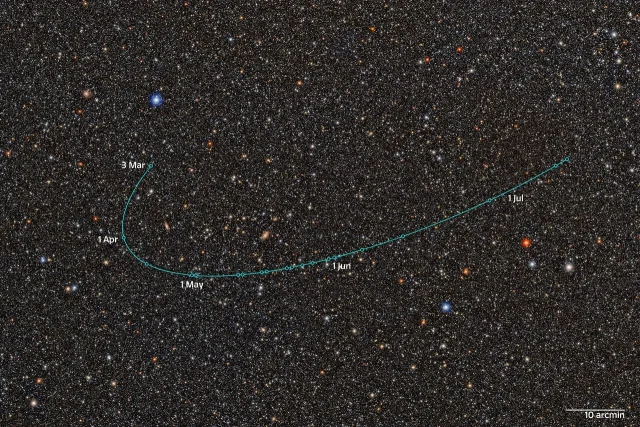
In the distant regions of the Solar System, where sunlight barely reaches and objects fade into the darkness, the Vera C. Rubin Observatory from NSF–DOE has detected a body that has captured the attention of astronomers: 2026 ED138, a large and bright trans-Neptunian object located beyond Pluto’s orbit. The Minor Planet Center (MPC) of the International Astronomical Union announced the observations, and the scientific team considers it a candidate for dwarf planet status. If confirmed, it would rank among the largest and brightest dwarf planets discovered in this region to date.
This discovery did not occur during a spectacular night of observation, but rather amid mountains of data. On the afternoon of October 13, Matthew Holman from the CfA at Harvard and Smithsonian, part of the Rubin Operations team, was processing data collected in early 2026 using a search code he developed alongside Kevin Napier. The program analyzes billions of moving object detections, comparing and identifying which correspond to the same body. This is how ED138 appeared.
«My first reaction was disbelief and excitement,» Holman shared. «Objects like this are very rare, so I immediately began checking to see if I had made an error or if it was the code that had the issue.»
His doubt was reasonable. The brightness and distance of the object suggested it was an unusually large body. To verify it, the team began an intensive search of the data. Mario Jurić, a professor at the University of Washington and the lead scientist for Rubin’s Solar System research, reviewed catalogs and images and found an additional 20 observations dating back to March 4, 2026. In total, the Rubin Observatory’s Simonyi Telescope observed ED138 during 30 occasions over 20 nights, from March 4 to July 11.
However, the story goes back further. Archive images from the Dark Energy Camera (DECam), created by the U.S. Department of Energy, and located by the ADAM Precovery service of the Asteroid Institute, provided data dating back to 2016. This information allowed the team to reconstruct over a decade of ED138’s orbital trajectory. This extended time frame is crucial: a well-determined orbit enables more accurate calculations of its distance, movement, and future classification possibilities.
A Candidate, Not a Confirmed Dwarf Planet
The label of “dwarf planet candidate” is significant. The International Astronomical Union defines a dwarf planet as a body that orbits the Sun, has enough mass for its gravity to assume a nearly round shape, has not cleared the neighborhood around its orbit, and is not a satellite. ED138 currently meets the requirement of orbiting the Sun beyond Pluto and exhibits a brightness and size consistent with a large body. However, further studies on its size, shape, albedo —its reflectivity— and physical properties are necessary to confirm its status.
Nonetheless, the finding is noteworthy. Trans-Neptunian objects are remnants of the Solar System’s formation, icy bodies that retain clues about how orbital patterns were organized and how external regions evolved. Discovering another large and bright object beyond Pluto not only expands the catalog of known worlds but also enhances understanding of the population of bodies inhabiting that vague frontier.
The discovery occurred during preparations for the Legacy Survey of Space and Time (LSST). The Rubin Observatory, jointly funded by the National Science Foundation (NSF) and the Office of Science of the U.S. Department of Energy (DOE), is designed to map the sky with unparalleled capability to detect movement and temporal changes.
«The superpower of the Rubin Observatory is its ability to clearly capture the movement and changes among an enormous array of objects and phenomena that we have never seen before,» noted Edward Ajhar, director of the NSF program for the Rubin Observatory. «This capability greatly expands our prospects for discovering and understanding new things about our Solar System, the Milky Way, and billions of other galaxies throughout the Universe.”
For her part, Kathy Turner, program manager of the Rubin Observatory at the DOE, highlighted that its unique capabilities make it an extraordinary tool for research ranging from dark energy to the discovery of this dwarf planet candidate.
The scientific announcement was made in a Minor Planet Electronic Circular from the MPC. Jurić and Holman presented the findings at a press conference during the 58th annual meeting of the Division for Planetary Sciences (DPS), held in Spokane, Washington.
What’s Next
Now begins the most delicate phase: confirming what ED138 truly is. Astronomers will need new follow-up observations to refine its orbit and determine its size, shape, and reflectivity. Only then can it be assessed whether it meets all criteria for official classification as a dwarf planet.
Meanwhile, this discovery already serves an important function: it demonstrates that Rubin can find distant and faint objects in the outer Solar System. And in an era when major astronomical discoveries are often associated with remote galaxies or black holes, ED138 serves as a reminder that there are still worlds to be uncovered in our own cosmic neighborhood, beyond Pluto, waiting for someone to see them moving among the stars.
E Ciudadano
Obtén tu Pasaporte y apoya a El Ciudadano
Elimina la publicidad, accede a contenido exclusivo y sé parte de la comunidad.
Cancela en cualquier momento · Sin permanencia