Original article: China y Suiza fortalecen su cooperación estratégica y apuestan por el libre comercio, la innovación y el multilateralismo
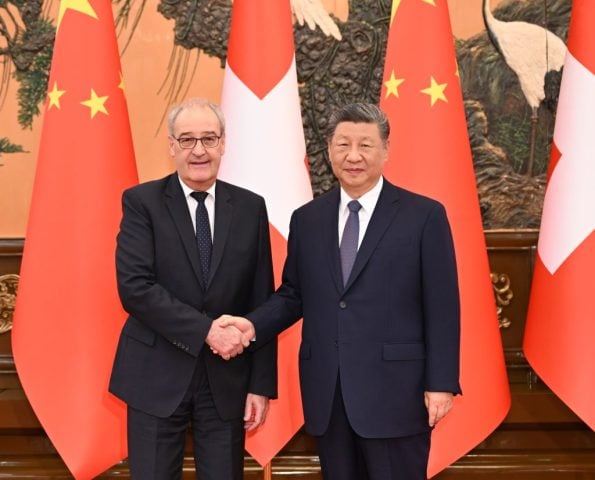
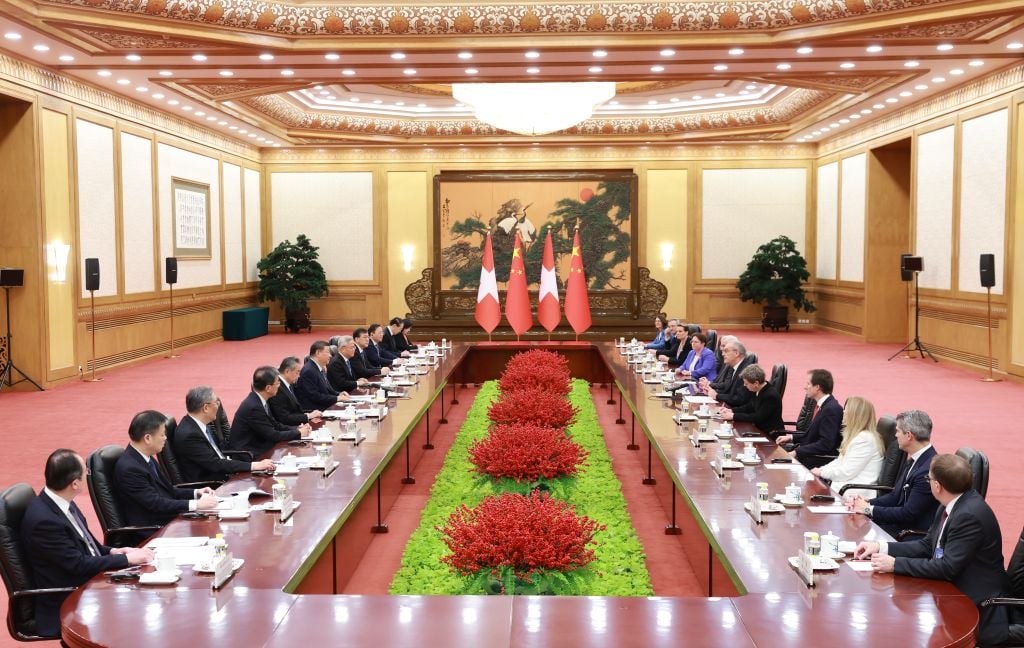
China and Switzerland are enhancing their strategic cooperation while advocating for free trade, innovation, and multilateralism. Chinese President Xi Jinping welcomed his Swiss counterpart Guy Parmelin in Beijing, reaffirming both nations’ commitment to deepening a relationship built over seven decades. The update of the free trade agreement and the signing of new cooperation documents in scientific research, employment, and media mark a new phase in bilateral ties, especially amidst international trade tensions and economic uncertainty.
By Bruno Sommer
China and Switzerland have agreed to strengthen their economic, scientific, and diplomatic cooperation, explicitly focusing on free trade, economic openness, and multilateralism. The meeting in Beijing between Xi Jinping and Guy Parmelin highlighted the importance both governments place on their relationship, which has persisted and deepened despite political, institutional, and economic differences.
During the meeting, Xi emphasized that Switzerland is an important partner for China in Europe, noting that their bilateral cooperation has historically been at the forefront of China’s relationships with European countries. He pointed out that the free trade agreement has become one of the key milestones in this partnership, demonstrating both countries’ commitment to economic openness and international collaboration.
The Chinese leader expressed Beijing’s willingness to collaborate with Bern to enhance cooperation and contribute to a more inclusive and beneficial economic globalization, instilling confidence and certainty in exchanges between China and Europe as well as in global economic development.
This meeting takes place at a particularly significant moment for international trade, characterized by tariff disputes, geopolitical tensions, and challenges to the functioning of multilateral mechanisms. In this context, the Sino-Swiss relationship takes on a dimension that transcends strictly bilateral concerns.
The history between both nations is unique within the European context. Switzerland diplomatically recognized the People’s Republic of China on January 17, 1950, becoming one of the first Western nations to establish relations with the new Chinese state.
Since then, both governments have developed a relationship based on diplomatic pragmatism, commercial exchange, and institutional cooperation, maintaining dialogue even during periods of significant international differences.
A key milestone occurred in 2013 when both countries signed a Free Trade Agreement that came into effect in July 2014, making Switzerland the first continental European nation to establish such an agreement with China.
In 2016, their collaboration took another important step with the establishment of the Swiss-China Innovative Strategic Partnership, aimed at expanding cooperation in areas such as science, technology, education, innovation, and the economy.
During the meeting in Beijing, Parmelin highlighted the tenth anniversary of this strategic partnership, underscoring that the relationship has generated tangible results in trade, investment, scientific research, innovation, and employment.
The Swiss president also praised the conclusion of negotiations to update the trade agreement, remarking that the process was completed in a short timeframe and of high quality, reflecting the existing trust between both governments.
Free Trade Against International Protectionism
The update of the Free Trade Agreement stands out as the most concrete outcome of the presidential visit and one of the most economically relevant elements of the meeting.
The original agreement, which has been in effect since 2014, established a preferential framework for trade between the two countries. Its modernization aims to broaden market access conditions for Swiss products and investments in China, as well as update the rules governing their economic relations.
According to information released by Swiss authorities, the new protocol incorporates binding provisions on environmental protection and labor rights, through a specific chapter on trade and sustainable development. This represents a novel feature in trade agreements signed by China.
The trade dimensions of the agreement are also significant. Information from Reuters indicates that the new framework will allow 99.8% of current Swiss exports to access the Chinese market duty-free, compared to just over half under the previous agreement, once the corresponding ratification processes are completed.
For Swiss companies, this represents an expansion of opportunities in one of the world’s largest markets. For China, it means solidifying a privileged trade relationship with a European country that maintains economic ties with the European Union and other major international financial centers.
The agreement also carries geopolitical implications. Amid increasing trade restrictions and tariff disputes among major economies, Beijing and Bern are presenting their partnership as a commitment to keeping markets open and strengthening international exchange.
In this context, Xi Jinping urged Switzerland to leverage its influence in Europe to promote balanced and stable trade between China and European nations.
Beyond traditional trade, Xi emphasized the need to direct bilateral cooperation toward emerging industries.
The Chinese president specifically mentioned three strategic sectors: the digital economy, green energy storage, and artificial intelligence.
This proposal aims to strengthen cooperation in innovation and develop industrial and supply chains that capitalize on the technological capabilities of both countries.
The initiative has a prior institutional foundation. For years, Switzerland and China have maintained joint research programs, university exchanges, and collaboration mechanisms between scientific centers.
Among the institutions involved in this ecosystem are the Swiss National Science Foundation, the Swiss Federal Institute of Technology Zurich (ETH Zürich), and the Swissnex platform, which connects universities, researchers, and companies from both countries.
The new agreement on research and development signed during the presidential visit aims to provide greater legal certainty for this cooperation. One of its central aspects is to establish rules for the cross-border exchange of scientific data, facilitating the sharing of information among Swiss and Chinese researchers within a regulated framework.
The significance of this dimension extends beyond immediate commercial results. The combination of scientific capabilities, industrial infrastructure, and financing can create opportunities in energy storage technologies, applied artificial intelligence, industrial automation, and solutions for the energy transition.
For China, cooperation with Switzerland deepens ties with one of the most advanced European ecosystems in applied research, engineering, and precision technology. For Switzerland, access to the industrial capabilities and Chinese market represents an opportunity to scale its technological developments.
Scientific Research and Employment: Agreements that Enhance the Relationship
Parmelin’s visit also facilitated agreements in areas that complement the new commercial framework.
Both governments witnessed the signing of documents related to scientific research, employment, and media.
In labor matters, a cooperation agreement regarding work and employment linked to the updated commercial treaty was signed. This aspect is significant as it incorporates institutional cooperation mechanisms in a field that has traditionally been treated differently from strictly commercial relations.
In scientific research, the agreement aims to strengthen the exchange of knowledge and data, creating clearer legal conditions for the development of joint projects.
As for media, the signing of a cooperation document opens another area for bilateral exchange. However, specific details of its commitments and implementation mechanisms have not been released in the official information available about the ceremony, so it is not appropriate to attribute more concrete objectives without knowing the text of the document.
Multilateralism as a Convergence Point
What is Multilateralism? by United Nations Development Programme
Another central aspect of the meeting was the shared agreement between both leaders on the importance of multilateralism.
Xi Jinping stated that China and Switzerland share similar positions and concepts in defending international cooperation and called for deepening coordination between the two countries in multilateral spaces.
In particular, he proposed to uphold the UN-centered international system and the international order based on the rule of law, as well as to advocate for reforms to the global governance system.
Parmelin, for his part, expressed Switzerland’s readiness to closely coordinate with China, champion free trade, and contribute to global development, prosperity, peace, and stability.
This convergence holds significant dimensions. Switzerland, traditionally linked to multilateral diplomacy and home to numerous international organizations, and China, a permanent member of the UN Security Council and one of the world’s major economies, possess different capabilities and positions but can find cooperation opportunities in global governance issues.
Parmelin’s statement regarding the one China policy is also noteworthy, reaffirming Switzerland’s diplomatic stance on this issue.
A Relationship with Prospects in Latin America
The deepening ties between China and Switzerland also raise questions and opportunities for other regions, particularly Latin America.
The bilateral experience offers intriguing elements for countries like Chile, where China is a key trading partner and there are significant challenges in innovation, industrialization, energy, and scientific development.
The cooperation between Switzerland and China demonstrates that it is possible to articulate European technological capabilities with the market, industrial infrastructure, and scientific development in China.
In the Latin American case, this experience could serve as a reference for exploring trilateral initiatives in areas such as:
- Mining and Lithium: applied research, extraction technologies, processing, and developing higher value-added products.
- Renewable Energies: energy storage, batteries, and solutions for electrical systems.
- Artificial Intelligence: university research, industrial applications, and technological development.
- Environment: monitoring technologies, energy efficiency, and natural resource management.
- Education and Research: joint programs between universities, scientific centers, and companies.
- Industrial Development: technology transfer, innovation, and building productive capacities.
For Chile specifically, the Swiss-Chinese experience could be relevant for considering cooperation models that go beyond the export of raw materials to include research, technological development, and involvement of national institutions.
By Bruno Sommer
The Citizen
Obtén tu Pasaporte y apoya a El Ciudadano
Elimina la publicidad, accede a contenido exclusivo y sé parte de la comunidad.
Cancela en cualquier momento · Sin permanencia