Original article: ¿Qué es Blocus? Policía de Barcelona activa alerta para hoy ante posible movilización
The Catalan capital is facing a heightened security alert level 4 today, the highest on the risk scale for demonstrations set by the Mossos d’Esquadra police. The question «What is Blocus?» arises as the police prepare for possible mobilizations linked to a new call for action. This follows last week’s incidents that saw Barcelona plunged into one of its most violent nights in recent years. However, one thing remains clear: no one truly knows what Blocus is. Speculations abound, with some suggesting it is externally orchestrated as part of a destabilization operation, while others believe it is driven by the far-right in Spain to incite anti-immigrant sentiment ahead of elections. A third and more prevalent interpretation among investigators describes it as a movement of disenfranchised youth grappling with economic injustices, who, fueled by frustration over inequality, looted stores for items they cannot afford.
By Analysis and Research Team, El Ciudadano
The Enigma of Blocus: Between Conspiracy and Exclusion
Blocus is not a formal organization. It is a tag—meaning ‘blockade’ in French—that numerous anonymous profiles on TikTok have used to call for protests, which, under the guise of advocating for better public education, escalate into acts of vandalism and looting. The modus operandi is consistently the same: posters and videos—many generated by artificial intelligence—featuring QR codes and links to private WhatsApp and Telegram groups. On these closed channels, participants receive explicit instructions to dress in black, conceal their faces, and, if possible, carry fireworks.
From there, the theories begin to diverge. The hypothesis of foreign interference is gaining traction among those pointing out that the initial messages appeared on accounts without a local history, featuring idiomatic errors and displaying coordination that exceeds the spontaneous capacity of a group of teenagers. In France, the controversial government of Emmanuel Macron has already warned of possible external influences in student protests that mirrored those of Blocus, although their claims seem more aimed at justifying the social inequalities exacerbated by the country’s own policies. In Spain, authorities are exploring whether this constitutes a “hybrid warfare” designed to destabilize the nation during a period of intense political tension.
The far-right hypothesis is actively circulating on social media and in some analyses. Proponents argue that the viral spread of looting perpetrated by youth of migrant descent seeks to create an atmosphere of insecurity that could push votes toward anti-immigration parties in the upcoming elections. However, investigators have found no evidence linking the tag to party structures, and the Catalan police maintain that this is «a new phenomenon, devoid of ideology and not organized».
The social exclusion hypothesis garners the most consensus among those analyzing the profiles of the arrested individuals. Most are young people from underprivileged neighborhoods, many of whom are minors, with backgrounds marked by school dropout and precariousness. They did not chant political slogans or carry banners; they simply entered stores and took shoes, phones, and computers. One message circulated on Telegram proclaimed, «You don’t want to go home with Rolexes, Gucci, Iphones…» For many analysts, this sentiment encapsulates the phenomenon better than any manifesto: it is not an ideological uprising, but an explosion of anger against inequality, a looting of what the economic model denies them, just a display window away.
The Immediate Precedent: The Night of October 24
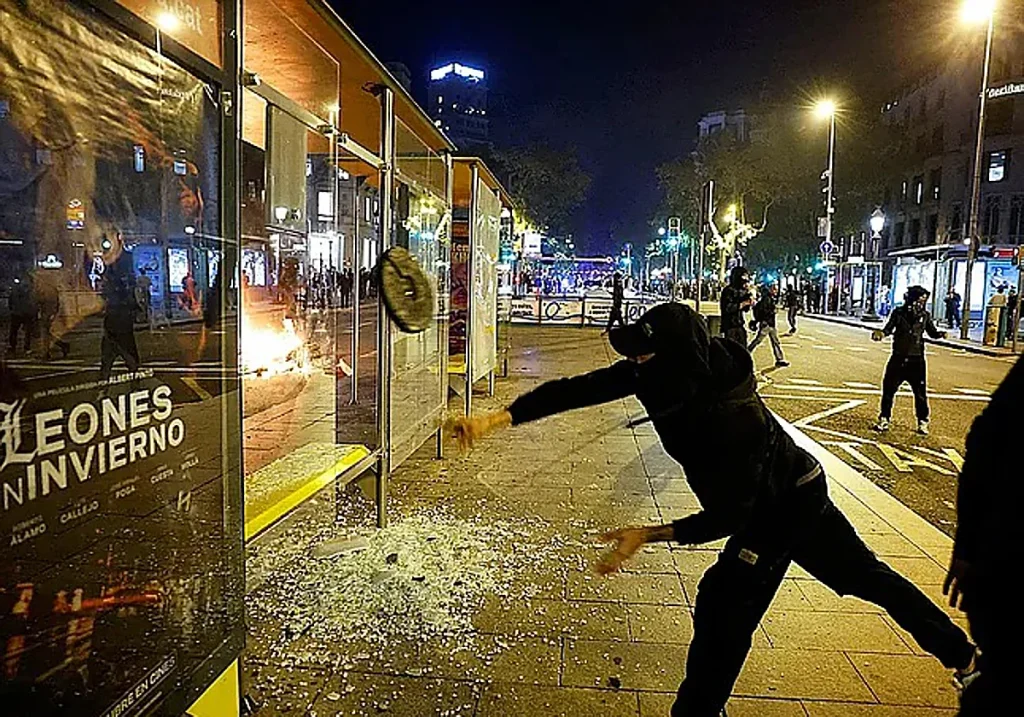
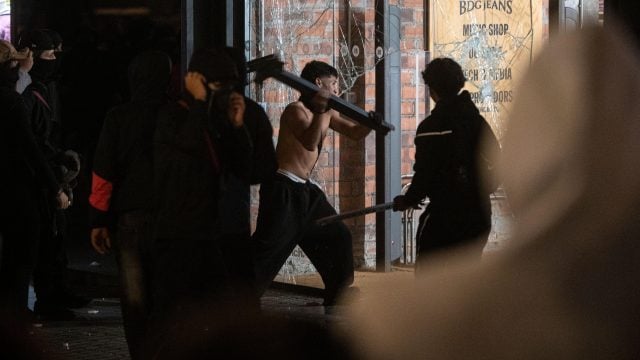
Last Saturday, October 24, approximately 600 young people—most of whom were minors—gathered in downtown Barcelona following a call from Blocus. What started as a protest quickly turned into a wave of looting, barricades, and attacks on police. The aftermath was staggering: 128 arrests—72 of them minors—23 businesses vandalized and looted, and 15 officers injured, four of them seriously. The damage to urban property was assessed by the city council at €36,000. Businesses targeted included major brands like Nike, Balenciaga, JD, H&M, Inditex, Decathlon, Loewe, and Carolina Herrera.
For that day, intelligence services rated a risk level 2, a projection that tragically proved insufficient in light of the «extreme violence» exhibited by the rioters, as acknowledged by Mossos Chief Commissioner Sílvia Catà.
Level 4: A Scale Reserved for Exceptional Scenarios
Since 2019, the General Information Commission of the Mossos categorizes the risk of protests on a scale from 1 to 4. The level 4—indicating a high likelihood that «many individuals could be combative» and commit widespread crimes—had only previously been activated once: during the protests in February 2021 following the incarceration of rapper Pablo Hasél. Now, Blocus has necessitated a return to that maximum alert. The distinction is significant: in 2021, there was a clear political trigger and an identifiable social basis. Today, the challenge is an anonymous tag on social media that has demonstrated greater mobilization and virulence in terms of arrests and looted businesses in just days.
The Plan for Today: Checks Starting at 15:00
The Mossos have devised a “robust” and “maximum” operational plan that will commence at 15:00 hours, featuring intensive checks on public transportation in Barcelona and its metropolitan area to identify individuals likely to participate in disturbances. Blocus has called for three actions in the city: at 17:00 in Plaza Catalunya and Passeig Lluís Companys, and at 20:00 in Passeig de Gràcia. Additionally, similar gatherings have been noted in other Catalan towns such as Lleida, Badalona, Girona, Terrassa, or Figueres, albeit at level 2 risk.
The president of the Generalitat, Salvador Illa, has issued a firm message: «Anyone who comes to loot will face justice, just as those arrested on the 24th are currently facing. And no one should be blamed for their origins.» Shops in the center, especially along Passeig de Gràcia, Plaça de Catalunya, Portal de l’Àngel, and Diagonal, have begun to fortify their windows with wooden boards, styrofoam panels, and metal bars.
Judicial and Police Response
Police pressure has already begun. The Civil Guard arrested a suspected founder and promoter of Blocus in Spain on Friday in Picanya (Valencia), accused of creating and managing Telegram groups used to coordinate the looting. In Catalonia, the Mossos have arrested three individuals—a 17-year-old minor and two 18-year-olds—for disseminating and inciting the disturbances, with at least a dozen arrests made throughout Spain for similar reasons.
Intercepted conversations reveal that, for today, organizers planned to direct the looting in real-time toward businesses with minimal police presence. Conversations included mentions of jewelry stores, luxury shops, and large department stores, while some participants even suggested setting businesses and the Barcelona City Hall on fire.
A Phenomenon Spreading Across Europe
Blocus is not exclusive to Barcelona. Similar calls have spread to Madrid, Bilbao, Valencia, and other Spanish cities, and the Mossos are collaborating with police forces across Europe to monitor this dissemination. The situation reflects France, where recent student protests—the Lycées Indignés movement—escalated into riots and looting in several cities weeks ago.
The looming question in Barcelona tonight is whether level 4 will be sufficient to contain a phenomenon that has no leaders, manifestos, or headquarters to shut down. Above all, whether behind the masks associated with Halloween lies foreign conspiracy, electoral calculations, or simply the fury of those who never had access to the showcase they are now breaking.
The children are angry.
By Analysis and Research Team El Ciudadano
Obtén tu Pasaporte y apoya a El Ciudadano
Elimina la publicidad, accede a contenido exclusivo y sé parte de la comunidad.
Cancela en cualquier momento · Sin permanencia