Original article: ¿Hablaron con abogados de Punta Peuco?: querella pide investigar celulares de Rabat y Silva por rebajas de penas
A lawsuit filed by attorney Gabriel Salinas seeks to investigate the private and public cell phones of Justice Minister Fernando Rabat and former Undersecretary Luis Silva. The aim is to examine their chats to determine if there were any communications with the lawyers representing former agents of the dictatorship of Augusto Pinochet who were convicted of crimes against humanity and received sentence reductions.
In the same document, which was accepted by the Seventh Criminal Court of Santiago, Salinas requests the Public Prosecutor’s Office to seize emails, notes, and attachments from both defendants, allegedly sent and received between January and October 2026, with the intention of establishing the factual knowledge of the Supreme Court rulings.
According to El Mostrador, the lawyer also requests that the Cybercrime Brigade of the PDI analyze the metadata of the documents related to the exempt decrees that reduced the sentences of dictatorship repressors. This is to utilize the IP addresses to identify the workstations where these documents were drafted, what modifications were made, and who participated in that process.
Simultaneously, he demands an analysis of the statements from the heads of the Legal Division and the Social Reintegration Division of the Ministry of Justice, along with those of Rabat and Silva.
Sentence Reductions for Dictatorship Repressors
The controversy arose after the Ministry of Justice granted sentence reductions to three former agents of the National Informative Central (CNI), convicted for human rights violations. Two of them, Patricio Leonidas González Cortés and Heraldo Veloso Gallego, are serving time at Punta Peuco prison, while the third, César Luis Acuña Luengo, is incarcerated in Colina I.
All three were convicted of the qualified kidnappings of Julián Peña Maltés, Alejandro Pinochet Arenas, Manuel Sepúlveda Sánchez, Gonzalo Fuenzalida Navarrete, and Julio Muñoz Otárola, five members of the Manuel Rodríguez Patriotic Front who were detained and disappeared in September 1987.
According to the records, former Undersecretary Silva sent two reports to the President of the Court of Appeals of Santiago, Marisol Rojas Moya, stating that it was appropriate to grant sentence reductions to González and Veloso, arguing that both condemned individuals met the requirements set by Law 19.856 and that there were no exclusionary grounds to deny them the benefit.
However, this benefit had been explicitly denied by the justice administration in September 2025.
Furthermore, on May 20, Subsecretary of Justice, Pablo Mira Hurtado, acting as substitute minister, was responsible for signing the decree that reduced Acuña’s sentence by 19 months. This occurred just one day after the Court of Appeals of Santiago ordered the Ministry to respond to the convict’s request without requiring the benefit to be granted.
In his lawsuit, lawyer Gabriel Salinas asserted that the resolution ratified by the Supreme Court stipulates that those convicted of crimes against humanity should not be eligible for “the ordinary domestic statute of sentence reduction”, as it would contradict the primary principle by “twisting” the certified good conduct as per Gendarmería.
According to the document, issuing reports and decrees for reducing sentences for human rights criminals fractured the “constitutional block”, attempting to isolate the application of Law No. 19.856 from Chile’s systemic commitments regarding human rights, such as the Rome Statute and the American Convention on Human Rights, which prohibit mechanisms of covered impunity.
“Attempting to impose a common administrative regulation of prison execution over a constitutional prohibition of conventional nature concerning the block of essential rights arising from human nature is an act of sheer naked arbitrariness, devoid of any valid legal cover,” the document states, as noted by El Mostrador.
According to the jurist, with this violation, the defendants may have committed administrative malfeasance by issuing a “manifestly unjust” resolution.
In the legal action, it was indicated that both Rabat and Silva voluntarily signed reports and decrees to create an “anti-juridical” effect, acting with dolus and failing in their duty of expertise and superior control.
“The essential core of administrative malfeasance lies in the issuance of unjust resolutions that surpass the limits of essential rights of human nature. This pertains to the fact that the sentence is being reduced not for common criminals, but for human rights violators. Thus, under this aspect, we are facing an administrative illegality,” Salinas explained to the cited media.
Obtén tu Pasaporte y apoya a El Ciudadano
Elimina la publicidad, accede a contenido exclusivo y sé parte de la comunidad.
Cancela en cualquier momento · Sin permanencia
Artículos Relacionados
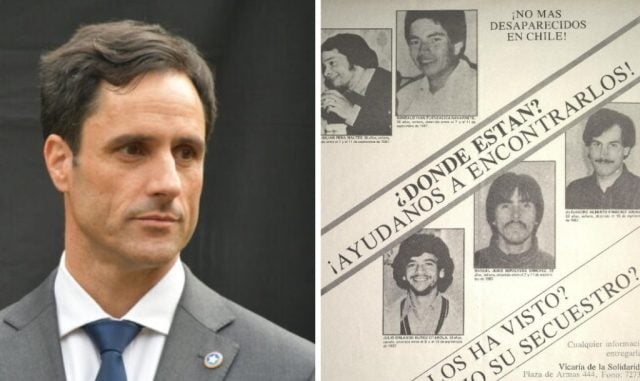
Five Victims Remain Missing as Silva Supports Sentence Reductions for CNI Agents Convicted of Kidnappings
Hace 2 semanas