Original article: Peter Kuznick: que Estados Unidos o Israel utilicen un arma nuclear contra Irán representa un riesgo inaceptable que debe tomarse en serio y prevenirse
The arrival of the USS Theodore Roosevelt in the Western Asia region has increased the number of U.S. aircraft carriers operating in the area to three, amidst rising tensions due to the ongoing conflict between the United States and Israel against Iran. Tehran has warned that it may not wait for Washington to initiate another attack before responding. These developments come amid mixed signals from the Trump administration. U.S. President Donald Trump has communicated to his advisors that he might refrain from launching further attacks if Iran and Ansarullah, the Yemeni armed group, do not provoke. The combination of heightened U.S. military presence and uncertainty about Washington’s next move has cast doubt on the prospects for de-escalation.
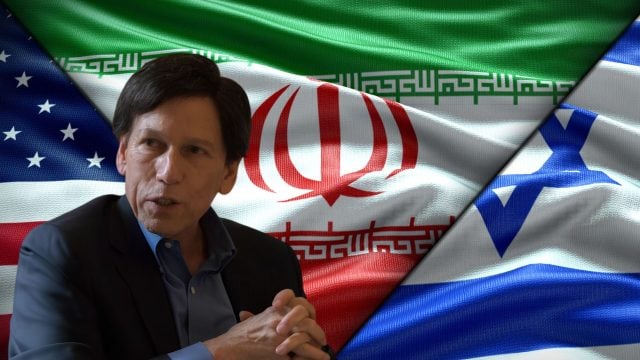
In this context, concerns over the risk of a broader conflict—and its potential nuclear implications—have taken on renewed urgency. In an interview with Mehr news agency, American historian and American University professor Peter Kuznick warned that even the possibility of a U.S. or Israeli nuclear strike against Iran represents an unacceptable risk. He emphasized that the war could have far-reaching implications that extend beyond regional military balance, undermining the credibility of the global nuclear non-proliferation regime, exposing the limits of U.S. military power, and highlighting the need for a collective security framework in Western Asia.
By Mohaddeseh Pakravan
The Risk of Nuclear Escalation
In your recent writings, you have cautioned that the war between Iran, the United States, and Israel could present a significant risk of nuclear escalation. To what extent do you believe the current confrontation has brought the region and the international community to that critical point? What diplomatic measures could avert it?
These are crucial questions. Even the slightest possibility that the United States or Israel may use a nuclear weapon against Iran poses an unacceptable risk that must be taken seriously and prevented. Unfortunately, there is considerable risk at this time. The overwhelming defeat of Republicans in last week’s elections could have two effects: it could further exasperate Trump and lead to a loss of control, or it could make him realize the unpopularity of this war and the widespread outrage that an escalation would provoke. This might not be enough to deter a pathological narcissist like Trump, especially knowing that there has been talk in his circle about the use of nuclear weapons. Right now, Trump appears to be trying to divert attention and downplay the war. The fact that he sidelined Vance from negotiations and labeled him with the supposed «Democratic corruption» is a clear example of this messaging. However, we all know that Trump can suddenly change his mind and backtrack. Reports indicate he has been furious since his humiliating defeat in the midterm elections, and his approval ratings continue to plummet. As I mentioned in the recent article for Al Jazeera that Ivana Nikolic Hughes and I wrote, I am confident that historians will rank Trump as the worst president in U.S. history, and rightly so. But what concerns me even more at this moment is what Netanyahu and the Israelis might do. For them, an Iranian nuclear program represents an existential threat. Israeli intelligence reports suggest that the alleged Iranian nuclear activity appears to be taking place at Mount Pico, beneath 90 meters of granite. Neither the United States nor Israel possesses conventional weapons capable of penetrating that depth, which raises fears they might use one or more nuclear weapons. Compounding the issue, an increasing number of Iranians assert that, following two recent waves of Israeli and U.S. attacks on Iran, the country needs nuclear weapons to deter future attacks. I understand that logic, but given Trump’s obsession with preventing Iran from acquiring a bomb and the Israeli statements of «never again» alongside the existential threat a nuclear Iran poses, a dangerously explosive mix emerges where any action by the U.S. and Israel is possible. The fact that Trump’s closest advisors—Stephen Miller, Pete Hegseth, Sebastian Gorka, Elbridge Colby, Brad Cooper, Marco Rubio—hold perversely hawkish views and that Israel continues to incite Trump worries me, as it makes such reckless behavior possible.
Regarding diplomatic measures, I drafted a letter to Pope Leo XIV urging him to use his unique moral authority as a staunch opponent of war and advocate for nuclear abolition to convene an emergency summit, at minimum with Putin, Xi, and Trump, to steer us away from this path of war and potential nuclear war. That letter is published in the Nuclear Insanity Subforum and has received backing from nearly 250 highly influential individuals worldwide, along with hundreds more. The Pope has joined many experts in warning that discussions about using nuclear weapons have risen at an alarming rate. Former National Intelligence Director Tulsi Gabbard warned 18 months ago that we are closer to nuclear annihilation than ever. The situation has worsened considerably since then. The new article that Ivana and I published in Al Jazeera urges Putin, Xi, and Trump to do what Reagan and Gorbachev were close to achieving in Reykjavik 40 years ago: to rid the world of nuclear weapons in three stages over 12 years. All three leaders have at some point recognized the madness of trying to defend their countries with weapons that, if used, would annihilate all life on our planet. We now know that the threshold for triggering a nuclear winter is much lower than scientists believed in the 1980s. We also know that the Global South—the BRICS, the SCO, the African Union, and others—are driving a new world order based on peaceful growth and development. Therefore, we are mobilizing global forces to urge superpowers to find a new direction, ending the wars in Southwest Asia and Ukraine and starting the search for peaceful alternatives. It is time to return to diplomacy and reject war as a means of resolving differences. But the people of the planet, many of whom still live in poverty and underdevelopment, must raise their voices to press «leaders» to change course.
The Nuclear Arsenal of Israel and Regional Security
You have claimed that the Middle East should become a zone free of weapons of mass destruction. How does Israel’s undeclared nuclear arsenal affect the regional balance of power and the security calculations of other countries? Do you believe the international community applies consistent standards to nuclear non-proliferation in the Middle East?
We estimate that Israel possesses between 90 and 250 nuclear weapons, which it will not renounce as long as it believes its security is threatened. Despite its long-standing and deplorable treatment of the Palestinians, it was once a respected and admired nation. Now, following the genocide in Gaza and its rampant militarism, it is the most hated country in the world. The more isolated Israel has become, the more it has shifted to the right. It has long been governed by far-right extremists who staunchly oppose both the one-state and two-state solutions. U.S. support for Israel was a significant issue in the recent midterm elections. The Biden-Harris administration’s backing of the massacre in Gaza was a crucial topic in Trump’s 2024 electoral campaign. Trump has proven to be even worse than Biden. However, the American public has seen enough, and AIPAC’s support for candidates turned out to be more harmful than helpful in the midterms. Without unwavering U.S. support—financial, military, and diplomatic—Israel is likely to find itself even more isolated. But not only will U.S. support for Israel decrease, but the overall role of the United States in the region will also change, as its bases and alliances have come under attack. Corrupt Gulf leaders, who have long taken for granted benefiting from U.S. protection, are being forced to reconsider whether hosting U.S. military bases and aligning with the U.S. provides greater security or makes them easier targets. Additionally, much of the U.S. military infrastructure has been destroyed, and its replacement will cost billions. Therefore, Israelis will have to make a decision: live in perpetual hostility towards their neighbors or learn to coexist peacefully. If they choose the former, they will retain their nuclear arsenal and seek shelter under it. If they opt for the latter, after years of trust-building, they could reconsider their dependence on nuclear weapons.
Israel is one of four nuclear powers and one of five countries outside the Nuclear Non-Proliferation Treaty (NPT), but it is the only country outside the NPT in what was previously known as the Middle East. Its official position on possessing nuclear weapons is ambiguous, but it is publicly known that it has held them for decades. Western powers, led by the United States, have shielded Israel from further scrutiny and sanctions. Therefore, yes, there is a clear double standard regarding Israel’s nuclear interests and policies.
Iran, which is a party to the NPT and had allowed IAEA monitoring until the bombing of its nuclear facilities in June, has faced severe sanctions, bombings, and assassinations for enriching uranium, although the NPT permits it. This double standard and hypocrisy have not gone unnoticed by much of the world.
The Historical Pattern of U.S. Military Interventions
Based on your research into the history of U.S. foreign policy, what historical patterns do you observe in Washington’s decisions to intervene in the current confrontation with Iran? To what extent does this war reflect the recurring belief that military superiority can yield political outcomes, despite prior U.S. intervention experiences?
The United States has always considered Southwest Asia crucial to its national security and has allied without hesitation with reactionary dictators who allowed it to exploit the region’s oil resources. It has been willing to use force when necessary to maintain these leaders in power and prevent more progressive leaders from challenging them. Perhaps the most flagrant case is what the CIA did in Iran in 1953 when they overthrew Mohammad Mossadeq, despite his enormous popularity both inside and outside the country. He had been named Time magazine’s Man of the Year in 1951, and the U.S. ambassador claimed he had the support of between 95% and 98% of the Iranian people. But he committed the cardinal sin: believing that the Iranian people, not the British oil companies, were entitled to the profits from the sale of Iranian oil. When Iran nationalized the oil industry, the CIA overthrew Mossadeq and installed the Shah, who ruled with an iron fist and the brutal SAVAK until 1979. This exposed the U.S. claims of supporting democracy. Soon, U.S. oil companies controlled 40% of the Iranian market. Thus, the overthrow of the repressive and despised Shah, whom Jimmy Carter declared his beloved friend in the infamous New Year’s Eve dinner, «There is no leader with whom I feel greater gratitude and friendship,» should not have been a surprise. The United States has maintained its hostile stance towards Iran since then, although there were moments, such as in the 1980s during what is referred to here as the «Iran-Contra Scandal,» when it was willing to sell arms to Iran to raise cash for its Central American allies, war criminals.
Meanwhile, the United States has built a regional strategy based on alliances with Israel and Saudi Arabia, while simultaneously maintaining ties with other countries in the region. In 1944, Franklin Roosevelt informed British ambassador Lord Halifax that Saudi oil would belong to the United States, Iranian oil to the British, and Iraqi and Kuwaiti oil to both. U.S. policy has long focused on controlling the regional oil supply. This was evident in the Carter Doctrine of 1980, the Gulf War of 1990-91, the invasion of Iraq in 2003, the overthrow of Gaddafi in Libya in 2009, and other actions. Since 2011, the U.S. has attempted to pivot towards Asia but continues to be drawn back into the Gulf region.
The United States has not won a significant war since World War II, and however important and necessary victory over Hitler was, even that victory is questionable considering militaristic and conservative Germany is leading Europe’s rearmament and rightist Japan is steering Asia’s rearmament. However, what has become clear is that war is obsolete in the modern era of drones, robotics, artificial intelligence, and asymmetric warfare. After almost five years of war, Russia has yet to gain control of Donbas, and after nine months, the U.S. has not been able to defeat Iran, despite Trump’s absurd claims otherwise. The Russians could do to Kiev what the Israelis did to Gaza: reduce it to rubble. But the world would be so outraged by such atrocity that it would open the door to a future so bleak that our planet might not survive. Thus, the two most powerful nations on the planet have failed to compel the weaker nations to concede to their demands. In the nuclear era, particularly, war is not only obsolete but also extremely dangerous. It is time to give diplomacy a chance.
The Limits of Military Power and the Possibility of a Political Solution
The United States has invested enormous military and financial resources in wars across various regions, often failing to achieve its declared political objectives. What does the current war reveal about the limits of U.S. military power? Can Washington find a way to end the conflict without further escalation?
As I just wrote, war should be obsolete as a means of achieving objectives in the 21st century. Prime Minister Modi often says that it’s not a time for war. He refers to the fact that it shouldn’t be. Pope Leo XIII agrees. China has avoided war since 1979. Jimmy Carter claimed in 2019 that the United States had been constantly at war. He said that the U.S. is the greatest warmonger in history, asserting that in its 242 years, it has known only 16 years without being at war. It wasted trillions on endless wars, money that could have been invested in improving the lives of the American people. Americans, like people everywhere, want to see investments in what gives life meaning: education, nutrition, housing, healthcare, research, clean energy—not in what makes war more lethal. Global rearmament is obscene, as is nuclear modernization and expansion.
The real question is whether Trump can end the war without further escalation, and no one knows the answer. His attention span is very limited. He expected a quick victory, like the euphoria he felt when seizing Maduro. The Iranians had a say in the matter and were prepared to stand up to the U.S. and Israel this time. They have Trump on the ropes and aren’t letting go. They deserve much credit for Trump’s overwhelming defeat in the midterms. Thus, Trump has three options: he can escalate the conflict, prolong the current stalemate, or accept defeat. In the latter case, he may withdraw and proclaim victory, as he has been doing. Everyone will know it’s a lie, but Trump always lies, and he may not care. He is under pressure from his party to act. Some condemn him for not having acted more decisively, yet others recognize the unpopularity of the war and Trump’s betrayal of his promises to his MAGA base. In any case, the war should be shortened. Democrats know they must act quickly and decisively on several fronts in January, or public opinion will also turn against them. A top priority will be cutting off funding for the war. This doesn’t mean Trump will end it quickly. He has funds he can use to maintain it. But doing so, in the face of bipartisan opposition and overwhelming public sentiment, will ensure another crushing Republican defeat in 2028, the end of the MAGA movement, and potentially the suicide of the Republican Party. It was Florida Governor Ron DeSantis, a Trump-aligned Republican, who described the midterm elections as a «near extinction event» for the Republican Party. If the U.S. simply withdraws and declares victory, it will be a significant triumph for the Iranian people, but they will not obtain the lifting of sanctions, frozen funds, reparations, the end of regional wars, or other things they legitimately demand. The United States could largely withdraw from the region, and Iran will become a much more powerful force on the world stage. I hope that Iran seizes the victory and collaborates with other states in the region in a broadly inclusive peace and regional reconstruction effort that one day, I hope, includes a transformed Israel, prepared for a Palestinian state and to coexist harmoniously with its neighbors in a Middle East free of nuclear weapons. I know we are still very far from that.
The Consequences for the International Nuclear Order
How might the war with Iran affect the global nuclear non-proliferation regime and the credibility of the Nuclear Non-Proliferation Treaty (NPT)? Could the perception that countries without nuclear weapons remain vulnerable to military attacks increase incentives for nuclear proliferation?
The impact of the war between the United States and Israel with Iran on the Nuclear Non-Proliferation Treaty (NPT) could be devastating. Being a member of the NPT was supposed to provide some security against an attack from a nuclear power. But that has clearly not worked, and this is not the first time. NPT member countries have been repeatedly attacked by the United States. Russia invaded Ukraine, an NPT member, which had given up its stockpile of nuclear weapons made by Russia. Iraq and Libya also relinquished their weapons of mass destruction before being invaded and their leaders assassinated. Much of the world is fed up with the privileged status of the five original nuclear powers, which have refused to meet the Article 6 obligations of the NPT, which required them to have given up their nuclear weapons long ago. In surveys, 73% of South Koreans expressed a desire for their government to possess nuclear weapons. President Nawrocki of Poland stated that Poland needs its own nuclear weapons. Ukrainian President Zelensky declared that Ukraine should join NATO or receive its own nuclear weapons. Others have similarly called for nuclear arms. France has debated extending a nuclear umbrella over Europe. North Korea claimed that Saddam Hussein’s grave mistake was not to possess nuclear weapons. It argued that had he possessed them, the U.S. would not have been able to invade the country. North Korea has taken this lesson about the United States and South Korea very seriously.
However, enriching uranium to 60% without developing a nuclear weapon proved counterproductive for Iran. It made it a more vulnerable target, not less. In Iran’s case, neither compliance with the NPT nor good-faith diplomacy protected it from an attack by two nuclear-armed states. Therefore, other states might question the benefits of NPT membership. Another consideration is that allowing inspections by the IAEA and transparency in general could also facilitate hostile states attacking facilities in adversarial countries, even if they comply with the NPT.
Thus, while countries may feel the need for nuclear deterrence to prevent an attack from an aggressive and hostile nation like the United States or one that feels endangered by others, such as Russia, engaging in uranium enrichment or conducting other research would easily turn compliant NPT countries into larger targets. In other words, while possessing a bomb might provide a country with greater security, being suspected of building one would make it more vulnerable. In Iran’s case, Supreme Leader Khamenei issued a fatwa against building a bomb; the CIA assessed that Iran had abandoned its nuclear weapons program in 2003; the IAEA reported Iran was fully compliant with the terms of the JCPOA; post-JCPOA uranium enrichment was permitted under the NPT terms; and there was no evidence that Iran had intentions of constructing a bomb; however, Iran was illegally bombarded by one recognized nuclear state and another unrecognized. This has made the Earth a much more perilous and lawless place, and Donald Trump and Bibi Netanyahu will have a special place reserved for them in hell. Iran must firmly and forcibly announce that it will never develop a nuclear weapon in the future, or it may provide its enemies with the excuse they seek to finish the job with nuclear weapons.
The Humanitarian and Historical Consequences of War
Beyond its immediate military and political consequences, what long-term effects could the war have on the civilian population and the future of the Middle East? What lessons should policymakers learn from the history of Hiroshima and Nagasaki when considering the consequences of escalating military confrontation in the nuclear age?
When I reflect on the necessity for all countries in the Middle East region to agree and collaborate peacefully in the future, the fragility of alliances and universal vulnerability become clear to me and, I hope, to everyone in the region. Iran has the power to cause enormous damage throughout the region. The Houthis have shown what they are capable of against Saudi Arabia. Israel, with American support, has inflicted widespread suffering in Iran. The Iranian nuclear plant at Bushehr represents a terribly vulnerable target, just as Israel’s nuclear facility at Dimona does. The United States has threatened to destroy Iran’s essential infrastructure, and Iran has issued similar threats against Gulf states. Iran has threatened to attack desalination plants throughout the region. According to one estimate, Qatar relies on desalination for 99% of its drinking water; Bahrain and Kuwait obtain 90%; Oman 86%; Saudi Arabia 70%; and Israel between 70% and 80%. The destruction of the desalination system would render the region uninhabitable. Not to mention the nuclear threats from both the United States and Israel. Therefore, nations in that region must learn to coexist in peace and harmony, because the alternative is simply unthinkable. I hope the war has made everyone aware of their vulnerability and how much their existence depends on the goodwill of others in the region. They also need to collaborate to plan a future that does not depend on the extraction of fossil fuels nor maintaining the vast regional gap between rich and poor.
Thus, I envision a Middle East with close economic ties to Russia, China, the Global South, and the West, united around a common development strategy. First, the British and then the Americans employed the divide-and-conquer strategy to maintain control. It is time for a different approach: what the Russians call «indivisible security» and the Chinese, «mutual benefit».
As Tulsi Gabbard remarked in the video she published from Hiroshima on June 10, 2025, warning that the world is closer to nuclear annihilation than ever, the bomb that destroyed Hiroshima was primitive compared to the weapons we possess today. Still, it devastated an area of nearly three square kilometers in all directions and killed tens of thousands of people. In fact, the effects of radiation continue to claim lives today, more than 81 years later. Today’s weapons are more precise, efficient, and lethal. Iran should not only not have them; no one should have them. I hope that the meeting of Presidents Putin, Xi, and Trump turns this week’s Shenzhen meeting into a second Reykjavik and completes what Reagan and Gorbachev started in 1986: the elimination of all nuclear weapons.
Interview conducted by Mohaddeseh Pakravan
Mehr News Agency
Obtén tu Pasaporte y apoya a El Ciudadano
Elimina la publicidad, accede a contenido exclusivo y sé parte de la comunidad.
Cancela en cualquier momento · Sin permanencia