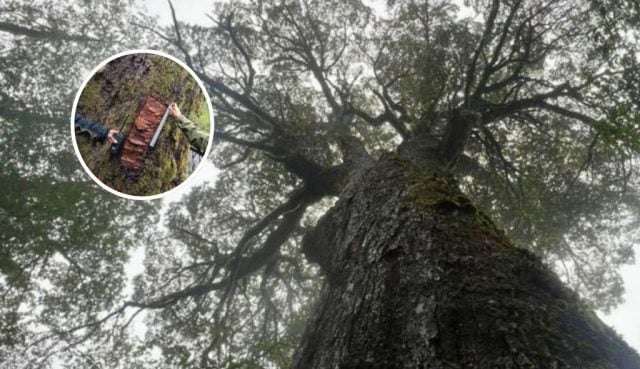
Original article: Ataque a un ícono patrimonial: CONAF denuncia ante Fiscalía el daño al Coihue Abuelo de 600 años
The Mocho Choshuenco National Reserve, a natural treasure in southern Chile, has been the site of an environmental attack that has shocked the scientific and conservation community. The National Forest Corporation (CONAF) of Los Ríos has filed a formal complaint with the Regional Prosecutor’s Office regarding the illegal extraction of bark from the «Coihue Abuelo,» a Nothofagus dombeyi specimen around 600 years old, recognized as an ecological and heritage icon of the protected area.
Regional director of CONAF, Arnoldo Shibar, filed the legal action citing environmental damage based on Articles 310 and 310 bis of Law 21.595, which amends the Penal Code concerning economic and environmental crimes.
The complaint seeks to prompt the specialized unit of the Public Ministry to initiate an in-depth investigation to identify and sanction those responsible for the severe damage inflicted on this ancient tree within the protected area.
«Throughout December, various actions have been taken regarding the situation at the Mocho Choshuenco National Reserve, specifically related to a coihue tree, which involves bark extraction from its trunk. Firstly, we filed the corresponding complaint with the Regional Prosecutor’s Office and provided necessary information for the complaint to proceed accordingly,» Shibar explained.
In addition to legal action, urgent protective measures have been implemented.
«Furthermore, other measures have been taken in the area, mainly to secure the trail; access to that trail has been temporarily restricted. We are also incorporating the possibility of installing cameras in the area to maintain daily oversight of the trail situation. Additionally, we want to place signs for visitors that address the responsibilities associated with these environmental damages,» he stated, as quoted in a press release.
The contingency plan also includes an operational reinforcement consisting of ranger patrols and the upcoming launch of a regional awareness campaign that, according to Shibar, aims to establish «the responsibilities of individuals visiting our protected areas in the Los Ríos region.»
CONAF further indicated that «extracting bark, damaging, mutilating, or interfering with native species within protected wild areas is a serious offense penalized by Law 20.283 on the Recovery of Native Forests and Forestry Promotion.»
In-Situ Technical Assessment: “Anthropogenic” Damage to Coihue Abuelo
To accurately evaluate the impact of the attack, CONAF coordinated an emergency visit with Austral University of Chile. Forest pathologist Cristian Montalva personally examined the «Coihue Abuelo,» providing a crucial technical diagnosis for the case.
«What was observed was anthropogenic damage involving bark extraction, which exposed tissue in a localized area. It is a localized damage that does not compromise the entire circumference,» Montalva clarified. This characterization is vital as it establishes the human origin (“anthropogenic”) of the wound.
The specialist also offered a note of hope, confirming the current vitality of the tree: «In this inspection, the tree’s crown was active, with good foliage, and no signs of a regressive death pattern attributable to immediate severe stress were observed.»
However, he cautioned that although «no fruiting bodies of fungi are currently visible in the wound, there are no signs of mycelium or advanced decay (…); the greatest risk is the potential for some type of fungus to enter and begin to colonize and decompose.»
The professional recommendation is to «protect and strengthen control around the tree. Allow it to undergo its natural healing process and maintain monitoring.»
Crime of “Severe Impact” in Protected Area
CONAF’s complaint is grounded in a robust and specific legal framework for such assaults. Article 310 of the Penal Code penalizes those causing «severe environmental impact» in specially protected areas, a category that includes all National Reserves. Penalties can reach imprisonment or major incarceration at its minimum level, increasing in cases of reckless or gross negligence.
The key to the prosecutor’s investigation will be determining whether the damage to the Coihue Abuelo constitutes the “severe impact” defined in Article 310 bis. The regulation states this requirement is met when the harm meets one or more of the following conditions:
– Has spatial relevance based on the ecological characteristics of the area.
– Causes prolonged effects over time.
– Is irreparable or difficult to repair.
– Affects a significant group of species in the area.
– Impacts species categorized as threatened (endangered, vulnerable, or critically endangered).
– Poses a risk to the health of one or more individuals.
– Significantly impacts ecosystem services or functions.
The law is particularly severe when the damage is irreversible: if it is established that the attack caused irreversible harm to the ecosystem or to this unique specimen, the maximum penalties prescribed must be applied.
The “Coihue Abuelo” is more than just a tree. With six centuries of history, it stands as a silent witness to the evolution of the temperate rainforest, a crucial habitat for numerous species and an ecological symbol of the Los Ríos Region. Its deterioration represents an invaluable loss and a direct attack on the natural heritage of all Chileans.
