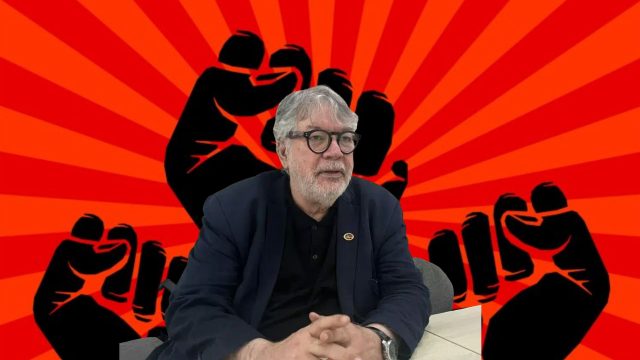
Original article: Claves para quebrar la hegemonía semántica de la agenda ideológica (falsa conciencia) capitalista
Any dismantling of the capitalist semantic architecture requires an understanding that signs do not exist in a metaphysical vacuum; they emerge directly from the material conditions of production and the inherent tensions of class struggle. The bourgeoisie has refined a device of symbolic capture through the naturalization of its historical contingencies, transforming the language of dispossession into a compendium of supposedly universal axioms.
By Fernando Buen Abad Domínguez
In the face of this cognitive paralysis, emancipatory praxis requires a theoretical and practical offensive that unveils the material violence embedded in each hegemonic word and restores to the working class its creative power and historical self-awareness. Capitalism not only confiscates the surplus value of the working body but also seizes the social capacity to name the future, confining collective imagination to the strict limits of its fetish market. Disarticulating this monopoly involves executing a radical hermeneutics of suspicion that fractures the ideological apparatus of the ruling class, exposing the hidden antagonisms beneath bourgeois notions of freedom, progress, and democracy.
A key to this rupture lies in the de-fetishization of the contemporary technocratic lexicon, which is specifically designed to suppress the visibility of the original social conflict. Concepts like ‘human capital’, ‘governance’, or ‘resilience’ operate similarly to verbal anesthetics, transforming explicit exploitation into supposedly neutral administrative variables. A humanist perspective grounded in Marxism must challenge this false neutrality, thus restoring the existential, corporeal dimension that mercantile abstraction has severed from everyday discourse.
Class consciousness solidifies when the historical subject recognizes that categories presented as laws of nature comprise sedimentations of accumulated political power. By subverting this nomenclature, language regains its character as a battleground, preventing bourgeois semantics from continuing to operate as the supreme tribunal of social truth. The production of meaning must be re-rooted in the lived experience of the proletariat, where the pain of alienated labor transforms into an organized capacity for structural change.
It is imperative to reject the Western algorithmic logics that seek to quantify and codify the complexity of human emancipation under parameters of market efficiency. These information systems are not aseptic tools; they represent the mathematical crystallization of bourgeois biases, programmed to perpetually reproduce the statu quo and atomize any budding organic solidarity.
The critical response rejects nostalgic retreat to the past; it demands the construction of a semiotic counter-hegemony that transcends the reductionist binaries of corporate software. This task requires a militant erudition capable of hybridizing the rigor of social sciences with the historical urgency of dispossessed masses, thus avoiding pedagogical simplifications that underestimate popular acuity. The narrative mediocrity of mass cultural industries seeks to create a docile, entertained subject, incapable of articulating deep systemic critique.
Breaking this inertia requires a discursive density that challenges the aesthetics of waste, offering a horizon of intelligibility where the historical totality becomes comprehensible to the oppressed. The core of the semiotic offensive should focus its energies on the radical re-signification of historical memory, a territory constantly atomized by the propaganda apparatus of capital. The bourgeoisie operates through planned amnesia, presenting the current social order as the only possible outcome of human evolution, thus canceling any teleological dimension of change. Class consciousness emerges fully when this blind determinism fractures, as it allows the past of subaltern struggles to erupt into the present as a living, mobilizing force.
Every emancipatory force must carry the memory of both proletarian defeats and victories, transforming language into a testament of resistance and active offense. By linking the linguistic sign with the historicity of production relations, it prevents revolutionary categories from being absorbed by the dynamics of cultural consumption. Counter-hegemonic semantics constitutes an incorruptible theoretical-practical trench, immune to aesthetic co-optation attempts that the system of domination uses to neutralize dissent.
To deepen this rupture, it is essential to dismantle the illusion of abstract individuation, the anthropological foundation of liberal mythology. Capitalism supports its verbal framework upon the figure of the self-sufficient individual, a social atom disconnected from collective responsibilities, whose only freedom lies in choosing its modalities of subjugation. A non-dogmatic semiotics must oppose this reductionism with a semantics of social revolution, asserting that human beings only achieve true self-realization through communal praxis.
Concepts of solidarity, internationalism, and collective property must be purified of bourgeois sentimentality and reintegrated into their original matrix of class self-defense. The linguistic battle shifts to the realm of deep subjectivity, disputing the very meaning of what it means to be human against the grasping anthropology of the homo economicus. Far from being a mere quarrel of dictionaries, we witness an ontological confrontation defining whether language will perpetuate reification or herald the revolution of consciousness and humanity.
With scientific rigor, this endeavor requires avoiding the sclerosis of dogmatism that turned historical materialism into a sterile catechism during certain passages of the 20th century. The revitalization of critical thought demands an epistemological flexibility that incorporates the complexities of contemporary communication without losing the organizing axis of critique to political economy.
The semantic dominance of capital has become molecular, infiltrating the interstices of desire, the structures of leisure, and the subtlest forms of affective digital communication. In the face of this capillary power, Marxist analysis must deploy superior conceptual acuity to dismantle the micro-discourses of voluntary submission with the same precision used to analyze the macro-structures of imperialism. The self-awareness of the working class must be stimulated through a narrative rich in nuances, capable of deciphering the paradoxes of modern exploitation, where workers are led to perceive themselves as entrepreneurs of their own existence. This illusion of individual autonomy represents the culmination of the bourgeois semantic victory, which must be demolished to expose the material determinations governing the global labor market.
Another fundamental front in this dispute is the demolition of the bourgeois idea of universality, which conceals the particular interests of the ruling class under the guise of abstract rights. Capitalist law, along with its semantic framework, codifies private property as a sacred good, subordinating the lives of the majority to the preservation of abstract value that self-appreciates. The revolutionary key in this domain consists of opposing a concrete universality, founded on satisfying the vital needs of the entire social body, in abolishing class divisions.
The language of emancipation must be explicit in its rejection of false discursive reconciliations that attempt to dissolve material antagonisms in the name of pacified national unity. The peace of capital is the daily war against the conditions of existence of the proletariat—a reality that must be enunciated with scientific rigor and rhetorical elegance. By refusing to use the vocabulary of artificial reconciliation, counter-hegemonic language preserves the critical edge necessary to organize indignation, thus transforming it into structured political will.
Therefore, breaking the capitalist semantic hegemony is an indispensable requirement for the viability of any radical societal transformation project. As long as the proletariat continues to perceive its reality through the conceptual categories provided by its exploiters, its political actions will tend to reproduce the limits of the existing system. The production of a new historical sense is an act of epistemic sovereignty realized in the heat of popular organization—in the factories, communities, and critical thought laboratories.
And the transformed sense stops being a mere reflection of alienation and becomes the vector that anticipates new social relations of production based on justice and human dignity. This semiotic task is inseparable from the material destruction of the bourgeois state; both processes feed reciprocally in the march towards the definitive overcoming of human prehistory. Erudition, grammatical precision, and theoretical depth are not mere academic adornments; they represent the intellectual weapons necessary for the working class to conquer its right to write its own history.
To enhance this rigorous plan for emancipatory struggle, it is beneficial to specify the following theoretical coordinates:
∙ A dialectical methodology suitable for dismantling the affective discourses of “biocapitalism.”
∙ Organized mechanisms for validating a new epistemology.
∙ Aesthetic criteria that will guide the creation of counter-hegemonic language without falling into mechanical realism.
This dispute for historical sense demands the structuring of alternative institutional mechanisms that rigorously validate the new epistemology of the working class, thereby preventing its dispersal or folkloric assimilation by bourgeois academies. Knowledge born in the heat of communal revolution is often disqualified by official knowledge courts as mere empirical opinions lacking scientific universality. Founding autonomous critical thought laboratories, networks of militant research, and councils of popular knowledge is essential for formal methodological status to be granted to the systematization of the experience of the oppressed.
These spaces for cross-validation must operate independently from state or transnational funding sources to safeguard theoretical production against the demands of the hegemonic editorial market. Revolutionary science does not seek contemplative neutrality; it pursues the practical transformation of reality, thereby validating its hypotheses through the effectiveness of mobilization and the solidity of communal organization. By providing the masses with their own intellectual legitimization infrastructure, the cultural dependency that subjugated rebellious thought to the dictates of the bourgeois organic intellectuality is broken.
Simultaneously, the creation of this unprecedented instrumental must adhere to highly refined ethical and aesthetic criteria, decidedly distancing itself from the simplistic empiricism that stalled cultural production during bureaucratic socialism in past eras. The beauty and metaphorical power of emancipatory language must not be sacrificed for simplistic pamphleteering didactism, which underestimates the conceptual assimilation capacity of the broad majorities.
With a counter-hegemonic ethics and aesthetics, an estrangement will be possible, utilizing poetic language and narrative density to denaturalize the commodified environment, revealing the monstrous realities underlying the normality of mercantile exchange. It is not about passively illustrating the guidelines of an organization committee; it is about freeing social imagination from the molds predetermined by corporate entertainment industries.
Revolutionary art and discourse acquire scientific validity by capturing the contradictions of the entire social fabric in its constant becoming and by offering forms of readability that awaken wonder and the will to combat. By merging formal excellence with critical rigor, the semantics of liberation ceases to be an inventory of worn slogans and instead becomes a cultural force capable of demolishing the foundational myths of the bourgeois order. And, with that, it breaks the backbone of the bourgeois ideological agenda.
Fernando Buen Abad Domínguez*
*Doctor in Philosophy
Obtén tu Pasaporte y apoya a El Ciudadano
Elimina la publicidad, accede a contenido exclusivo y sé parte de la comunidad.
Cancela en cualquier momento · Sin permanencia
Artículos Relacionados
Milei's Visit to Chile: Defending Capitalist Accumulation Amid Historical Controversies
Hace 4 semanas